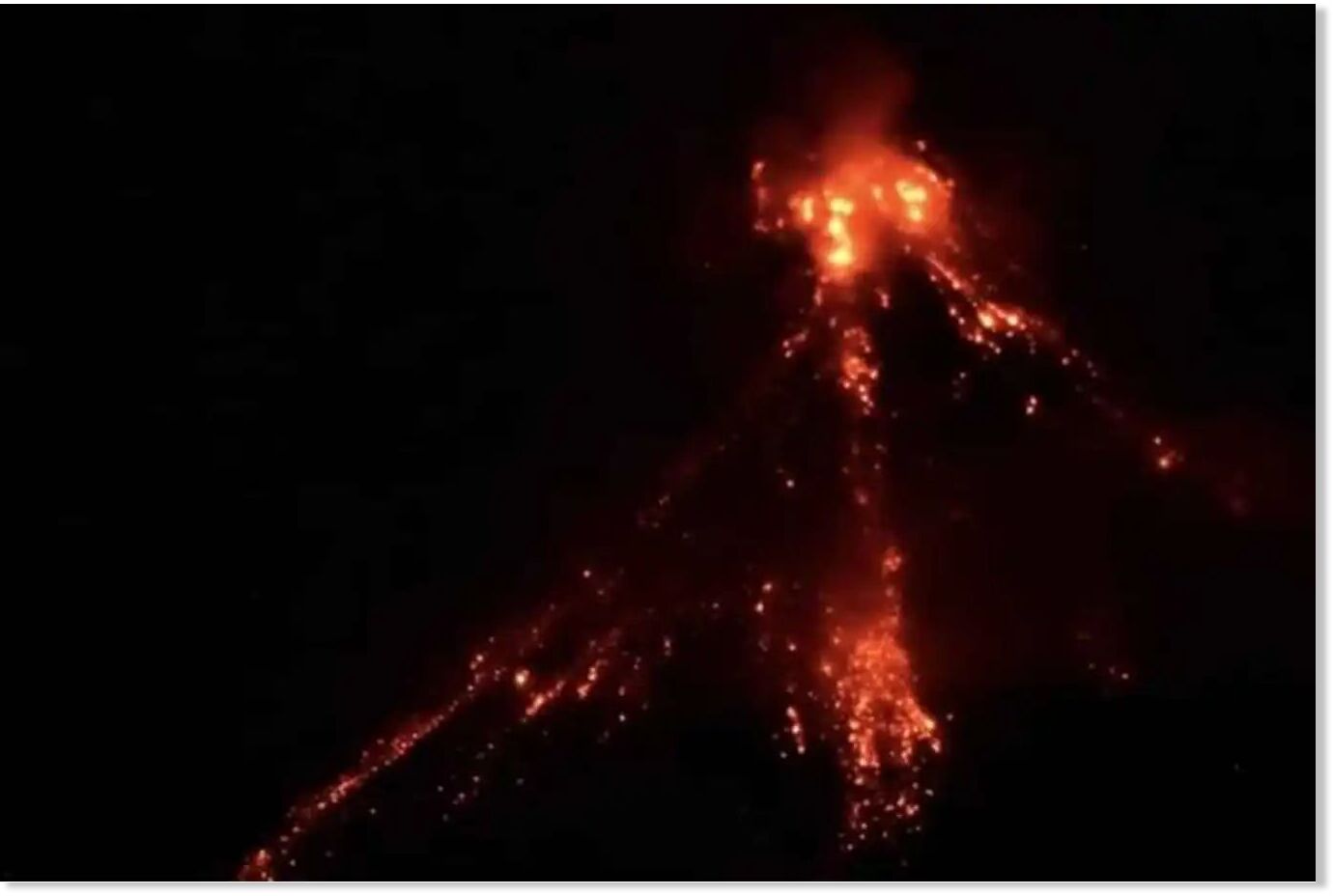
Lava erupted from the Philippines' most active volcano, Mayon, reaching heights of up to 100 meters early Tuesday morning in a spectacular yet potentially dangerous display.
The sporadic lava fountaining was observed at 1:39 a.m. (Jan. 13) by the Philippine Institute of Seismology and Volcanology (Phivolcs), News.Az reports, citing Philippine media.
The National Disaster Risk Reduction and Management Council (NDRRMC) shared video footage of the brief eruption on social media.
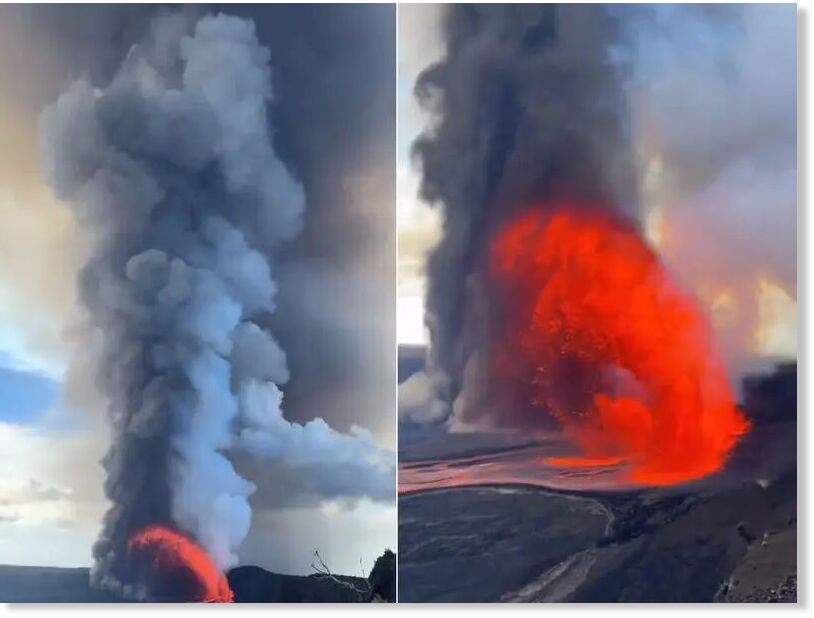
Stunning video captures Hawaii’s Kilauea volcano unleashing lava fountain
One of the most active volcanoes in the world, Hawaii's Kilauea, began its 40th eruptive episode on Monday (Jan 12), the US Geological Survey (USGS) confirmed.
The volcano, which has been regularly erupting for over a year now, unleashed a lava fountain of more than 1,500 feet (460 meters) high into the air, with thick plumes of smoke and gases rising as high as 20,000 feet (6 kilometres).
The recent eruption lasted nearly 10 hours, starting at 8:22 am and abruptly ending at 6:04 pm. Streams of lava poured from several vents within the Halemaʻumaʻu crater on Kilauea. The gas released during the eruption reacts in the atmosphere to form a visible haze known as vog—volcanic smog—which can trigger respiratory issues and other health problems.
Mount Semeru, located on the border of Lumajang and Malang Districts, East Java, erupted on Sunday night (Jan 12), sending pyroclastic flows -locally known as hot clouds- as far as five kilometers from the summit.
"Mount Semeru erupted at 10:25 p.m. local time. The eruption consisted of a pyroclastic flow with a distance of approximately 5 km," an officer at the Mount Semeru Observation Post, Sigit Rian Alfian, said in a written report.
The eruption column was observed to be approximately 2,000 meters above the summit, or 5,676 meters above sea level (masl).
This latest activity follows a period of heightened unrest for the volcano, which has remained frequently active for several years.
Kanyshai Butun Anadolu Agency Thu, 08 Jan 2026 13:44 UTC
The Philippines' most active volcano, Mayon, is showing signs of escalating activity, prompting authorities to reinforce exclusion zones and warn of potentially dangerous eruptions, the Philippine Institute of Volcanology and Seismology (Phivolcs) said Thursday.
Phivolcs said entry into the six-kilometer (3.7-mile) Permanent Danger Zone around the volcano is strictly prohibited, while aircraft have also been advised to avoid flying close to the summit.
Nearly 50 pyroclastic flows -- fast-moving currents of hot gas, ash and volcanic debris -- were recorded over a 24-hour period, the agency added.
Phivolcs Director Teresito Bacolcol warned of the deadly potential of such flows, recalling they killed 77 people during Mayon's 1993 eruption, according to the Philippine News Agency.
Indonesia's Semeru Volcano Monitoring Station (PGA) in Lumajang regency, East Java Province, recorded 31 volcanic eruption-related earthquakes just within Tuesday morning.
A report from the PGA Semeru Station at Mount Sawur showed that the eruption-related earthquakes had amplitudes of 11-22 mm and lasted 64-115 seconds, indicating that volcanic activity remains complex.
Besides, the monitoring station also recorded one avalanche earthquake with an amplitude of 6 mm lasting 20 seconds, four wind-induced earthquakes, and two tremor events.
The Indonesian Center for Volcanology and Geological Hazard Mitigation (PVMBG) advised people not to enter the southeast region along the Besuk Kobokan stream within a 13 km radius from the summit, which is a high-risk area affected by hot gas flows and lava.
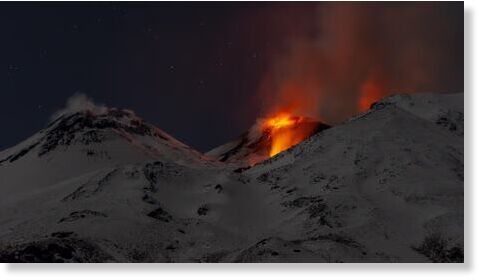
Italy's most active volcano erupted on Saturday, prompting scientists to issue a red Volcano Observatory notice for aviation, signalling a potential risk for aircraft.
Despite the alert, authorities said flights continued operating normally at Catania-Fontanarossa airport, adding that no disruption was expected unless ashfall increased.
Despite heightened activity after the Piparo mud volcano erupted yesterday, no residents were evacuated.
However, emergency responders, State agencies, utility services and Government representatives visited the site and remained on standby to assist residents should the situation worsen.
Some residential properties began cracking after the eruption, which occurred around 9 am, as did a portion of the roadway, which was eventually deemed impassable.
But Fidel Solomon, who lives very close to the site, told Guardian Media the situation was worse than the major eruption a few years ago, when his home was split.
As a precautionary measure, Solomon began packing his belongings, bracing for the possibility of evacuation.
'It's like twice as much as last time. The concrete burst open, the tiles start to crack, the galvanise start to raise up, the ground start to open up, the road start to crack up. Right now, the road impassible on one side. Right now, I trying to move out my things because our house getting the worst damage...It run through our house. Basically, everything collapsing now. T&TEC line burst," he said.
Fountain of lava spouts inside Hawaii’s Kilauea Volcano
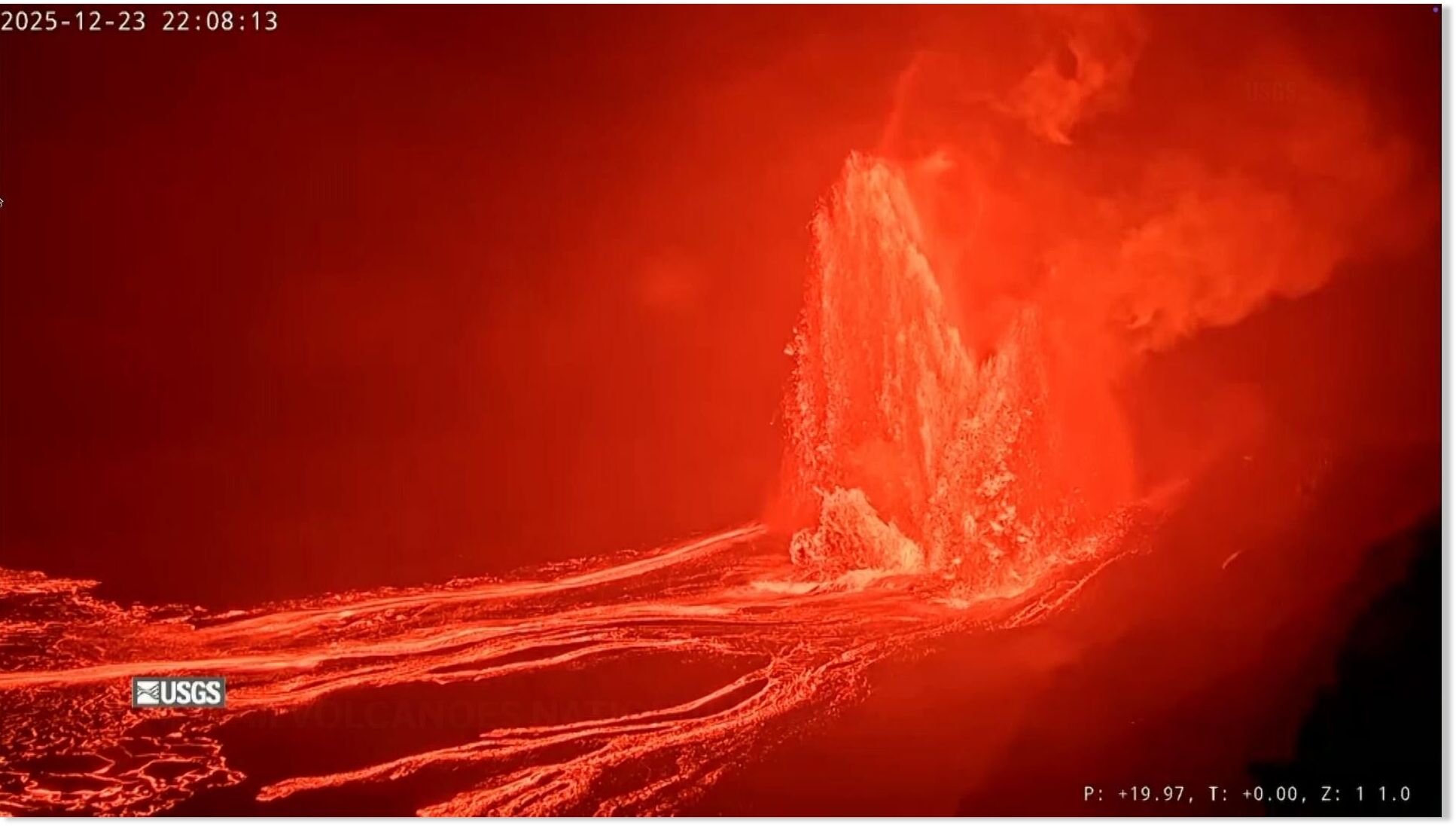
Kīlauea's summit eruption reached its one-year anniversary Tuesday as episode 39 brought fountains reaching more than 1,000 feet.
A glow and intermittent spatter were observed throughout the day from the north and south vents.
Then, around 8 p.m., the vents began shooting fountains up to 70 feet high.
By 9:45 p.m., the south fountain reached a height of 1,400 feet. The north fountain peaked at 920 feet shortly after 9 p.m., but lowered to 700 feet shortly before 10 p.m.
Two ash emissions was recorded at the summit crater of Kanlaon Volcano on Monday, Dec 22, 2025. - Screenshot of timelapse footages of Phivolcs/Facebook
The National Disaster Risk Reduction and Management Council advised the public Monday (Dec 22) night, to be cautious of possible ashfall emitted by Kanlaon Volcano.
Kanlaon Volcano spewed ash four times on Monday from 9.01am to 9.20am, 10.29am to 11.07am, 4.05pm to 6.02pm, and 8.31pm to 9.10pm, the Philippine Institute of Volcanology and Seismology (Phivolcs) reported.
It said the ash emission at 4.05pm persisted for nearly two hours with the ash plume rising 900 meters above the summit.
Thin ash may have affected communities in La Carlota and Bago cities and Murcia, Negros Occidental, Phivolcs said.
Shocking mud eruption at Yellowstone's black diamond pool
"Kablooey!"
That's the word U.S. Geological Survey volcanic experts used to describe a muddy eruption at Black Diamond Pool in Yellowstone National Park on Saturday morning.
Video shared by the USGS on social media shows mud spraying up and out from the pool just before 9:23 a.m. in Biscuit Basin about midway between park favorites Old Faithful and Grand Prismatic.
Other recent eruptions have mostly been audible and not visible, because they happened either at night or when the camera was obscured by ice.
The agency said the Black Diamond Pool was previously the site of a hydrothermal explosion, in July 2024, that sent rocks and mud flying hundreds of feet high and damaged a boardwalk. It prompted the closure of the area to visitors due to the damage and the potential for additional hazardous activity.
So-called dirty eruptions reaching up to 40 feet (about 12 meters) have occurred sporadically since then.