Georgia Diebelius Mirror Sun, 21 Dec 2025 17:53 UTC
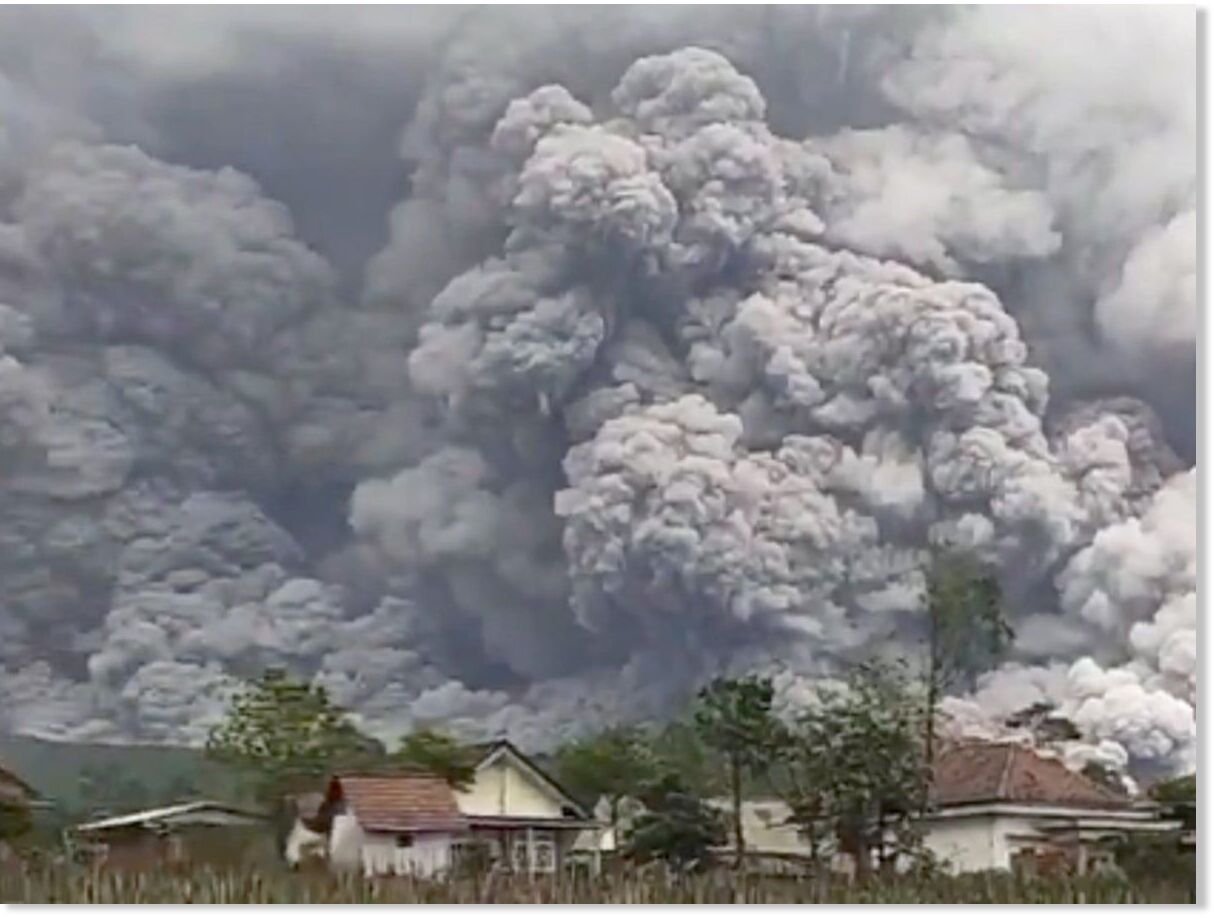
A huge volcano has sent an enormous 3,937ft column of ash into the air after erupting six times in one day.
Mount Semeru, in East Java, Indonesia, has been on a high level active alert for several years
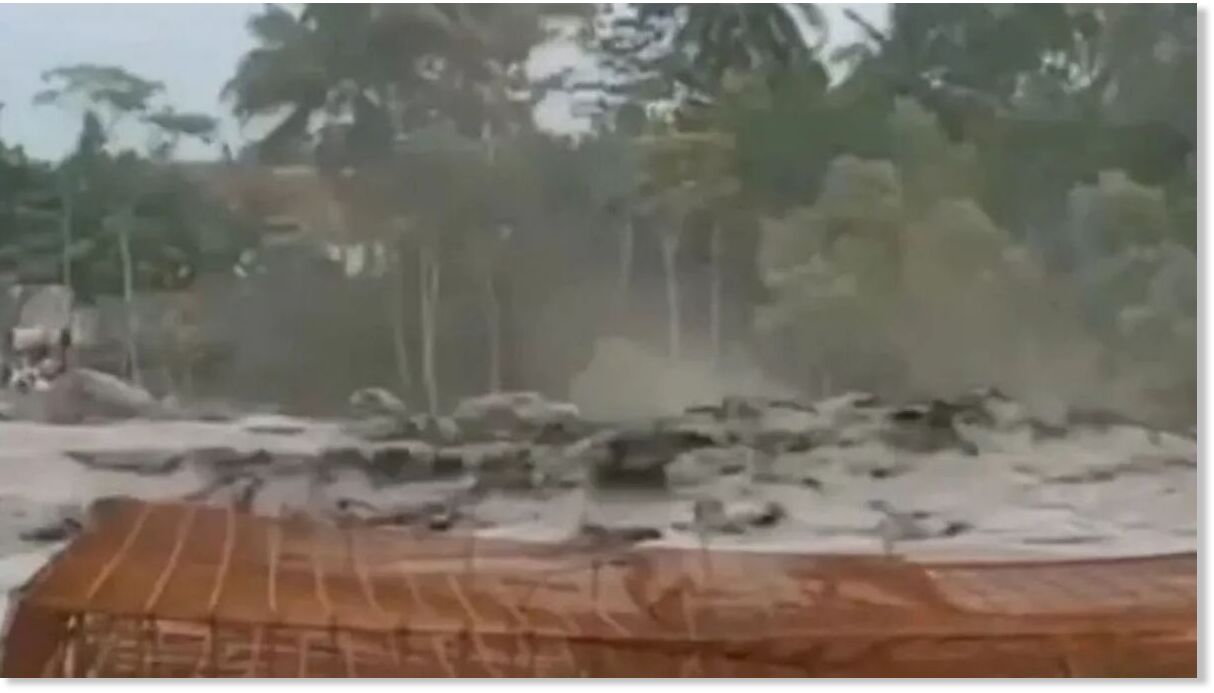
Mount Semeru, in East Java, Indonesia, has been on a high level active alert for several years. The eruption has left torrents of mud flowing through towns, leaving a trail of destruction in its wake.
Massive mudslides have been seen flowing through the streets, taking huge chunks of debris along with them. The eruption happened at around 5.45am local time this morning, with plumes of 1,200 metres seen above the summit.
The volcano, which lies on the border between the Lumajang and Malang regions, is currently on a Level III alert status, according to the state-run Antara News. The outlet said the volcano erupted six times on Sunday morning.
"An eruption occurred on December 21, 2025, at 5.45am local time, with an observed column height of 1,200 metres above the summit," said Mount Semeru Observation Post Office, Liswanto, in Lumajang. People have now been warned by the Center for Volcanology and Geological Hazard Mitigation to stay 13km away from the volcano.
An incredible sight at the summit of Kilauea volcano on Saturday morning, as Episode 38 erupted enormous lava fountains across the caldera, destroying one of the webcams that was live streaming the event.
All images and video are courtesy the U.S. Geological Survey. A synthesized text-to-video voiceover was used in the narration for this story.
A rare eruption from Purace volcano has pushed authorities to raise the alert to orange.
Footage shows ash and smoke billowing near Popayán, while officials report ashfall reaching the city, nearly 28 km away, for the first time since its 1977 eruption.
Mount Marapi in West Sumatra erupted again on Tuesday (2/12/2025), the eruption occurred at 10.34 WIB.
Mount Marapi erupted today, sending a towering ash plume over homes in Indonesia. The restive volcano sparked panic when it spewed a billowing cloud of smoke at around 10:34 am local time today. Footage shows the eruption as seen from different parts of West Sumatra.
The Indonesian Centre for Volcanology and Geological Hazard Mitigation (PVMBG) said: 'Mount Marapi, West Sumatra, erupted at 10:34 a.m. WIB, but the height of the ash column was not observed. 'This eruption was recorded on a seismogram with a maximum amplitude of 30.3 mm and a duration of approximately 51 seconds.' Mount Marapi is currently placed at the hazard Alert Level II.
The PVMBG warned locals and tourists to clear a three-kilometre radius from the volcano. Mount Marapi, located in West Sumatra, is one of the country's most active volcanoes and is known for frequent, sudden eruptions. Its steep slopes and popular hiking trails attract many tourists, but authorities often restrict access due to ongoing volcanic activity. Indonesia lies on the Pacific 'Ring of Fire' where the majority of Earth's volcanic eruptions and earthquakes happen.
A volcano has sent sent a thick column of ash more than three miles into the air in Russia's far east.
Scientists say the ash plume has travelled as far as 33.5 miles northeast and could result in air travel chaos in and around the site. According to local media, an orange aviation hazard code is now in force. It comes just a day after scientists warned of a possible explosive eruption.
Bezymianny was at one point considered extinct because it had been dormant for around 1,000 years - before a catastrophic explosion rocked the site in 1955.
Hayli Gubbi, Ethiopia's long-dormant volcano, located in the Erta Ale Range, has erupted for the first time in 10,000 years, spewing towering ash columns that drifted across the Red Sea toward Oman and Yemen. Scientists say the eruption marks one of the most extraordinary volcanic awakenings in the region's recorded history.
The explosive eruption began around 8:30 a.m. UTC on Sunday, according to VolcanoDiscovery, citing an advisory from the Toulouse Volcanic Ash Advisory Center (VAAC). Satellite data later confirmed the presence of a massive ash cloud rising an estimated 10 - 15 km into the atmosphere.
When something unexpected happens, people respond in different way. To the article, there was just one comment from a person recommending, essentially, that people surrender to Islamic fundamentalism. In a certain perspective, is such a statement different from fear based policies imposed by secular Governments that then lead to poorer health, reduced wealth and increased control?
According to the UK Centre for Observation and Modelling of Earthquakes Volcanoes and Tectonics (COMET) response reports, explosive activity at Erta Ale (12 km NW) on 15 July was accompanied by an intrusion of magma along a dike that propagated SE towards Hayli Gubbi. Sentinel satellite imagery on 16 July showed a line of fissure vents that produced lava flows outside the S caldera of Erta Ale (6 km S of the northern pit craters). Another group of four fissure vents opened further along the rift to the SE, with the most distant only 2 km from the Hayli Gubbi crater. No lava lakes were seen in the pit craters after 18 July, but satellite data indicated uplift in the region during 21 July-3 August, and an anomalous white cloud within Hayli Gubbi's crater was observed on 25 July. Satellite data showed that the white plume covered the crater floor in most of the images (several per month) at least through 18 November.
Mt. Semeru erupted again on Saturday, sending a column of smoke and ash about 1,000 meters (3,280 feet) above its peak in Indonesia's East Java province, according to local media reports.
Mt. Semeru has shown a sharp increase in volcanic activity, with monitoring instruments recording 157 eruptions during the latest observation period, Kompas TV reported.
The monitoring team also recorded 17 avalanche earthquakes and 19 eruption earthquakes.
Authorities have advised the public to avoid all activity within a 20-kilometer radius southeast of the crater.
Julian Atienza Fox Weather Wed, 19 Nov 2025 12:52 UTC
Indonesia's Mount Semeru volcano erupted Wednesday afternoon around 4:00 p.m. local time, sending ash more than 6,500 feet into the air, according to data from the country's Center for Volcanology.
The eruption was ongoing as of Wednesday evening.
The Center warned people to stay at least 5 miles away from the volcano due to potential hot ash clouds or lava flows. Ejected pyroclastic rocks are possible 1.5 miles away from Mount Semeru's peak, according to the warning.
There's no word on any injuries resulting from the eruption.
Australia's Bureau of Meteorology's Volcanic Ash Advisory Center, which is responsible for the airspace around Southeast Asia, issued a Volcanic Ash Advisory for air traffic stating that the eruption is posing an immediate threat to aviation.
Mount Semeru is the highest volcano on the island of Java and is one of the region's most active volcanoes, according to the Smithsonian Insititution's Global Volcanism Project.
The Sakurajima volcano in Kagoshima prefecture in southwestern Japan erupted early Sunday, sending ash and smoke as high as 4,400 meters (14,436 feet), Kyodo News reported.
The eruption continued after the initial blast, leading the local weather agency to issue an ashfall forecast for the Kagoshima, Kumamoto and Miyazaki prefectures.
There have been no reports of injuries or structural damage.
The eruption occurred around 12.57 am(1557GMT Saturday) at the Minamidake crater and produced a plume surpassing 4,000 meters for the first time since Oct. 18 last year, according to the local meteorological observatory.
Large volcanic rocks were hurled as far as the fifth station, though no pyroclastic flows were observed. The alert level remains at three out of five, limiting access to the volcano.
Sakurajima, one of Japan's most active volcanoes, is connected to the Osumi Peninsula on Kyushu, the southwestern main island. It used to be an island until a lava flow in 1914 formed a land bridge to the peninsula.
Sean Scanlan Taiwan News Thu, 13 Nov 2025 13:13 UTC
Mud volcano in Pingtung County.
A fiery mud volcano erupted in Pingtung County's Wandan Township around 5 a.m. Wednesday and lasted for about three hours, sending mud flowing into nearby fields.
The eruption, which occurred in front of Huangyuan Temple, was the second this year. The volcano produced five vents that spewed mud and flames up to two meters high. Temple abbot Chang Pao-hui (張寶惠) said the last eruption took place six months ago, per CNA.
Wannei Village Chief Chen Yu-yi (陳玉意) said that after receiving reports of the eruption, he quickly arrived at the scene. He later coordinated efforts to dig diversion channels to prevent mud from flooding surrounding farmland.
Mud volcanoes are a geological phenomenon formed when high-pressure underground gases, such as methane, mix with groundwater to dissolve mudstone, creating a slurry that is pushed to the surface through fissures.
These formations can vary greatly in size, from a few meters to several kilometers in diameter, and can reach heights of several hundred meters. The Wandan mud volcano, located near the border of Wandan and Xinyuan townships, has erupted at least once a year since 1988.
Although eruptions are difficult to predict, they most commonly occur in Wannei Village or nearby areas, according to local officials.
Comment: Also pertinent: Russia: Kamchatka's Krasheninnikov volcano erupts for the first time in 600 years
When something unexpected happens, people respond in different way. To the article, there was just one comment from a person recommending, essentially, that people surrender to Islamic fundamentalism. In a certain perspective, is such a statement different from fear based policies imposed by secular Governments that then lead to poorer health, reduced wealth and increased control?
Further up the tectonic fault lines, there was in early 2023:
Best of the Web: Turkey hit by second major earthquake, magnitude 7.5 - UPDATE: Turkey/Syria rocked by third quake, magnitude 6.0
The eruption may have been unexpected, but there were still signs. From the Smithsonian/USGS Weekly Volanic Activity Report, there was: