
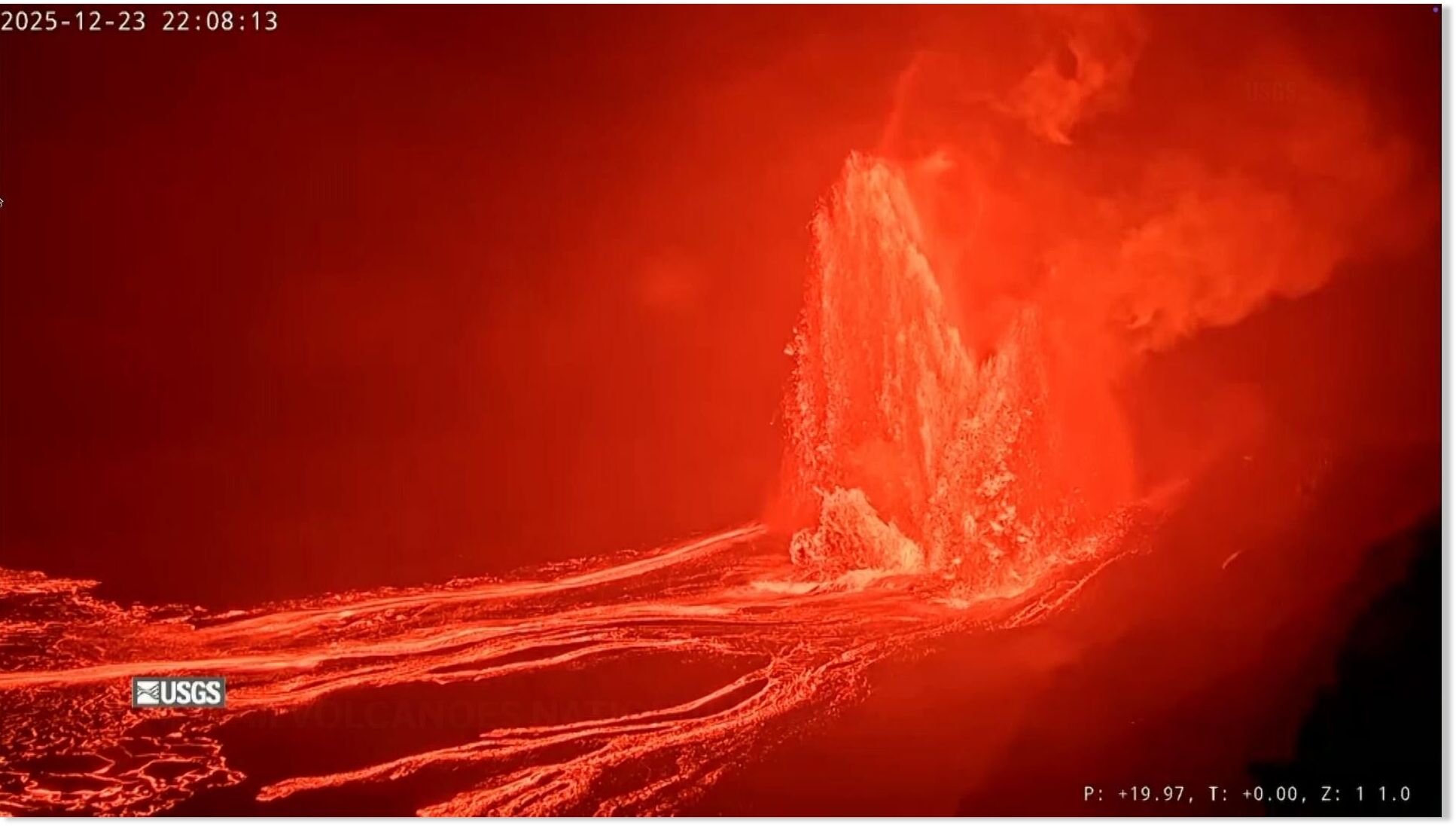
Fountain of lava spouts inside Hawaii’s Kilauea Volcano
A glow and intermittent spatter were observed throughout the day from the north and south vents.
Then, around 8 p.m., the vents began shooting fountains up to 70 feet high.
By 9:45 p.m., the south fountain reached a height of 1,400 feet. The north fountain peaked at 920 feet shortly after 9 p.m., but lowered to 700 feet shortly before 10 p.m.
Year of explosive episodes transforms park
The current eruption began on December 23, 2024, launching a series of explosive episodes that have transformed Hawaiʻi Volcanoes National Park's terrain and drawn visitors from around the world.
"This by far is the most amazing thing I've seen in my life in terms of Hawaiian volcanism," said Ken Hon, scientist-in-charge at USGS Hawaiian Volcano Observatory.
Two vents on Halemaʻumaʻu crater's southwest floor have produced 53 billion gallons of lava over the past year.
"It's built up a big wedge that's over 200 feet thick of lava on the surface of the lava lake. Never seen anything quite like that before," said Hon.
Episodes vary dramatically in size and duration
The 38 episodes so far have varied dramatically in duration and intensity. Episode 20 lasted just 4.5 hours, while Episode 3 continued for 8.5 days. Episode 35 produced the highest fountains, reaching 1,500 feet. That's roughly the height of the Eiffel Tower in Paris, France.
"It's never been the same day twice since this eruption began," said Jessica Ferracane, public affairs specialist for Hawaii Volcanoes National Park.
Episode 38 stands out as most powerful
Each episode has been magnificent. But scientists and park officials agree Episode 38, which occurred on December 6, 2025, had something extra special.
"This last one, episode 38, even if you were watching it on the live streams, it was truly astonishing," Ferracane said.
"I think the last one was a pretty 'wow' for everybody," Hon added. "That was the highest effusion rate, which is how much magma is coming through the vent at a given time or how much lava is erupting at a given time. Instantaneous, during the highest part of the high fountains, it was 1,000 to 1,200 cubic yards per second."
The episode's power buried one of the Hawaiian Volcano Observatory's live monitoring cameras.
"If you saw the movie of the end of the V3 camera, you could see these glowing spatter bombs coming at you. Those were about 3 feet long. They look a lot smaller in there, but they were huge, the spatter bombs that hit in that area," Hon said.
Scientists don't expect to see that equipment ever again. It's now under 50 feet of molten spatter that welded into solid rock.
"Thanks to our excellent field engineers and our geology group who runs the cameras, we've got a brand new camera sitting out there," Hon explained.
Volcanic debris creates challenges for scientists
Each episode has blanketed portions of the park with volcanic debris called tephra. The rim behind the fountains now stands 140 feet high with accumulated tephra.
The debris easily disintegrates and anyone who tries to drive across it may get stuck. But scientists have figured out a safe way to travel the park on foot.
"We ended up buying snowshoes and those work great," Hon said. "And I have to admit; this was something from the 1980 Mount St. Helens eruption. They were walking on some of the pyroclastic flows afterwards and they came up with the first idea of wearing something like a snowshoe to walk on recent volcanic deposits."
Visitor surge prompts safety reminders
The eruption has created a visitor boom. More than 157,000 people visited in November 2025. That was a 43% increase compared to November 2024. The surge is prompting park officials to emphasize safety guidelines.
"Stay alive. And to do that, you stay on trail, you stay out of closed areas, and you stay away from cliff edges," Ferracane said. "Keep your children close, especially when you're coming here at night."
She also urges visitors to be mindful of the area's significance.
"Volcanoes deserve our respect and so does the local culture," Ferracane said. The Hawaiian people who come here to the park to practice their traditional practices, I would say give them space and be respectful of both the volcanoes and everybody else around you."
Scientists are constantly monitoring Kīlauea and there are no signs the eruption will stop anytime soon.
"It has been a lot of work. We're continuing to learn, but it is also just a blessing to be able to be here and witness this and be able to study these eruptions," Hon said.



Reader Comments
to our Newsletter