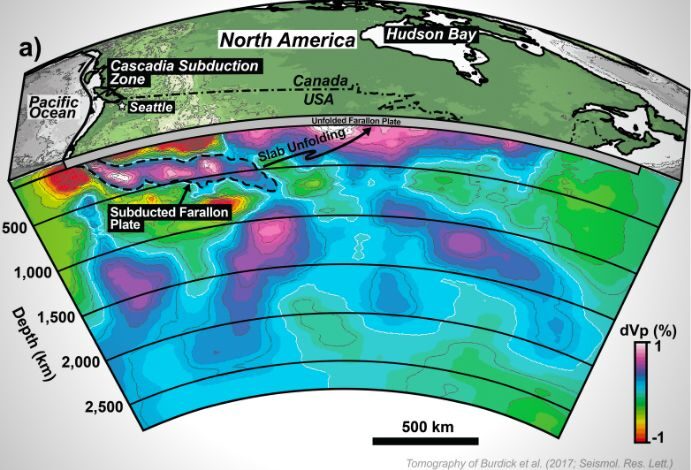
© University of HoustonA 3D block diagram across North America showing a mantle tomography image reveals the Slab Unfolding method used to flatten the Farallon tectonic plate. By doing this, Fuston and Wu were able to locate the lost Resurrection plate.
The plate, dubbed Resurrection, has long been controversial among geophysicists, as some believe it never existed. But the new reconstruction puts the edge of the rocky plate along a line of known ancient
volcanoes, suggesting that it was once part of the crust (Earth's top layer) in what is today northern Canada.
"Volcanoes form at plate boundaries, and the more plates you have, the more volcanoes you have," Jonny Wu, a geologist at the University of Houston,
said in a statement. "Volcanoes also affect
climate change. So, when you are trying to model the Earth and understand how climate has changed ... you really want to know how many volcanoes there have been on
Earth."
Wu and his co-author, University of Houston geology doctoral candidate Spencer Fuston, used a computer model of Earth's crust to "unfold" the movement of tectonic plates since the early
Cenozoic, the geological era that began 66 million years ago. Geophysicists already knew that there were two plates in the Pacific at that time, the Kula plate and the Farallon plate.



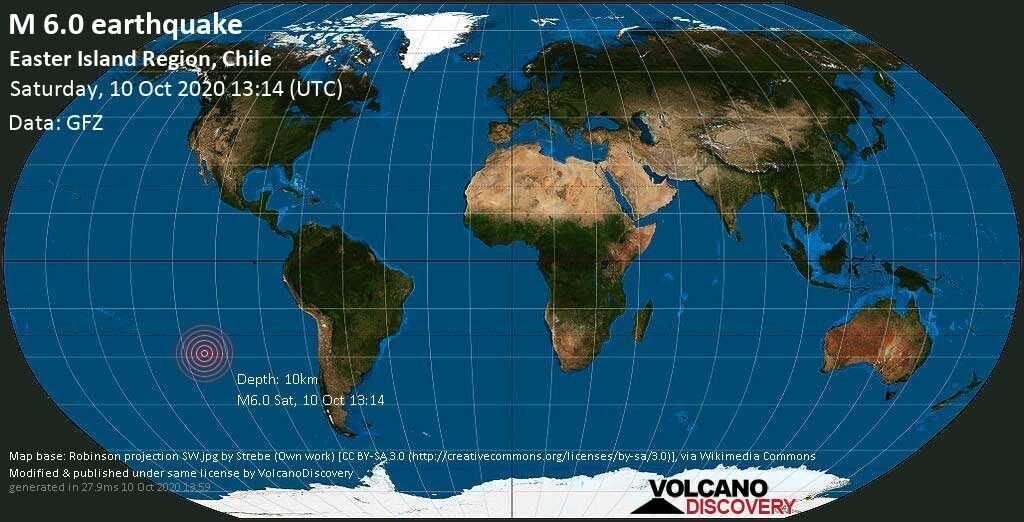



Comment: About 5 hours earlier and also in the Pacific Ocean: Shallow 6.0-magnitude earthquake hits West Chile Rise