Earthquakes
S


Map

Another earthquake hits Sabah, Malaysia - 89th aftershock recorded since June 5th

Image
© Fire and rescue servicesMudslides at the foothills of Mount Kinabalu have seen boulders as big as fars flowing down the river and cut off road access between Mesilau and Kundasang.
Another tremor was felt in Sabah at 5.33pm today, making it the 89th aftershock since the deadliest earthquake in the country on June 5.

According to state Meteorological Department director Abdul Malek Tussin, the latest was a 4.3 magnitude earthquake, occurring some 19km northwest of Ranau, Sabah.

Mild tremors were felt as far away as Kota Kinabalu, Ranau, Kota Belud and Kundasang.

Sabah, particularly the Kundasang and Ranau regions, has been rocked by aftershocks — the biggest being 5.1 magnitude — since a 5.9-magnitude quake hit Sabah on June 5, killing 18 climbers on Mount Kinabalu.

Damage from the aftershocks so far include rockfall, mudslides, landslides and cracks to buildings including schools in the area.

Villagers at the foothills of mount Kinabalu have been traumatised by the quake and its subsequent aftershocks, many claiming they are not able to sleep at night for fear of another quake.

Dominoes

Magnitude 6.0 earthquake hits east of Ndoi Island, Fiji

Image
© USGS20.457°S 178.351°W depth=561.4 km (348.8 mi)
Time
  1. 2015-06-21 21:28:16 (UTC)
  2. 2015-06-21 17:28:16 (UTC-04:00) in your timezone
  3. Times in other timezones

Nearby Cities
  1. 42km (26mi) ENE of Ndoi Island, Fiji
  2. 336km (209mi) WNW of Nuku'alofa, Tonga
  3. 423km (263mi) SE of Suva, Fiji
  4. 507km (315mi) SSE of Lambasa, Fiji
  5. 533km (331mi) SE of Nadi, Fiji

Post-It Note

Scientists find 'unprecedented' evidence African continent capable of megaquakes

Image
© James Cook University
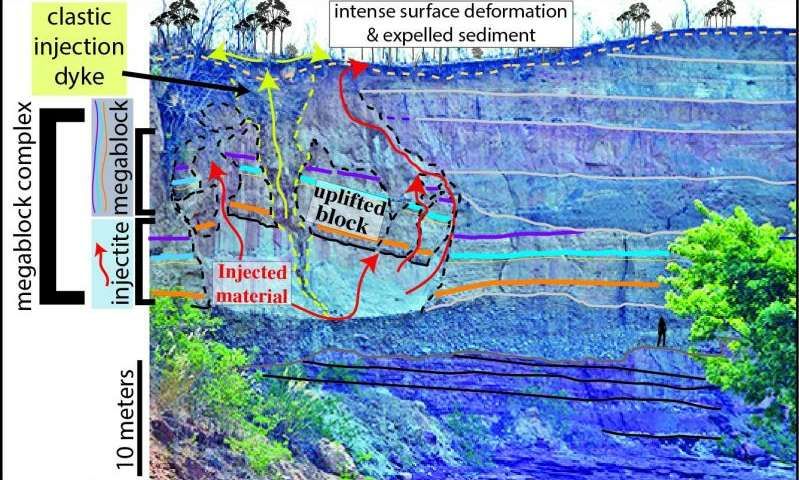
Lead researcher Hannah Hilbert-Wolf and supervisor Dr. Eric Roberts used innovative methods to examine the ground around Mbeya in Tanzania where a large earthquake occurred some 25,000 years ago.

They found evidence of fluidisation (where soil behaves like quicksand) and upward displacement of material unprecedented in a continental setting, raising questions of how resilient the rapidly growing cities of the region would be in a major shake.

'We can now use this to evaluate how the ground would deform in a modern earthquake,' said Dr. Roberts. 'This is important because the approach is inexpensive and can be used to model how structures might be affected by future events, providing a valuable tool in hazard assessment.'

Hilbert-Wolf said the team found evidence of massive ground deformation and previously unknown styles of liquefaction and fluidisation, caused by past earthquakes. 'This could be a major concern for the growing urban population of East Africa, which has similar tectonic settings and surface conditions,' she said.

The study comes on the back of a series of damaging earthquakes already this year, including in Nepal and Papua New Guinea and the study may be of much use in predicting the effects of earthquakes in those countries.

'What we have shown is that in developing countries in particular, which may lack extensive seismic monitoring, the rock record can be used to not only investigate the timing and frequency of past events, but also provide important insights into how the ground will behave in certain areas to seismic shock,' said Hilbert-Wolf.

Bizarro Earth

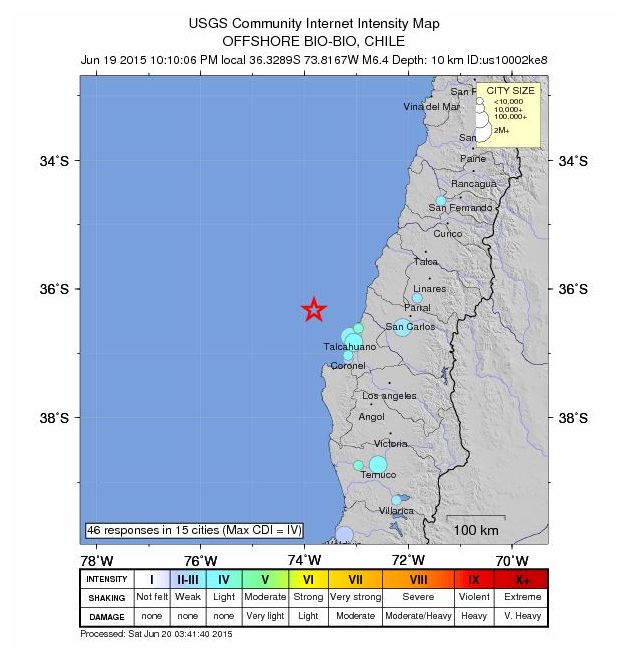
USGS: Earthquake Magnitude 6.4 - 76km NW of Talcahuano, Chile

Talcahuano Quake_200615
© USGS
Time
  1. 2015-06-20 02:10:06 (UTC)
  2. Times in other timezones
Nearby Cities
  1. 76km (47mi) NW of Talcahuano, Chile
  2. 83km (52mi) WNW of Tome, Chile
  3. 87km (54mi) WNW of Penco, Chile
  4. 88km (55mi) NW of Concepcion, Chile
  5. 430km (267mi) SW of Santiago, Chile
Scientific Data

Hardhat

Dramatic increase in earthquakes in central and eastern U.S. due to oil industry's high-rate injection wells

earthquakes oil gas wells
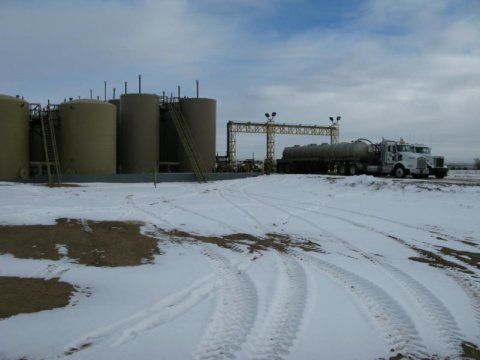
© Bill Ellsworth, USGSA new study ties high-rate injection wells like this salt water disposal well in Colorado to enormous earthquake increase.
A dramatic increase in the rate of earthquakes in the central and eastern U.S. since 2009 is associated with fluid injection wells used in oil and gas development, says a new study by the University of Colorado Boulder and the U.S. Geological Survey.

The number of earthquakes associated with injection wells has skyrocketed from a handful per year in the 1970s to more than 650 in 2014, according to CU-Boulder doctoral student Matthew Weingarten, who led the study. The increase included several damaging quakes in 2011 and 2012 ranging between magnitudes 4.7 and 5.6 in Prague, Oklahoma; Trinidad, Colorado; Timpson, Texas; and Guy, Arkansas.

"This is the first study to look at correlations between injection wells and earthquakes on a broad, nearly national scale," said Weingarten of CU-Boulder's geological sciences department. "We saw an enormous increase in earthquakes associated with these high-rate injection wells, especially since 2009, and we think the evidence is convincing that the earthquakes we are seeing near injection sites are induced by oil and gas activity."

Comment:


Bizarro Earth

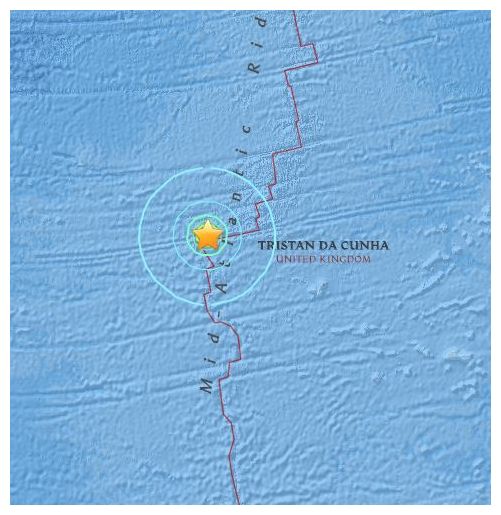
USGS: Earthquake Magnitude 7.0 - Southern Mid-Atlantic Ridge

Mid-Atlantic RidgeQuake_180615
© USGS
Time
  1. 2015-06-17 12:51:33 (UTC)
  2. Times in other timezones
Nearby Cities
  1. 494km (307mi) WNW of Edinburgh of the Seven Seas, Saint Helena
  2. 2750km (1709mi) SE of Arraial do Cabo, Brazil
  3. 2752km (1710mi) SE of Armacao de Buzios, Brazil
  4. 2755km (1712mi) SE of Cabo Frio, Brazil
  5. 3513km (2183mi) ESE of Montevideo, Uruguay
Scientific Data

Binoculars

6.0 magnitude earthquake strikes off East Indonesia; no tsunami warning issued

Image
© theextinctionprotocol.wordpress.com
An earthquake measuring 6.0 on the Richter scale jolted North Sulawesi province in the eastern part of Indonesia earlier Tuesday, but it was not potential for tsunami and left no casualties, an official said in Jakarta.The quake struck at 04:04 a.m. Jakarta time Tuesday with epicenter at 71 km northeast Sangihe Island of the province and with the depth at 71 km under seabed, an official of the Meteorology and Geophysics Agency told Xinhua over phone.

"The shakes of the quake were felt moderate. It was not potential to trigger tsunami and did not cause damage. The condition of the people is normal," Sutopo Purwo Nugroho, spokesman of the national disaster management agency told Xinhua via phone after the quake.

Previously at 00:40 a.m. Jakarta time Tuesday another quake measuring 5.8 on the Richter scale struck off East Nusa Tenggara province in central part of Indonesia, the official of the meteorology and geophysics agency said.

The quake was centered at 64 km southeast of the province and with the depth at 65 km under seabed, he said.

Sutopo also confirmed that the quake did not cause any damage.

Indonesia is prone to quake as it lies on a vulnerable quake- hit zone called "the Pacific Ring of Fire."

Question

Alabama rattles with swarms of earthquakes; experts say reasons unclear

Image
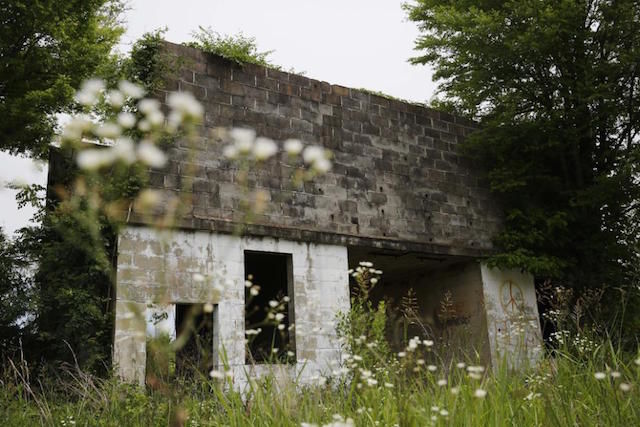
© AP/Brynn AndersonThis Tuesday, June 9, 2016, photo shows an abandoned building near Eutaw, Ala., where there have been reported earthquakes. More than a dozen weak earthquakes have followed in the seven months since in west Alabama's rural Greene County, and geologists are trying to figure out what is causing the seismic swarm in an area of the South more prone to tornadoes than earthquakes.
Jim Sterling didn't know what had hit his 156-year-old antebellum home when an earthquake struck Alabama's old plantation region early one morning last November. Startled, he grabbed a gun and ran outdoors.

In the pre-dawn chill, Sterling said, he found an odd scene: horses were galloping, cows mooing and dogs barking.

"I heard a boom and felt the shaking," Sterling said. "It really upset me."

More than a dozen weak earthquakes have followed in the seven months since in west Alabama's rural Greene County, and geologists are trying to figure out what is causing the seismic swarm in an area of the South more prone to tornadoes than earthquakes.

"It is interesting that recently there has been more activity there than in the last four decades," said Sandy Ebersole, an earthquake expert with the Geological Survey of Alabama.

Records from the U.S. Geological Survey show the first of 14 earthquakes occurred on Nov. 20, when a magnitude 3.8 earthquake was recorded about 10 miles northwest of the community of Eutaw. The second occurred in mid-December, followed by another in January and three within a few hours of each other on Feb. 19.

The tremors have continued ever since, with the most recent occurring June 6, when a magnitude 3.0 quake rattled the area. All the tremors have been weaker than the initial jolt in November, and Ebersole said some have been too slight for residents to detect.

Comment: See:


Dominoes

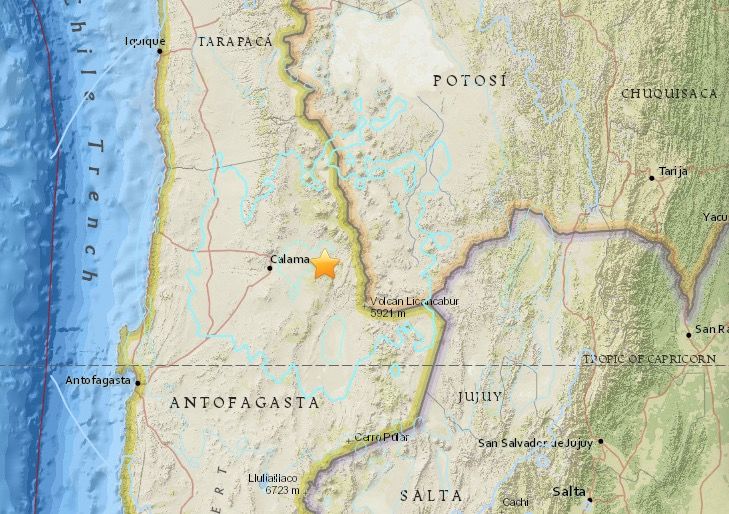
San Pedro de Atacama, Chile hit with magnitude 6.0 earthquake

Image
Time
  1. 2015-06-10 13:52:08 (UTC)
  2. 2015-06-10 09:52:08 (UTC-04:00) in your timezone
  3. Times in other timezones
Nearby Cities
  1. 57km (35mi) NNW of San Pedro de Atacama, Chile
  2. 62km (39mi) E of Calama, Chile
  3. 195km (121mi) E of Tocopilla, Chile
  4. 252km (157mi) ENE of Antofagasta, Chile
  5. 654km (406mi) S of La Paz, Bolivia
Tectonic Summary

Seismotectonics of South America (Nazca Plate Region)

The South American arc extends over 7,000 km, from the Chilean margin triple junction offshore of southern Chile to its intersection with the Panama fracture zone, offshore of the southern coast of Panama in Central America. It marks the plate boundary between the subducting Nazca plate and the South America plate, where the oceanic crust and lithosphere of the Nazca plate begin their descent into the mantle beneath South America. The convergence associated with this subduction process is responsible for the uplift of the Andes Mountains, and for the active volcanic chain present along much of this deformation front. Relative to a fixed South America plate, the Nazca plate moves slightly north of eastwards at a rate varying from approximately 80 mm/yr in the south to approximately 65 mm/yr in the north. Although the rate of subduction varies little along the entire arc, there are complex changes in the geologic processes along the subduction zone that dramatically influence volcanic activity, crustal deformation, earthquake generation and occurrence all along the western edge of South America.

Attention

Magnitude 4.7 quake hits Tokyo, surrounding region; no tsunami alert

Image
© USGS
An earthquake with a preliminary magnitude of 4.7 struck Tokyo and its surrounding region on Tuesday morning, the Meteorological Agency said, No tsunami alert was issued.

The 5:44 a.m. temblor occurred in the southern part of Ibaraki Prefecture at a depth of about 50 kilometers, registering 4 on the Japanese seismic intensity scale to 7 in Moka, Tochigi Prefecture, and 2 in central Tokyo.

Comment: USGS: Earthquake Magnitude 6.2 - 64km ENE of Mutsu, Japan