Earthquakes
S


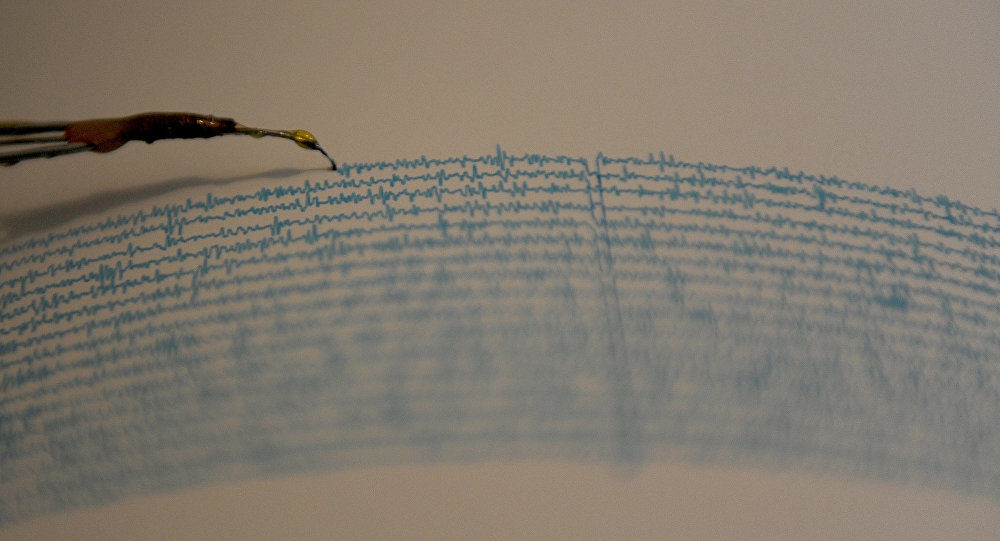
Seismograph

Avacha Bay, Eastern Kamchatka region hit by 5.6-magnitude earthquake

Avacha Bay
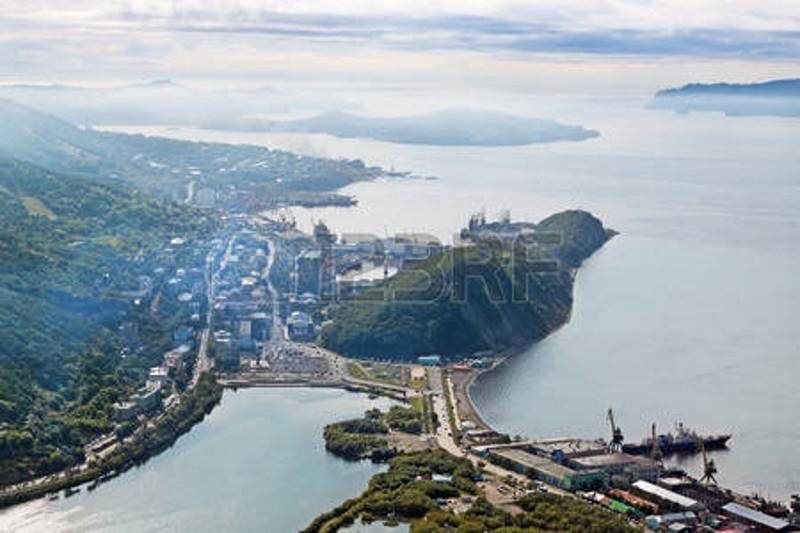
© 123RFFar east, Russia, Avacha Bay, the city of Petropavlovsk-Kamchatsky
A magnitude 5.6 earthquake was reported in the Russian Far East near the Kamchatka Peninsula, which is located in a seismically active zone and regularly suffers from earthquakes.

A 5.6-magnitude earthquake hit on Sunday the Avacha Bay near the Kamchatka Peninsula in the Russian Far East, local department of the Russian Emergencies Ministry said in a statement.

"According to the data obtained by the Petropavlovsk seismological station, the seismological event occurred at 9:00 a.m. local time [21:00 on Saturday GMT] in the Avacha Bay. The epicenter of the earthquake was located at a depth of 72 kilometers [about 45 miles] ... The magnitude of the seismological event amounted to 5.6. The seismological event was felt in some parts of Petropavlovsk-Kamchatsky as tremors with up to 3.0-magnitude," the statement said.

The epicenter was located 72 kilometers east of Petropavlovsk-Kamchatsky.

"The tsunami alert was not declared," the statement said.

The Kamchatka Peninsula is located in a zone of volcanic and geothermal activity and contains 68 active volcanoes. The region is the part of the so-called "Ring of Fire" - a string of volcanoes encircling the Pacific Ocean.

Bizarro Earth

Mysterious 'earthquake lights' explained after Mexico's huge quake?

Mexico earthquake lights
© IMPACTO El Diario/YouTubeWhat makes skies over quakes glow?
After an 8.1-magnitude earthquake struck off the southern coast of Mexico on 7 September, videos of fuzzy green smears in the night sky went viral online.

Earthquake lights are a phenomenon so unusual that they border on myth. The first known reports of them are from 89 BC, with spotty descriptions over the centuries.

Recently, they've been seen during foreshocks and the main earthquake in L'Aquila, Italy, in 2009, and as flashes of blue lightning over Wellington, New Zealand, in 2016.


"These phenomena are well-documented because of so many security cameras running day and night now," says Friedemann Freund at NASA's Ames Research Center.

Comment: Videos of the mysterious lights in the sky following the 8.1 magnitude earthquake (the strongest for a century) which struck Mexico last week have been shared widely across social media. On the same day, images taken by the GOES-16 satellite showed countless lightning storms crackling within Hurricane Irma as the monster storm churned its way towards Florida. Last week also saw the sun unleash a monster X9.3 solar flare, the strongest in a decade & the 4th X-class within a week.


In the chapter, Earth 'opening up', in Earth Changes and the Human-Cosmic Connection, Pierre Lescaudron discusses various factors pertaining to earthquakes and volcanic eruptions, including the Earth's minute slowdown exerting mechanical stress on the crust and electromagnetism.
Precursors that indicate alerts of this potential rise also include increases in: low frequency electromagnetic emission, magnetic field anomalies, earthquake lights from ridges and mountain tops, temperature anomalies over wide areas and changes in plasma density of the ionosphere


Snowflake

Snowfall recorded at higher elevations in Montana with winter storm warning issued

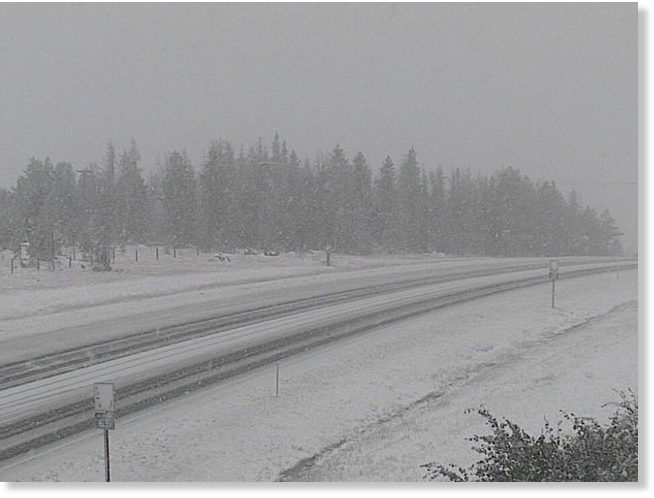
MacDonald Pass on US 12 in Montana the morning of Friday, September 15, 2017.
Big, fluffy snowflakes are falling in some parts of Montana today, and snowplows are out working to clear the roads at higher elevations.

The Montana Department of Transportation says that people driving through mountain passes should be alert for conditions ranging from slush to ice to snow.

Rain at lower elevations and snow at higher elevations is expected to continue through Saturday.

Temperatures are expected to dip into the 30s tonight for most areas, and even below freezing for some spots.


Comment: See also: Early snowfall at Rogers Pass, Montana


Seismograph

Magnitude 8.0 earthquake hits off Mexican coast, tsunami warning - UPDATES

Mexico 8.0 earthquake
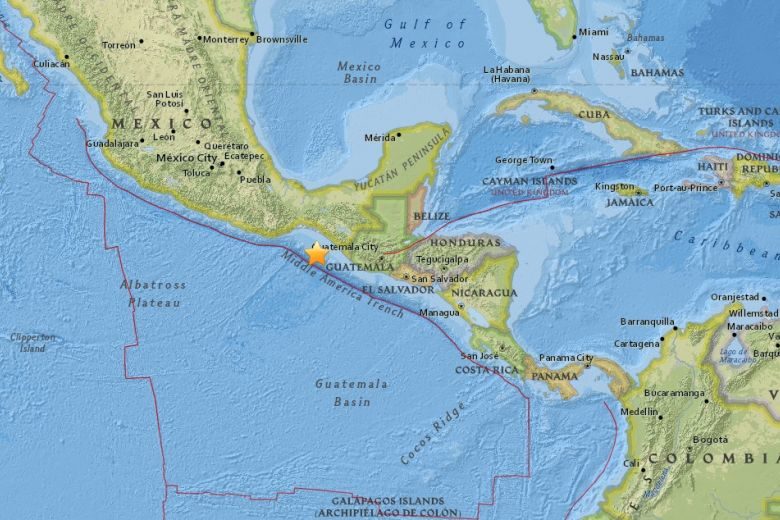
© SCREENGRAB FROM USGSHazardous widespread tsunami waves are possible in Mexico, Guatemala, El Salvador, Costa Rica, Nicaragua, Panama, Honduras, and Ecuador following the quake, said USGS.
An earthquake of magnitude 8.0 struck off the southern coast of Mexico late on Thursday, the United States Geological Survey (USGS) said, shaking buildings in the capital city.

People in Mexico City ran out into the streets after the quake struck, a Reuters witness said.

Its epicentre was 123km south-west of the town of Pijijiapan, at a depth of 33km.

Widespread, hazardous tsunami waves are possible in Mexico, Guatemala, El Salvador, Costa Rica, Nicaragua, Panama, Honduras, and Ecuador, the Pacific Tsunami Warning Centre said.


Comment: The Pacific Tsunami Warning Center (PTWC) issued an updated situation report, saying that "Tsunami waves reaching more than 3 meters above the tide level are possible along some coasts of Mexico," and waves reaching up to one meter are expected to hit the coastlines of adjacent countries.


UPDATES: 09.35 (CET)

Officials said that it was the strongest quake to hit the capital since the 1985 tremor that killed thousands and flattened swathes of Mexico City. Five people have been killed including two children in Tabasco state. A deep 6.1 magnitude earthquake hit off Japan's Bonin Islands yesterday at a depth of 450 kilometres (280 miles).

An eyewitness uploaded dazzling footage of earthquake lights that appeared in the skies over Mexico City shortly after the quake.


The Pacific Tsunami Warning Center says waves of 1 metre (3.3 feet) above the tide level were measured off Salina Cruz. Smaller tsunami waves were observed on the coast or measured by ocean gauges in several other places.

The center's forecast said Ecuador, El Salvador and Guatemala could see waves of a metre or less. No threat was posed to Hawaii and the western and South Pacific.

16.00 (CET)

The death toll from the 8.2 magnitude (registered by local calculations) earthquake that hit Mexico has reached at least 32, according to tallies from local authorities. "It was a major earthquake in scale and magnitude, the strongest in the past 100 years," President Peña Nieto said. The US Geological Survey reported the quake's magnitude at 8.1.

Peña Nieto said the quake was felt by 50 million of the country's 120 million residents, and was also felt in much of Guatemala, which borders Chiapas. He warned more aftershocks are likely, and has urged people to check their homes and offices for structural damage and gas leaks.


Sept. 9 (09.55 CET)

The death toll from yesterday's Mexico earthquake, the strongest earthquake to hit the country in a century, is at least 61. Jana Pursely, a geophysicist at the US Geological Survey, told CNN that the quake was relatively shallow, which resulted in more "intense shaking".

Scenes of demolished buildings, teetering streetlight posts, and blacked-out subway stations have been circulating on social media. Mexico's Federal Commission of Electricity calculates that 1.85 million residents across the country were affected by power cuts.


The region where the earthquake struck is one of the most active seismic zones in the country: this is where the Cocos Plate dives, or subducts, under the North American plate. "Earthquakes of this size are not uncommon at subduction zone boundaries," notes Jascha Polet, a seismologist at California Polytechnic State University in Pomona.

But this quake was different: it occurred within the Cocos plate, as it warped or bent, not at the boundary with the North American plate, according to the US Geological Survey.

"The type of faulting that occurred here does not usually produce earthquakes of this magnitude," says Polet. "There have been others in the past 50 years of similar type and location, but none that was even close to this size." It is still too early to say why the earthquake was so massive, she adds, but "it is sure to inspire much future research".

Mexico's seismology agency has registered at least 337 aftershocks, with the strongest reaching a magnitude of 6.1.


Meanwhile Hurricane Katia has made landfall in the state of Veracruz on the Mexican Gulf coast, the U.S. National Hurricane Center (NHC) said. It lost some strength before it landed about 115 miles (185 km) northwest of the port city of Veracruz as a Category 1 storm with sustained winds 75 mph (120 km/h). The storm was expected to weaken rapidly over the next day, the NHC said.

Update (Sept. 12)

The death toll from last week's powerful earthquake in Mexico has risen to at least 96. Authorities also say 2.5 million people are in need of food, water and electricity. The 8.1-magnitude quake struck Friday near Mexico's border with Guatemala. It damaged at least 12,000 homes, and that number is expected to rise.


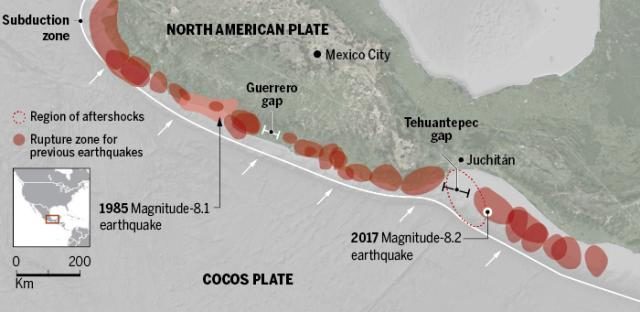
According to Science Magazine last week's unusual temblor may have relieved pressure in one of two "seismic gaps" in the subduction zone off Mexico's coast, where tectonic plates grind past one another. The epicenter of the quake, which struck just before midnight local time, was just southeast of the Tehuantepec gap, a 125-kilometer-long stretch of Mexico's Pacific coast that has been seismically silent since record-keeping began more than a century ago.

All along that coast, the ocean's tectonic plates meet the continental North American plate and are forced underneath it. Violent earthquakes mark the release of built-up pressure between the grinding plates. But the ruptures have somehow avoided the Tehuantepec gap and the Guerrero gap, more than 500 kilometers to the northwest.
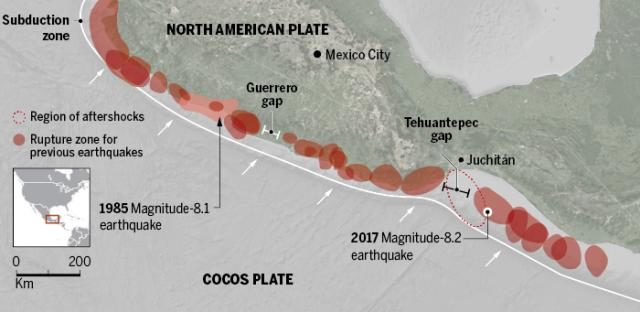
Mexico earthquake
© (Graphic) G. Grullón/Science; (Data) V. Kostoglodov; Mexico National Seismological Service
For decades, scientists have monitored the Guerrero gap because of its proximity to Mexico City. A rupture there could devastate the capital, which is built on a drained lakebed that amplifies seismic waves. In 1985, a magnitude-8.1 quake near the Guerrero gap killed thousands, spurring the city to install a seismic alert system and tighten building codes. Those measures seemed to help last week: The capital sustained little damage in spite of considerable shaking.

The quake's effect on the gap is hard to judge though, because of its unusual origin. Most big Mexican earthquakes occur right along the interface between the colliding Cocos and North American plates. But this rupture began 70 kilometers down, within the Cocos plate itself, and rose up before stopping at about 40 kilometers' depth, likely at the plate interface.

"It's not the same fault that they're expecting [to close] the Tehuantepec gap," says Joann Stock, a seismologist at the California Institute of Technology in Pasadena.

That leaves the future risk of the Tehuantepec gap unclear. In fact, Stock says, last week's quake might have even added stress at the gap and increased chances for future slipping. But, she adds, the depth of the shaking had at least one benefit: The rupture didn't break through all the way to the ocean floor, which dampened tsunamis. The resulting waves in Chiapas and Oaxaca were only 2 to 3 meters high.

Vladimir Kostoglodov, a seismologist at UNAM in Mexico City, says he is fielding requests for data from researchers around the world who want to investigate this "extremely strange" earthquake and its aftermath. "It's worth making a big effort to learn what's happening," he says. "This might happen in other subduction zones in other parts of the world."

Bizarro Earth

Southeast Idaho earthquake swarm continues as number of temblors surpasses 200 since September 2nd

earthquakes soda springs idaho sept 2017
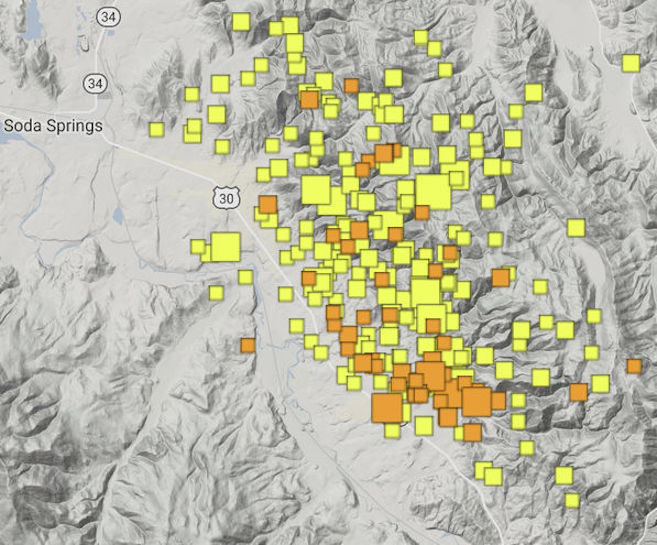
© University of Utah Seismograph Stations imageThe colored squares show the epicenters of the 204 earthquakes that have occurred since Sept. 2 in Southeast Idaho, according to University of Utah Seismograph Stations.

The earthquake swarm in Southeast Idaho looked like it might be ending or at least slowing down on Thursday and Friday.

But then Saturday arrived and by day's end 19 quakes had struck.

There have been 34 more temblors so far Sunday, bringing the earthquake total since the swarm began on Sept. 2 to 204 quakes. All of the quakes have occurred in the Caribou County area east, southeast and northeast of Soda Springs.

They have been felt throughout Southeast Idaho and as far away as Logan, Ogden and Salt Lake City in northern Utah.

Earthquake experts say the worst-case scenario is that the swarm ends with a destructive 7.0 magnitude quake that will destroy buildings and kill people, but the chances of that are slim.

Comment: September so far has been an almost apocalyptic month of environmental events


Seismograph

Guatemala suffers second earthquake in less than 72 hours

guatemala earthquake 2017
© EFEMore than six thousand people have been impacted by the first quake Tacana, Guatemala, September 8, 2017.
The western province of Huehuetenango was hit by a 7.7 magnitude quake on Thursday.

Guatemala has recorded a magnitude 5.4 earthquake without any casualties or damage, according to the National Institute of Seismology, Volcanology, Meterology and Hydrology (Insivumeh).


"Reports earthquake with magnitude of 5.4 and depth of 10 km 288 kilometers west of San Marcos."

The institute reported that the epicenter was 10 kilometers deep, located 288 kilometers west of the southwestern department of San Marcos, bordered by Mexico in the Pacific Ocean.

Thursday night's 8.1-magnitude earthquake in Mexico impacted on the lives of over six thousand people in neighbouring Guatemala, the National Coordinator for Disaster Reduction, Conred, reported.

Guatemala's western province of Huehuetenango which borders Mexico was also hit by a 7.7 magnitude quake in the aftermath and suffered major damage.

Some of the other regions hit by the tremors were Nueva Concepcion, Champerico, Retalhuleu, and the city of Escuintla.

An estimated 6,418 people have been affected in the western region of the central American country.

Hundreds of homes were damaged.

Seismograph

Shallow 5.9 magnitude earthquake at Reykjanes Ridge off Iceland

chart
5.9 magnitude earthquake

2017-09-10 21:40:21 UTC

USGS page: M 5.9 - Reykjanes Ridge
USGS status: Reviewed by a seismologist
Reports from the public: 0 people

10 km depth

Seismograph

5.7 magnitude earthquake hits Mexican coast

Seismograph
© AFP 2017/ PEDRO PARDO
A 5.7 magnitude earthquake occurred in waters off Mexico's Isthmus of Tehuantepec, the US Geological Survey (USGS) reported Sunday.

Quakes have been registered at 22:07 on Saturday local time (03:07 GMT on Sunday). The epicenter is located 80 kilometers (49) to southwest of the town of Paredon at the depth of 33 kilometers (about 32 miles).

Blue Planet

Winds, fire, floods and quakes: Mother Nature's recent nutty run

hurricane damage
With four big hurricanes, a powerful earthquake and wildfires, it seems that nature recently has just gone nuts.

Some of these disasters, like Friday's earthquake in Mexico, are natural. Others may end up having a mix of natural and man-made ingredients after scientists examine them. We also always tend to look for patterns and order in chaos, even when they aren't there, psychologists say.

"Nature's gone crazy," mused Jeff Masters, meteorology director at the private service Weather Underground. "Welcome to the future. Extreme weather like this is going to be occurring simultaneously more often because of global warming."


A look at a rough few weeks in North America:

Attention

Apocalyptic scenes from Mexico's earthquake; 3 days of mourning declared

mexican earthquake 2017
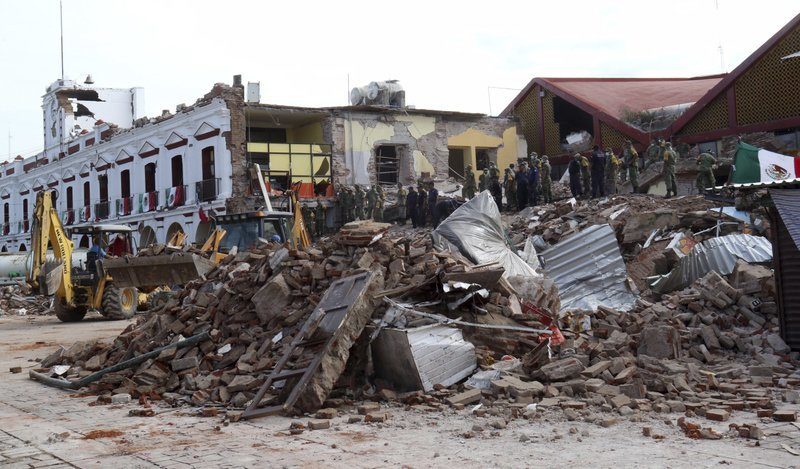
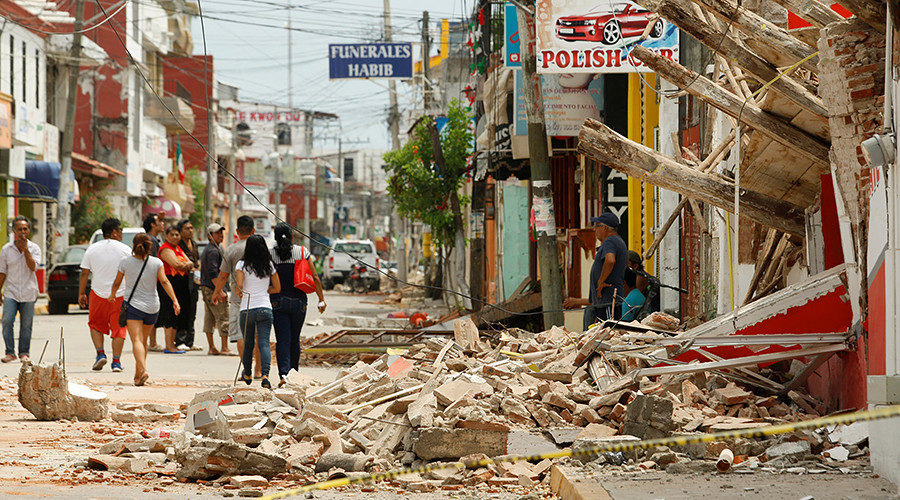
© Jorge Luis Plata / ReutersResidents walk past a building destroyed in an earthquake that struck off the southern coast of Mexico, in Juchitan, Mexico September 8, 2017.
The number of people killed by the 8.2-magnitude quake that hit the southern coast of Mexico late Thursday has risen to at least 61, with witnesses saying they cannot remember an earthquake this terrible. Three days of mourning have been declared.

Mexican President Enrique Pena Nieto said the quake was "the largest registered in our country in at least the past 100 years." He said in a televised address Friday night that at least 45 people were killed in Oaxaca, 12 in Chiapas, and four in Tabasco.