Earthquakes
S


Seismograph

Earthquake of 6.5 magnitude hits eastern Indonesia

quake
An earthquake of magnitude 6.5 struck north of Halmahera near the province of North Sulawesi in Indonesia on Thursday, the GFZ German Research Center for Geosciences (GFZ) said.

Indonesia's national weather and climate agency (BMKG) gave a magnitude of 7.1 and depth of 111 km. The GFZ put the quake's depth at 105 km.

BMKG spokesman Taufan Maulana told Reuters no damage had been caused and the earthquake did not pose a tsunami threat.

Indonesia is situated on the Pacific Ring of Fire, which is frequently hit by earthquakes that are sometimes accompanied by tsunamis.

Source: Reuters

Seismograph

Strong 6.8-magnitude earthquake strikes northern Chile

quake
According to preliminary information provided by the European Mediterranean Seismological Centre (EMSC), a quake has struck at a depth of 80 kilometres.

A 6.8-magnitude earthquake struck northern Chile on Wednesday, the European Mediterranean Seismological Centre (EMSC) said. There were no immediate reports about any damage or casualties.

Chile is situated in the easternmost part of the Ring of Fire, a seismically active zone in the Pacific Ocean, where many earthquakes and volcanic eruptions occur, including powerful ones.


Seismograph

Almost a dozen earthquakes occur in just 24 hours near Yellowstone Park

Yellowstone earthquake swarm
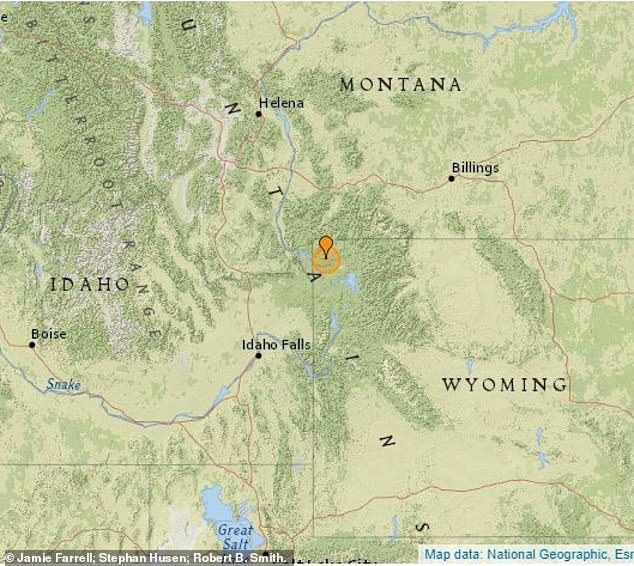
Nearly a dozen earthquakes shook parts of Yellowstone National Park in just 24 hours on Friday, May 29. The US Geological Survey reported 11 quakes in West Yellowstone Montana, with tremors ranging from 1.6 to 3.1 magnitude on the Richter scale
The 3,472 square mile park known for its wildlife and geothermal features, sits on a supervolcano, which if it erupts may cause devastation on Earth and even change the planet's climate.

Eleven earthquakes occurred in 24 hours in an area close to Yellowstone National Park last week with the strongest one measuring 3.1 on Richter scale, according to the US Geological Survey. The other quakes in West Yellowstone in Montana ranged between 1.6 to 3.1 on the scale and were almost three miles deep. According to website Earthquake Track, which has been monitoring tremors worldwide since 1990, the same area saw 34 earthquakes in the past 30 days.

Such an abundance tremors is not unusual as Yellowstone National Park is one of the most seismically active areas in the United States, with approximately 700 to 3,000 earthquakes occurring there each year. However, most of them are not felt.

Comment: 'Pulsing' of Yellowstone volcano is increasing due to trapped magma below


Info

Energy exchange between troposphere and ionosphere revealed in study

Atmospheric Wave
© Babalola OgunsuaAn illustration of the atmospheric wave dynamics from convective processes and ionospheric responses.
The Earth's ionosphere, extending about 80 to 1,000 km above the Earth's surface, connects outer space and the middle atmosphere. It's an important part and key layer in the whole Sun-Earth system.

However, the understanding of the equatorial ionospheric responses to thunderstorms remains a mystery due to the peculiarities in the dynamics of the ionosphere over this region.

A recently published study in Scientific Reports focuses on the Congo Basin, located in the equatorial region, where lightning and severe thunderstorms are considered to be the most active in the world.

Info

Geysers may be signalling magma intrusion under Yellowstone

Steamboat Geyser
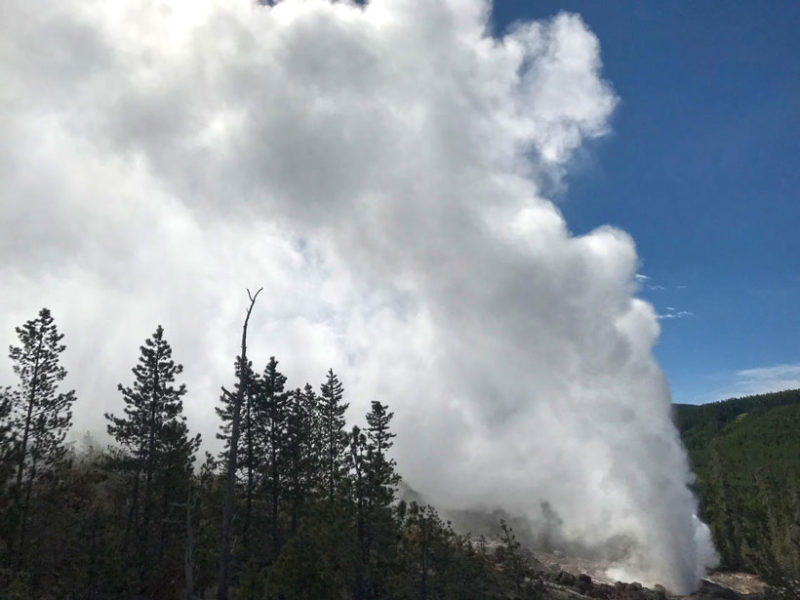
© Jamie Farrell, USGSSteamboat Geyser erupts on 4 June 2018. Scientists examined how deformation and hydrothermal activity in the northern rim area of the Yellowstone caldera might be linked to magmatic intrusions kilometers beneath the surface.
Steamboat Geyser in Yellowstone National Park is an enigma. It is the tallest currently active geyser in the world, sometimes blasting superheated water over 90 meters (300 feet) into the air. Yet unlike the more famous Old Faithful, Steamboat Geyser runs on its own rhythm. Sometimes the geyser is quiet for decades and then suddenly bursts back to life. It is a mystery exactly why Steamboat has such behavior. After a new period of activity started in 2018, we might have more clues about what drives these steam-and-water explosions.

Yellowstone caldera is a geologic wonderland. It is the source of three of the largest explosive eruptions in the past 3 million years. The caldera itself covers over 1,500 square kilometers (580 square miles) in the northeast corner of Wyoming. As Charles Wicks from the U.S. Geological Survey (USGS) puts it, "Yellowstone's roots seem to extend all the way to the core-mantle boundary. In that dimension, it's a magmatic system of continental scale."

The Yellowstone caldera is packed with geothermal features like geysers, hot springs, mud pots, and geothermal pools. This hydrothermal activity is driven by the vast reservoirs of heat beneath the Yellowstone area, most of which comes from the magma found many kilometers underneath the caldera. All this heat and water mean the land surface at Yellowstone rises and falls frequently, meaning Yellowstone is best described as a "restless caldera."

Seismograph

6.0-magnitude earthquake strikes Peru

quake
An earthquake with a magnitude of 6.0 jolted 32 km WNW of Lampa, Peru at 05:09:35 GMT on Sunday, the U.S. Geological Survey said.

The epicenter, with a depth of 153.41 km, was initially determined to be at 15.2747 degrees south latitude and 70.663 degrees west longitude.

Source: NAN/Xinhua

Info

New clues to deep earthquake mystery

Understanding Earthquakes
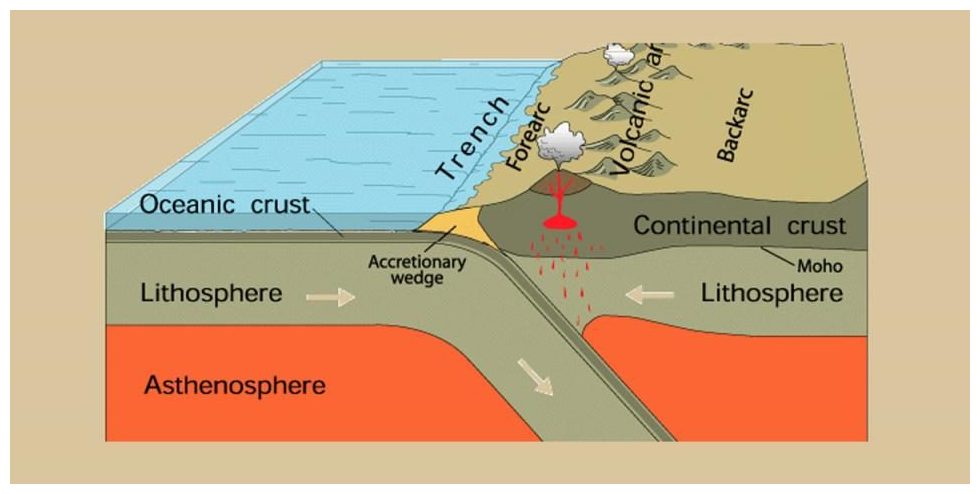
© U.S. Geological SurveySubduction zones occur where one tectonic plate dives under another. New computer modeling by Magali Billen, professor of earth and planetary sciences at UC Davis, shows why earthquakes on these sinking plates cluster at certain depths and could give insight into processes deep in the Earth.
A new understanding of our planet's deepest earthquakes could help unravel one of the most mysterious geophysical processes on Earth.

Deep earthquakes — those at least 300 kilometers below the surface — don't typically cause damage, but they are often widely felt. These earthquakes can provide vital clues to understanding plate tectonics and the structure of the Earth's interior. Due to the extremely high temperature and pressures where deep earthquakes occur, they likely stem from different physical and chemical processes than earthquakes near the surface. But it's hard to gather information about deep earthquakes, so scientists don't have a solid explanation for what causes them.

"We can't directly see what's happening where deep earthquakes occur," said Magali Billen, professor of geophysics in the University of California, Davis, Department of Earth and Planetary Sciences.

Seismograph

Powerful 6.1 earthquake hits off Vanuatu Coast

quake
The nation in located in a region that is part of the Pacific Ocean basin's "Ring of Fire", notorious for its earthquakes and volcanic eruptions.

A powerful 6.1-magnitude earthquake has struck off the coast of Vanuatu some 80 kilometres northwest of the capital Port-Vila, the United State Geological Survey said on Wednesday. The seismic activity was registered at a depth of 10 kilometres at 7:09 a.m. UTC, the USGS added. There are no reports of casualties or damage caused by the tremor. No tsunami alert was issued by the authorities.

Info

Ice Age Farmer Report: SOLAR LOCKDOWN: Plandemic & Grand Solar Minimum

solar
A "SOLAR LOCKDOWN" has been announced across media outlets, and Forbes even declares we should fear! But why? And what is a Grand Solar Minimum anyway? Christian breaks down how the script is now in play for food shortages and offers a refresher on the impact of solar cycles.


Sources

Seismograph

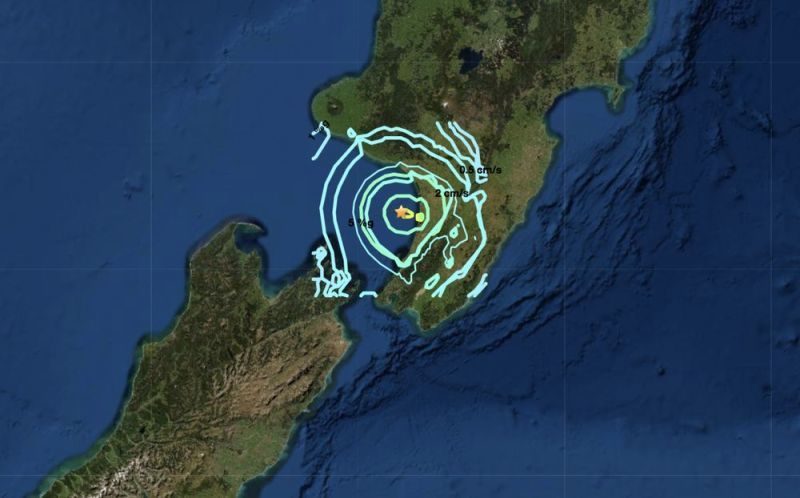
Magnitude 5.8 earthquake strikes New Zealand near Wellington

Map of the seismic activity near Wellington, New Zealand, on May 24
© USGSMap of the seismic activity near Wellington, New Zealand, on May 24.
New Zealand Prime Minister Jacinda Ardern was rattled live on television during a 5.8 magnitude earthquake in Wellington.

The strong Monday morning earthquake was centred 30km north west of Levin, a town around an hour's drive north of the New Zealand capital.

It was felt most sharply around the South Taranaki Bight, and the closest major town, Wellington, some 100 kilometres south.

Tens of thousands of Kiwis reported feeling weak rattling as far north as Auckland and as far south as Dunedin.

In the capital, it brought sustained shaking for around 15 seconds as Kiwis prepared for their day at 7.53am NZST (5.53am AEST).

The earthquake was 37km deep according to seismic monitoring agency GScience.