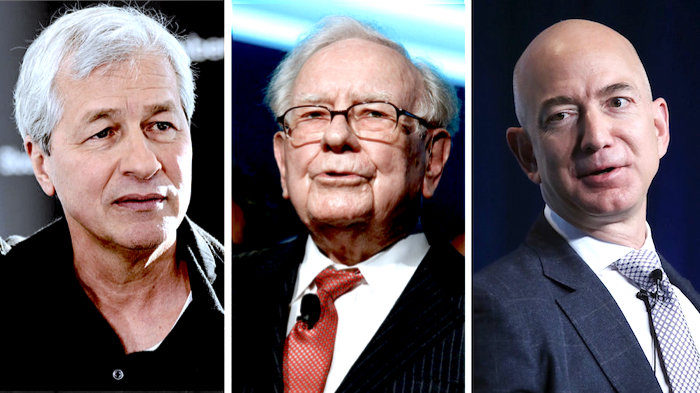
© Simon Dawson/Bloomberg/Getty Images; Andy Kropa/Invision/AP; Mark Wilson/Getty ImagesJamie Dimon, CEO JPMorgan Chase; Warren Buffett, CEO Berkshire Hathaway; Jeff Bezos, CEO Amazon
Sometimes, not very often, there is a news story that makes you sit up and think: wow, this is going to change the world. And so it was on Tuesday, when
Amazon, Berkshire Hathaway and
JPMorgan Chase announced they had agreed to join forces to create an independent healthcare system for their US employees.
It is headline stuff because it brings together the world's richest person (
Jeff Bezos), the most-admired US investor (
Warren Buffett) and the head of its largest bank by assets (Jamie Dimon).
Bezos understands logistics, Buffett understands insurance and Dimon understands money. Together they ought to be able to improve US healthcare. But it is more than that. I
f these three companies can really deliver more efficient healthcare, that will become a model that will disrupt health provision around the world. And the funny thing is that this has been inspired by Obamacare.
The reputations of those three companies are huge. That they should combine shows that big companies are dissatisfied with the provision of healthcare in the US. It is extremely expensive,
absorbing some 18 per cent of US GDP (double that of most European countries), and yet is uneven in its service. The best is wonderful, but there are of course many holes in the system,
and outcomes overall are not as good as Western Europe or Japan.
Comment: 'Amazon and the social media giants know a huge amount about us. If you could pool all the data and use artificial intelligence to analyze it'...and that statement is quite a scary thought, especially if "the chips are down."
Improving someone's health - but on who's research and by what standards? Will they outlaw evil vaccines? We probably know the answer to that one. Make it more efficient? Efficient is 'more profitable'.
More from
NPR:
So people perked up Tuesday morning when the CEOs of Amazon, Berkshire Hathaway and JPMorgan Chase said in a press release that their companies are going to partner in a nonprofit venture to figure out "ways to address healthcare for their U.S. employees, with the aim of improving employee satisfaction and reducing costs."
The press release, such as it is, said technological solutions would be the "initial focus" of the venture's work. All three companies have a lot of experience using technology to make life easier for consumers.
Amazon's online reach and experience may be the most obvious. But Berkshire Hathaway owns Geico, a juggernaut in direct-to-consumer sales of insurance. And JPMorgan Chase's consumer finance services - from mortgages and credit cards to traditional banking - give it expertise in dealing with people about complex decisions in person and online.
Think then of an online app that might help employees shop for health care with information about prices and quality. What if the app helped them book appointments with doctors and nurse practitioners, too?
Would an app that eases the way for employees to more easily choose health services that offer better value make much difference in how much the companies spend on care? Maybe a little, but probably not a lot.
In California, a health care pricing tool launched in 2014 for government employees and retirees didn't really catch on. Only 12 percent of employees used the tool to shop better for lab tests, office visits and imaging services, according to a paper published by the journal Health Affairs in August. And the tool didn't reduce overall spending on the services it included.
[T]his wouldn't be the first time that employers have banded together to improve health care quality and do something about costs. It has happened many times before, in fact.
Two prominent examples in recent years include the Leapfrog Group, founded by big companies in 2000 to spur hospitals to improve quality and patient safety, and the more recent Health Transformation Alliance, a corporate consortium that emerged publicly in 2016.
Neither of those efforts could be said to have fundamentally changed how health care is delivered or paid for, even if they have made a difference on the margins.
But as the Kaiser Family Foundation's Larry Levitt said on Twitter, there is no chance the nation can budge health spending without the big bosses at least trying.

















Comment: See also: