
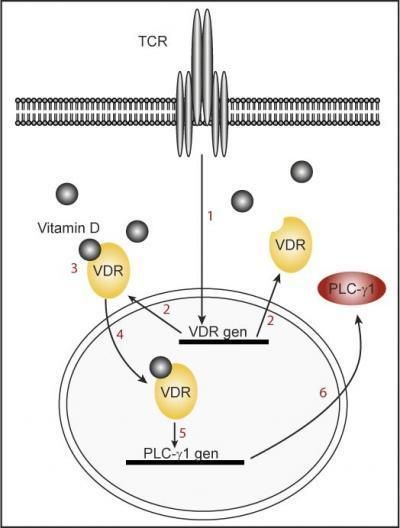
© Carsten GeislerWhen the naïve T cell recognizes foreign molecules with its T cell receptor (TCR) it sends activation signals (1) to the VDR gene. The VDR gene now starts the production of VDR (2). VDR binds vitamin D in the T cell (3) and becomes activated. Vitamin D bound to activated VDR goes back into the cell nucleus and activates the gene for PLC-gamma1 (5). PLC-gamma1 is produced (6) and the T cells can get started.
For T cells to detect and kill foreign pathogens such as clumps of bacteria or viruses, the cells must first be 'triggered' into action and 'transform' from inactive and harmless immune cells into killer cells that are primed to seek out and destroy all traces of a foreign pathogen.
The researchers found that the T cells rely on vitamin D in order to activate and they would remain dormant, naïve to the possibility of threat if vitamin D is lacking in the blood.
Chemical Reaction that Enables Activation
In order for the specialized immune cells (T cells) to protect the body from dangerous viruses or bacteria, the T cells must first be exposed to traces of the foreign pathogen. This occurs when they are presented by other immune cells in the body (known as macrophages) with suspicious 'cell fragments' or 'traces' of the pathogen. The T cells then bind to the fragment and divide and multiply into hundreds of identical cells that are all focused on the same pathogen type. The sequence of chemical changes that the T cells undergo enables them to both be 'sensitized to' and able to deliver a targeted immune response.
Professor Carsten Geisler from the Department of International Health, Immunology and Microbiology explains that "when a T cell is exposed to a foreign pathogen, it extends a signaling device or 'antenna' known as a vitamin D receptor, with which it searches for vitamin D. This means that the T cell must have vitamin D or activation of the cell will cease. If the T cells cannot find enough vitamin D in the blood, they won't even begin to mobilize."










Comment: Interestingly enough, there is no mention in this article of the real danger in so-called 'sugary' foods - known by the more obscure name of HFCS or High Fructose Corn Syrup. And, while it is a major cause of obesity as a health risk, the danger is much more deadly than just being over weight. For a more in-depth read, see: Flashback: High-Fructose Corn Syrup Produces Toxic Chemical "HMF" When Heated