Earth ChangesS


Snowflake

2nd blizzard in less than two weeks hits the U.S. Plains states - 'worse than the last one'

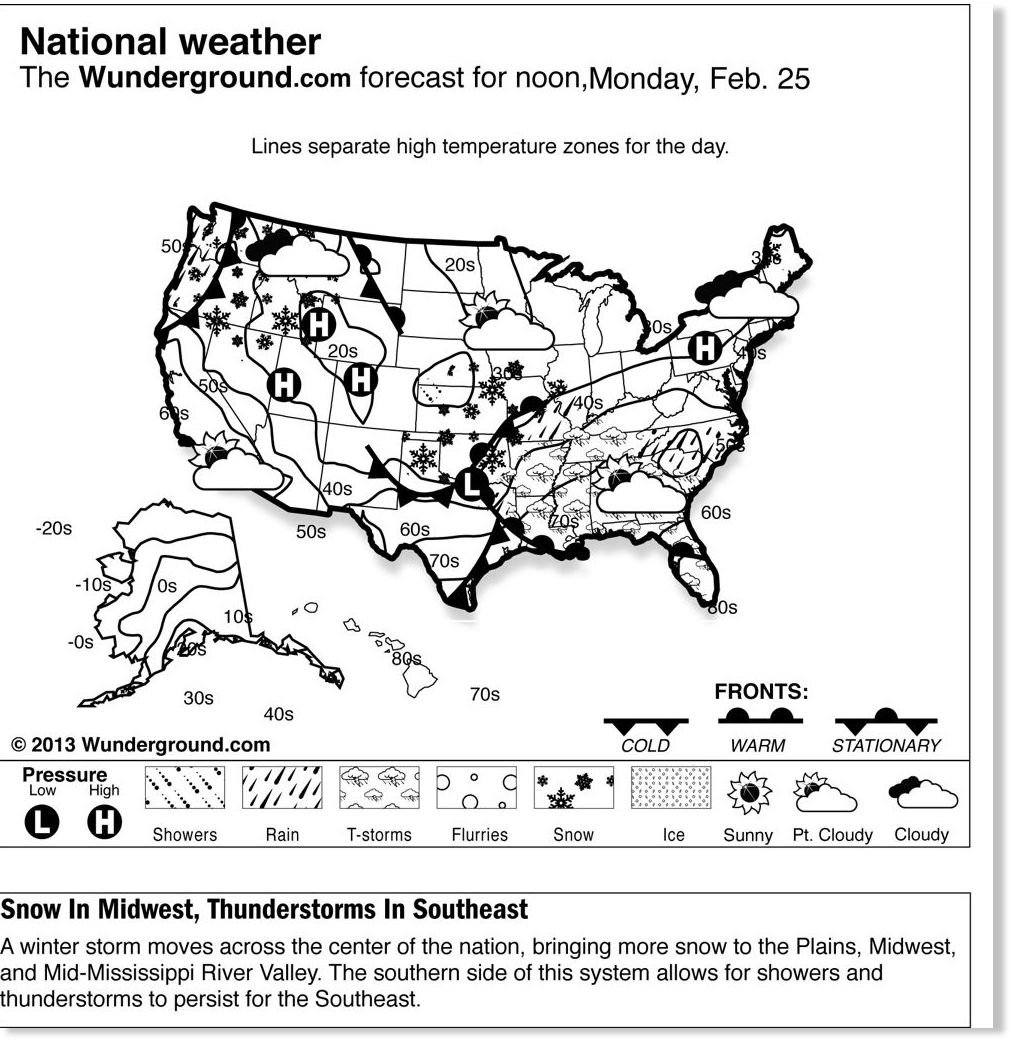
Blizzard conditions slammed parts of the central Plains Monday, forcing the closure of highways in the Texas and Oklahoma Panhandles and sending public works crews scrambling for salt and sand anew just days after a massive storm blanketed the region with snow.
Image
National Weather Service officials in Kansas and Oklahoma issued blizzard warnings and watches through late Monday as the storm packing snow and high winds tracked eastward across West Texas toward Oklahoma, Kansas and Missouri. Forecasters also warned of possible tornadoes further southeast.

Snow covered Amarillo, Texas, where forecasters said up to 18 inches could fall, accompanied by wind gusts up to 65 mph. Paul Braun, a spokesman for the Texas Department of Transport, said whiteout conditions and drifting snow had made all roads in the Texas Panhandle impassable. Interstate 40 was closed from Amarillo to the Oklahoma state line.

"It's just a good day to stay home," Braun said.

"This is one of the worst ones we've had for a while," he said. "And we kind of know snow up here."

Snowflake

The Winter of 1947 - "Climate disruption" before the current lunacy of "CO2 caused extreme weather" era

Image
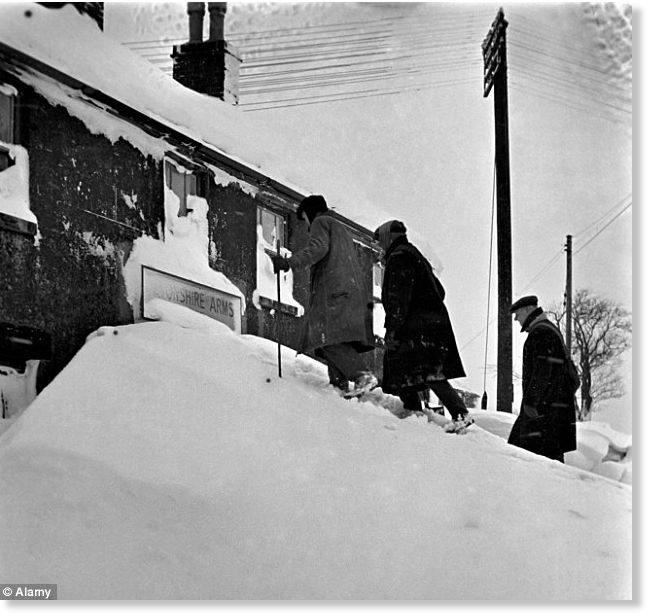
Wrong type of snow: Tunnels to front door of a house covered by snow in the Peak District, Derbyshire in 1947
The Great Freeze of 1963 was the coldest winter in the UK for over 200 years. However, the winter of 1947, while not as cold, was one of the snowiest.

The UK Met Office describe what the conditions were like.

Thousands of people were cut off for days by snowdrifts up to seven metres deep during the winter of 1947, which saw exceptional snowfall. Supplies had to be flown in by helicopter to many villages, and the armed forces were called in to help clear roads and railways.

Between January and March that year, snow fell every day somewhere in the country for 55 days straight. Much of this settled because temperatures stayed very low, just above freezing most days.

No-one expected this winter to be severe, as January started with very mild temperatures at up to 14 °C recorded. This was soon to change, however. An area of high pressure moved over southern Scandinavia, setting up a weather pattern which dominated the UK for the rest of the month. The first snow came on 23 January, falling heavily over southern England. Blizzard conditions occurred across the south-west of England, leaving many villages in Devon isolated.

Arrow Down

Update 2: Arizona highway 'sinkhole' is actually a whole mountain coming apart!

The giant fissure in the ground swallowed two cars in Page, Arizona, and caused 120 feet of highway to sink over 8 feet. But geologists are now also worried that the road may be irreparable for a long time because it appears that the whole side of the mountain is sinking!

Bizarro Earth

Peru: Dozens of dead sea creatures washed up


Experts are trying to work out why nearly 100 dead animals and birds have washed up on a Peruvian coastline.

The bodies of 18 sea turtles, 22 sea lions, eight dolphins, 16 angular roughsharks and 22 marine birds were found during an inspection by government officials.

Igloo

Northern Hemisphere sets new, all-time record cold temperature: -96.1°F In Oymyakon Siberia !!

That's -71.2°C, and it shatters the previous record of -68°C (-90.4°F) set in 1933! Hat-tip DirkH.

UPDATE: Russian media confirms the new record! (In Russian)

There's been a lot of confusion over the last couple of days concerning a record low temperature allegedly just recorded in Siberia. News reports in the mainstream media made it sound like the reading was recorded decades ago, or they just muddled it. For example The Mail had a feature here. No mention that it's a record set just days ago.

But now it appears that the record was actually set on February 19, in Oymyakon, Siberia.

The confusion is understandable, as the news just doesn't square with the global warming narrative.

Cloud Precipitation

Heavy rains and flooding isolate thousands in New South Wales, Australia

Image
© AAPFlooding isolates about 4000 people on the New South Wales north coast.
About 4,000 are isolated on the New South Wales' north coast as the region is hit with damaging winds, strong rains and flooding.

A severe weather warning is in place for northern NSW, with the Bureau of Meteorology warning of very heavy rains leading to flash flooding over the Northern Rivers, Mid North Coast, Northern Tablelands and Hunter forecast districts.

Late on Friday night, the NSW State Emergency Service said the extreme weather had isolated about 3500 people on the north coast.

An SES spokesman said the SES had received 1000 calls for assistance so far, and had completed nine flood rescues, including one in which three people were dragged from a car at Taree.

He expected the threat of flooding to increase on Saturday.

Bizarro Earth

Weather radar catches massive bug swarm over New Zealand

A vast swarm of bugs that covered much of the northern half of the North Island last night and this morning has been caught on the Metservice weather radar. (See animated weather radar image here.)

MetService didn't know what it was and entomologists were puzzled.

But there was a strong suspicion that it was an unwanted Australian heading home.

One was convinced it was the Tasmanian grass grub and another suspected huge swarm of aphids.

"I have no idea," said Bugman Ruud Kleinpaste.

"I would suggest go up in the air in aeroplane stick out a butterfly net and see what you catch."

He also speculated it could be a dust storm.

Fellow entomologist Stephen Pawson of Scion, a Crown research institute, had a more pragmatic answer; whatever if was, it was large, and it is going to be coming in on the surf at Piha and Muriwai for the next week or so.

Metservice's Peter Kreft said the unknown insects began swarming over the Waikato region about 9pm yesterday.

"They were pushed by the south easterly wind north toward Auckland," he said.

Cloud Precipitation

Landslides and flooding, from torrential rains, kill 17 in Indonesia

Four children were among 17 people killed over the weekend in central Indonesia after heavy rains triggered floods and landslides, officials said on Monday.The children, aged between two and nine, died along with 13 adults when flooding and landslides hit the northern part of Sulawesi island early Sunday, provincial disaster management agency spokesman Howke Makawarung told AFP. "We recorded 17 people killed. All bodies were found on Sunday," he said, adding that heavy rains had hit three areas, including the North Sulawesi provincial capital of Manado which saw water levels up to four meters (13 feet). Water, which inundated around 5,000 houses in Manado, had receded by Monday and residents had begun cleaning up their homes.


A landslide which hit the city killed a six-year old boy. "He was taking a bath in the morning when a landslide suddenly struck his house," the capital deputy mayor Harley Mangindaan told AFP. Indonesia is regularly affected by deadly floods and landslides during its wet season, which lasts for around six months. Environmentalists blame logging and a failure to reforest denuded land for exacerbating flooding. Heavy rains caused flooding in the capital Jakarta in January that left 32 people dead and at its peak forced nearly 46,000 to flee their homes. - Raw Story

Cloud Lightning

Remnants of 'super' winter storm to dump 'staggering amounts of rain' on Southeast U.S.

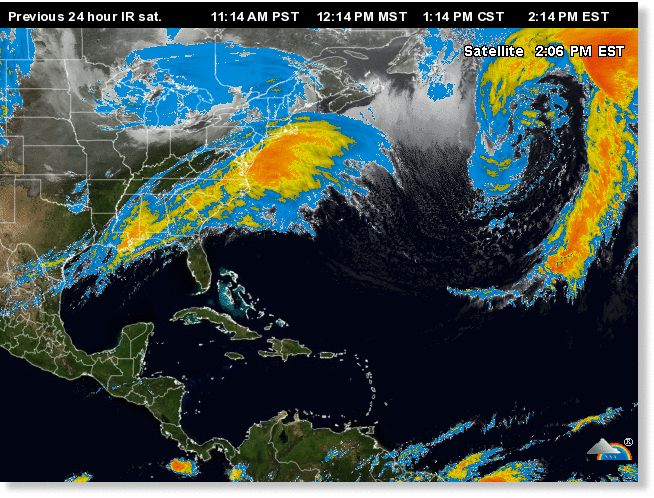
It will be a messy weekend in the Northeast and the Deep South as the massive weather system that walloped 20 states with a snowstorm rolls off towards the Atlantic Ocean. A winter storm is expected to deposit up to 10 inches of snow in isolated pockets of western Massachusetts, and 6 inches to a foot in parts of southern Vermont and New Hampshire, and central Maine. This is not the same storm that blanketed the Great Plains, said CNN Meteorologist Pedram Javaheri, although it is part of the same overall system that spans the country from north to south. It will be much less intense, he said, and it should not affect the places hardest hit by the blizzard that plastered the Northeast two weeks ago, knocking out power to hundreds of thousands of customers. Boston will likely see a slushy mix of rain and snow that could lead to downed branches and power lines, Javaheri said.

Image
Rain will continue to soak the eastern United States from Washington, D.C., on down, especially Sunday, according to the National Weather Service. "Across the Southeast, some of the rainfall totals are going to be staggering," said CNN Meteorologist Karen McGinnis. Parts of the central Southeast should get 4 - 6 inches of rainfall. The outgoing system will have made its mark on virtually the entire country from the southwest corner of California to central Maine, leaving its deepest imprint on Kansas. Wichita saw its second-highest storm snowfall total on record with 14.2 inches over two days, the National Weather Service said. The town of Russell in the state's middle lay under a 22 inch layer of white by the time the storm roared by. Missouri was not far behind, with accumulations of around a foot in some places. The snow set a record at Kansas City International Airport, with 9 inches falling in a single day. The old record was 5.1 inches set in 2010. Some businesses and universities shut down Thursday as state officials urged residents to stay off the roads. The white blanket emptied the streets of Kansas City. - CNN

Bizarro Earth

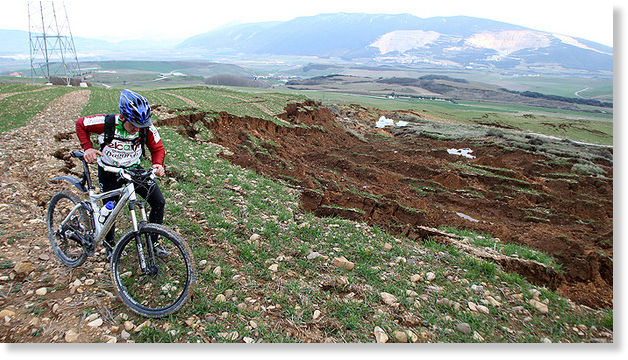
The Great Collapse: Crust weakening, slipping, and collapsing across the planet - UK, Spain, Kashmir, China, U.S.

Massive landslip in the UK

There is no end in sight to the severe disruption a landslide has caused for Scunthorpe area rail passengers, according to a leading rail expert. Sim Harris, managing editor at Railnews, the national newspaper for the British rail industry, says the landslide near Hatfield Colliery that is affecting thousands of North Lincolnshire rail passengers is the worst in decades. The disruption for passengers travelling between Scunthorpe and Doncaster has seen their journeys extended by up to an hour as they take buses to and from their destination. Work cannot begin repairing the track until the landslide stops moving - and officials at Network Rail say they have no idea when this will be. Mr Harris said: "Landslips themselves are not that uncommon and over the last year there have been quite a few because of the heavy rain that we have had. "There have been a lot of landslips that have not been rail-related, but some railways have been affected. This one is certainly the worst in my recollection and you have to go back a long way to find anything of this nature. In 1953, there were floods along the east coast service near Newcastle, where bridges were washed away. I don't think I have seen anything like this in recent memory. I don't recall anything as serious as this. There is no end in sight. He says repairing the line will not be an easy task. Until the ground stops moving, there is not much that Network Rail can do - their hands are tied. When it stops moving, it will take more than five minutes to rebuild four tracks of main railway. There are junctions that are involved which make it much more difficult." - TIS.uk


Unprecedented landslip in Spain

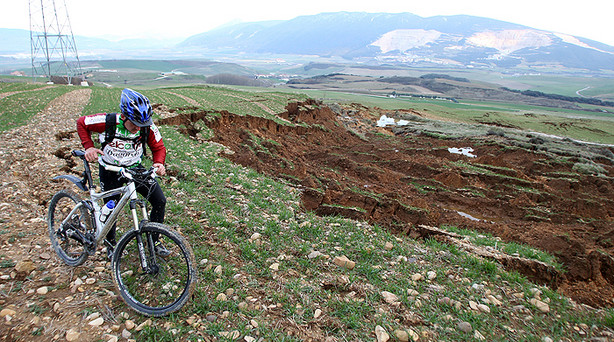
Heavy rains in recent weeks have caused a major landslide in Subiza (Cendea of ​​Galar) that has devastated rural roads, farms and caused serious damage to two electrical towers that are at serious risk of falling. The landslide is located on the southeast slope of Mount of Forgiveness, towards Bells, and therefore did not affect any house in this small town of Basin, about 190 inhabitants. The dimensions of the land mass, dragged stones and vegetation, as a result of heavy rainfall are calculated such that can reach 800 meters long and 700 wide. "It is of immense dimensions, and quite tremendous." I've never seen one this big slide," claimed yesterday Esteban Faci, geologist of the Government of Navarre, in an initial field assessment. Continuous rains, during January and February, along with the snowmelt, are behind this spectacular landslide, which began about three or four weeks, according to Ismael Amatriain. As if it were a glacier, the tongue of land, rocks and vegetation has shifted gradually from the hillside, taking about six or seven fields of wheat and barley crops with it. It has also destroyed three rural roads; sometimes breaking them so dramatically that you could see a stretch perfectly, you can see where the next, 10 or 15 feet had moved. In addition, roads, are covered by tons of earth in places, and have large and deep cracks. The council has sealed off many of these roads, making access totally impassable. The landslide also destroyed a cattle track that crossed the region. - Noticias
Image
A massive landslip destroys dozens of fields and roads near Cendea de Galar Spain
Image
Nightmarish cracks, splits land in Kashmir
At least 200 families of Yamrad Bala, 16 km from Handwara have been forced to migrate to other locations after cracks developed in the land around their houses. The cracks are widening constantly giving a nightmarish experience to the inhabitants. Locals said that land was developing cracks, which were widening with each passing day. They expressed fear that their residential structures may collapse anytime and result in devastation of life and property. The land is developing cracks and it appears that major soil erosion may wreak havoc to life and property," said Habibullah Qureshi, a local. The village is located at a slope and a non-metallic road connects it with the Handwara town. We have a joint family of 18 members living under a single roof. Fearing collapse of our house, we were forced to evacuate during the night and stay with relatives in Magam since Monday," Muhammad Ayoub, a local said. Some families who muster courage to stay in their homes during nights said it was a nightmarish experience for them to spend nights amid increasing fear of widening of cracks. Following a representation by locals about soil erosion in the village, a team from Soil Conservation Department accompanied by Tehsildar Handwara Ghulam Ahmad Khan today visited the village. Officials of Soil Conservation Department collected the sample of soil and sent it for testing. There is no need to panic and necessary measures will be taken for the safety of inhabitants of the village," Khan said. Most of the families evacuated their houses and moved to safer location in nearby localities during nights. "Staying for nights here may prove disastrous because land is developing more cracks at different places. For past two days, we have been moving to other locations to spend nights and avoid any eventuality," a local Muhammad Sarwar said. "The soil may have turned marshy after many years. If that is the case, then the entire village may be forced to migrate to other areas for rehabilitation," said another local Abdul Rashid Lone. - Rising Kasmir