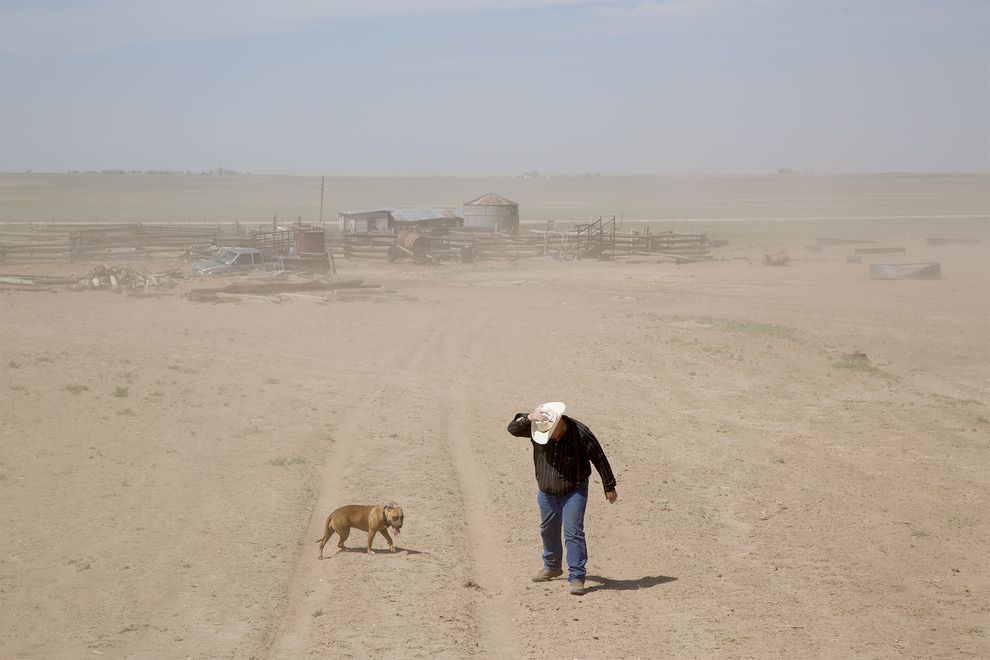
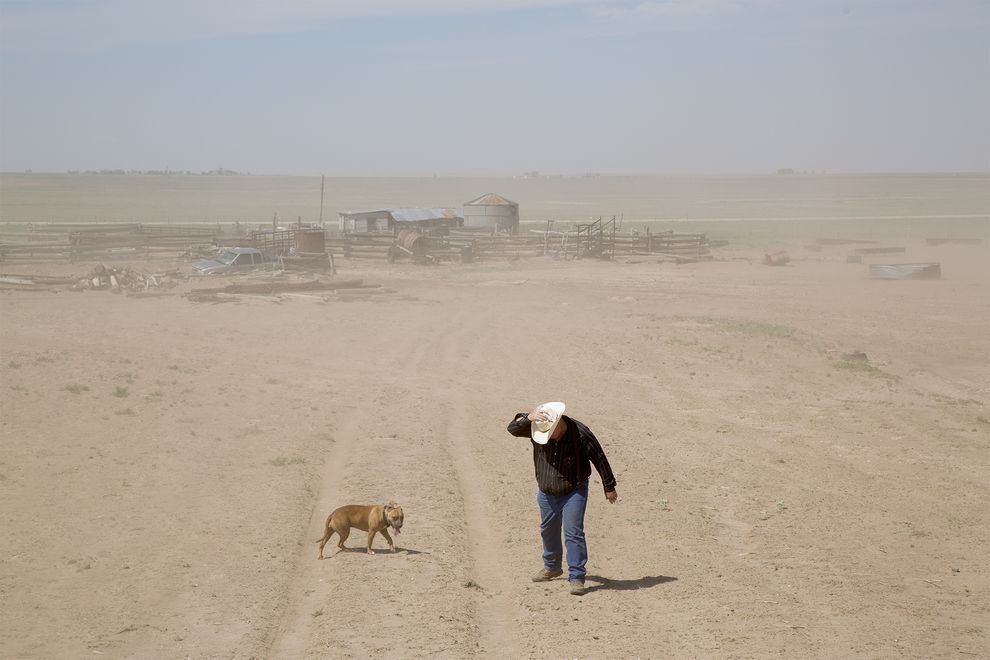
© Ed Kashi, VIIA farmer walks in a dust storm on drought-stricken lands near Felt, Oklahoma, on August 1, 2013.
In Boise City, Oklahoma, over the catfish special at the Rockin' A Café, the old-timers in this tiny prairie town grouse about billowing dust clouds so thick they forced traffic off the highways and laid down a suffocating layer of topsoil over fields once green with young wheat.
They talk not of the Dust Bowl of the 1930s, but of the duster that rolled through here on April 27, clocked at 62.3 miles per hour.
It was the tenth time this year that Boise City, at the western end of the Oklahoma panhandle, has endured a dust storm with gusts more than 50 miles per hour, part of a breezier weather trend in a region already known for high winds.
"When people ask me if we'll have a Dust Bowl again, I tell them we're having one now," says
Millard Fowler, age 101, who lunches most days at the Rockin' A with his 72-year-old son, Gary. Back in 1935, Fowler was a newly married farmer when a blizzard of dirt, known as Black Sunday, swept the High Plains and turned day to night. Some 300,000 tons of dirt blew east on April 14, falling on Chicago, New York, Washington, D.C., and, according to writer Timothy Egan in his book
The Worst Hard Time, onto ships at sea in the Atlantic.


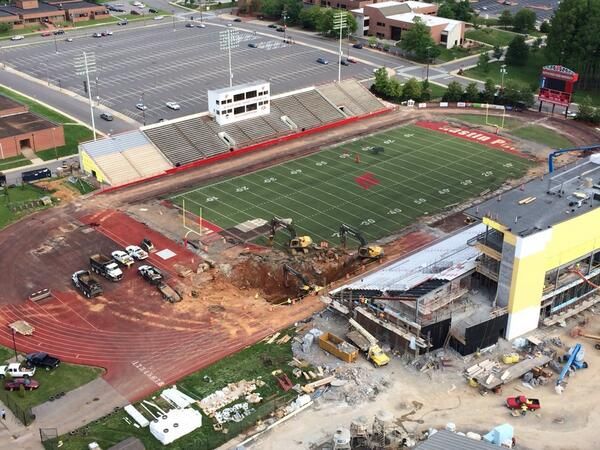



Comment: As seen in the video, repurposing early sinkhole indents as they call 'the bowls', for student use and merely landscaping around them, looks like a nomination for a Darwin award. These holes are potentially deadly as they open up in no time, and like academics are most they choose to just sweep the inconvenient evidence under the carpet. Earth is increasingly opening up at an alarming rate: