Science of the SpiritS


Info

Babies May Not Have a 'Moral Compass' After All

Baby
© oksun70 / FotoliaNew research from New Zealand's University of Otago is casting doubt on a landmark US study that suggested infants as young as six months old possess an innate moral compass that allows them to evaluate individuals as 'good' or 'bad'.
New research from New Zealand's University of Otago is casting doubt on a landmark US study that suggested infants as young as six months old possess an innate moral compass that allows them to evaluate individuals as 'good' or 'bad'.

The 2007 study by Yale University researchers provided the first evidence that 6- and 10-month-old infants could assess individuals based on their behaviour towards others, showing a preference for those who helped rather than hindered another individual.

Based on a series of experiments, researchers in the Department of Psychology at Otago have shown that the earlier findings may simply be the result of infants' preferences for interesting and attention grabbing events, rather than an ability to evaluate individuals based on their social interactions with others.

The Otago study was recently published in PLoS One, an international, peer-reviewed, open-access, online journal.

Lead author Dr Damian Scarf says that the Yale study caused an international sensation when it was published in the leading journal Nature.

"The paper received a lot of attention when it was first published, including coverage in the New York Times. It has received well over 100 citations since 2007, a phenomenal number over such a short period. The paper was initially brought to our attention by one of the PhD students in our lab.

The head of the lab, Professor Harlene Hayne, suggested that a group of us read the paper together and then meet to discuss it. Our original motivation for reading the paper was merely interest. Obviously, the idea that morality is innate is extremely interesting and, if true, would raise questions about which components of our moral system are innate and also have implications for the wider issue of the roles that nature and nurture play in development," says Dr Scarf.


Bulb

Best of the Web: Why Mass Killers Aren't Necessarily Psychopaths

Image
© EPAJared Lee Loughner, Greenbaumed?
The term "psychopath" is often a misunderstood one; although people frequently refer to alleged mass killers like Colorado shooter James Holmes or the Tucson, Ariz., shooter Jared Loughner as psychopaths, that doesn't mean these men fit the description of this mental health disorder.

In the last week, a psychiatric evaluation report was released stating that after months of receiving treatment for schizophrenia, 23-year-old Loughner seemed to understand that he was agreeing to a guilty plea for the 2011 shooting rampage that killed six people and wounded 13 others, including then-Congresswoman Gabrielle Giffords.

Meanwhile, lawyers for Holmes announced they believe the 24-year-old suffers from mental illness, though they haven't yet determined the exact nature of his illness. Weeks before the shooting, Holmes' psychiatrist, Dr. Lynne Fenton, University of Colorado professor who specializes in schizophrenia, had alerted university police about Holmes' behavior.

Comment: It's understandable that people confuse mass killers with psychopaths because the psychopaths-in-power have made sure to conflate the two (think Silence of the Lambs). They can point to Loughner and Holmes and say, "See, we're not like that. You can trust us. Give us more power and we will protect you from them."

While all mass killers display at least some psychopathic tendencies and while some of them may in fact be psychopaths (that is, they were born without a conscience), the answer to the question of what makes a mass killer is not as black and white as some believe:

The Greenbaum Speech

Project Paperclip, MKULTRA, Dr. Greenbaum and Seung Hui Cho: Was the VA Tech Gunman Mind Programmed?

The Cs Hit List 05: Dr. Greenbaum and the Manchurian Candidates


People

Need an Expert? Try the Crowd

Image
© James CridlandCan a crowd be an expert? Two UVM scientists think the answer is yes.
In 1714, the British government held a contest. They offered a large cash prize to anyone who could solve the vexing "longitude problem" - how to determine a ship's east/west position on the open ocean - since none of their naval experts had been able to do so.

Lots of people gave it a try. One of them, a self-educated carpenter named John Harrison, invented the marine chronometer - a rugged and highly precise clock - that did the trick. For the first time, sailors could accurately determine their location at sea.

A centuries-old problem was solved. And, arguably, crowdsourcing was born.

Crowdsourcing is basically what it sounds like: posing a question or asking for help from a large group of people. Coined as a term in 2006, crowdsourcing has taken off in the internet era. Think of Wikipedia, and its thousands of unpaid contributors, now vastly larger than the Encyclopedia Britannica.

Magic Wand

Feedback can have a negative impact on performance

Research shows not all feedback is good for you.

People who give positive encouragement and constructive criticism could be wasting their breath according to the latest research from a psychology expert at Queen Mary, University of London.

The study, published in the journal Frontiers in Neuroscience, found that when people received either positive or negative feedback about their performance on complex decision-making tasks, it made their decision making worse.

Study author Dr Magda Osman explained: "The kind of task people had to perform was difficult and demanding. So, when people received positive or negative feedback, it overloaded them with too much information and distracted them from making a good decision.

"We found that people's performance got worse when they had to make sense of the feedback they were given while also performing the main task.

"The role of feedback is overemphasised. People typically think that any form of feedback should improve performance in many tasks, and the more frequently it is given the better performance will be.

"However what needs to be considered is how complex the task is in the first place, because this will determine how much feedback will actually interfere with rather than facilitate performance."

The study involved about 100 people who were given the task of choosing how best to either predict or control the state of health of a baby, revealing that feedback can play a negative role in a particularly complex decision-making scenario.

People

Social status and incompetence: Why are people overconfident so often?

It's all about social status, a UC Berkeley study finds.

Researchers have long known that people are very frequently overconfident - that they tend to believe they are more physically talented, socially adept, and skilled at their job than they actually are. For example, 94% of college professors think they do above average work (which is nearly impossible, statistically speaking). But this overconfidence can also have detrimental effects on their performance and decision-making. So why, in light of these negative consequences, is overconfidence still so pervasive?

The lure of social status promotes overconfidence, explains Haas School Associate Professor Cameron Anderson. He co-authored a new study, "A Status-Enhancement Account of Overconfidence," with Sebastien Brion, assistant professor of managing people in organizations, IESE Business School, University of Navarra, Haas School colleagues Don Moore, associate professor of management, and Jessica A. Kennedy, now a post-doctoral fellow at the Wharton School of Business. The study will be published in the Journal of Personality and Social Psychology (forthcoming).

"Our studies found that overconfidence helped people attain social status. People who believed they were better than others, even when they weren't, were given a higher place in the social ladder. And the motive to attain higher social status thus spurred overconfidence," says Anderson, the Lorraine Tyson Mitchell Chair in Leadership and Communication II at the Haas School.

Social status is the respect, prominence, and influence individuals enjoy in the eyes of others. Within work groups, for example, higher status individuals tend to be more admired, listened to, and have more sway over the group's discussions and decisions. These "alphas" of the group have more clout and prestige than other members. Anderson says these research findings are important because they help shed light on a longstanding puzzle: why overconfidence is so common, in spite of its risks. His findings suggest that falsely believing one is better than others has profound social benefits for the individual.

Moreover, these findings suggest one reason why in organizational settings, incompetent people are so often promoted over their more competent peers. "In organizations, people are very easily swayed by others' confidence even when that confidence is unjustified," says Anderson. "Displays of confidence are given an inordinate amount of weight."

Info

Is Death An Illusion? Evidence Suggests Death Isn't the End

Light At Death
© RobertLanza, Biocentrism
After the death of his old friend, Albert Einstein said "Now Besso has departed from this strange world a little ahead of me. That means nothing. People like us ... know that the distinction between past, present and future is only a stubbornly persistent illusion."

New evidence continues to suggest that Einstein was right - death is an illusion.

Our classical way of thinking is based on the belief that the world has an objective observer-independent existence. But a long list of experiments shows just the opposite. We think life is just the activity of carbon and an admixture of molecules - we live awhile and then rot into the ground.

We believe in death because we've been taught we die. Also, of course, because we associate ourselves with our body and we know bodies die. End of story. But biocentrism - a new theory of everything - tells us death may not be the terminal event we think. Amazingly, if you add life and consciousness to the equation, you can explain some of the biggest puzzles of science. For instance, it becomes clear why space and time - and even the properties of matter itself - depend on the observer. It also becomes clear why the laws, forces, and constants of the universe appear to be exquisitely fine-tuned for the existence of life.

Until we recognize the universe in our heads, attempts to understand reality will remain a road to nowhere.

Consider the weather 'outside': You see a blue sky, but the cells in your brain could be changed so the sky looks green or red. In fact, with a little genetic engineering we could probably make everything that is red vibrate or make a noise, or even make you want to have sex like with some birds. You think its bright out, but your brain circuits could be changed so it looks dark out. You think it feels hot and humid, but to a tropical frog it would feel cold and dry. This logic applies to virtually everything. Bottom line: What you see could not be present without your consciousness.

Info

Why Do Women Get More Migraines?

Brain Scans
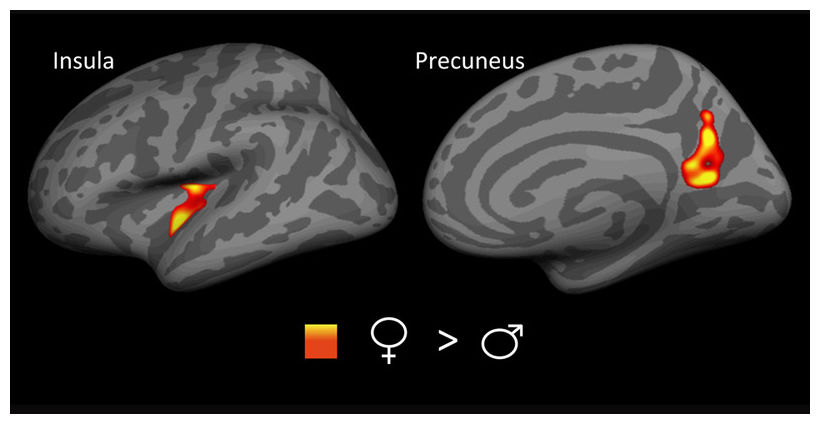
© Nasim Maleki Sex on the brain. Women who have migraines have thickening in two brain regions: the insula, shown here in the back left side of an average brain, and the precuneus, shown here in the right hemisphere viewed from the middle. Areas of yellow show the biggest differences, compared to men who have migraines and people of both genders who do not have migraines.
Migraines are a battle of the sexes that women might prefer not winning. Each year, roughly three times more women than men - up to 18% of all women - suffer from the debilitating headaches, as tallied by epidemiological surveys in Europe and the United States. A new brain imaging study may explain the divide: The brains of women with migraines appear to be built differently than those of their male counterparts.

To conduct the study, researchers headed by David Borsook, a neurologist and neurobiologist of Boston Children's Hospital and Harvard Medical School, recruited 44 men and women, half of whom were migraine sufferers. The women who had migraines rated them as being as intense as the men did, but they tended to find them more unpleasant. Borsook says the distinction is analogous to the loudness of fingernails scratching on a chalkboard versus the torment of hearing the sound.

The team then scanned the brains of the volunteers. The researchers gathered two kinds of data sets, one that captured brain shapes and features, and one that measured brain activity. Female migraine sufferers showed slightly thicker gray matter in two regions: one, the posterior insula, is well-known in pain processing; the other, the precuneus, has been recently linked to migraines but is more widely known as a fundamental brain hub that may house a person's consciousness or sense of self. The other volunteers, including the male migraine sufferers, did not show this thickening. All of the scans were done when people did not have a migraine.

To figure out what those structural changes meant, lead author Nasim Maleki, a medical physicist at Boston Children's Hospital and Harvard Medical School, returned to the MRI scans of only those men and women with episodic migraines. The team compared brain activity while the volunteers experienced pain - in this case, three 15-second bursts of heat to the hand, spaced 30 seconds apart, generated through a small metal cube, akin to touching a too-hot cup of coffee. In women with migraines, "these thicker areas talk to each other and work together to respond to pain" in a pattern not seen in the men, Maleki says.

Heart

The Compassionate Species

mother and child
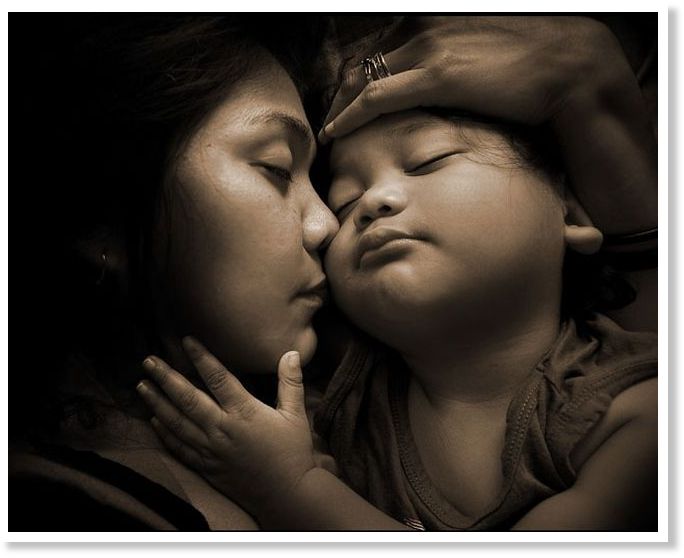
The vulnerability of our children transformed human relationships, argues Dacher Keltner, and made compassion essential to our survival.

Charles Darwin was the beloved and engaged dad of a really rambunctious group of children. When one of his daughters died at age 10, Darwin started to have these deep insights about the place of suffering and compassion in human experience.

That led him to write, in The Descent of Man, that "sympathy is our strongest instinct, stronger than self-interest," and he argued that it would spread through natural selection, for "the most sympathetic members, would flourish best, and rear the greatest number of offspring."

This point was totally forgotten by evolutionary science for quite some time. Well, given all the awful things humans do to each other, how could you make the case that sympathy is our strongest instinct?

The answer lies in the dependence and vulnerability of our children. Little baby chimpanzees eat by themselves; human babies can't. Baby chimpanzees sit up on their own; you sit up a human baby, and they go, "Watch out, man, my head's really big!" Boom!

Their heads are so big because their brains are so big. To fit their big heads through the human birth canal - which narrowed as we started to walk upright on the African savanna - our babies were born profoundly premature and dependent upon people to take care of them.

In fact, our babies are the most vulnerable offspring on the face of the Earth. And that simple fact changed everything. It rearranged our social structures, building cooperative networks of caretaking, and it rearranged our nervous systems. We became the super caregiving species, to the point where acts of care improve our physical health and lengthen our lives. We are born to be good to each other.

Comment: Éiriú Eolas, the scientific breathing and meditation program, can help stimulate our compassion nerve back into action, relieving you at the same time from stress, inflammation, and physical/emotional toxins.


Heart

Forget Survival of the Fittest: It Is Kindness That Counts

Image
A psychologist probes how altruism, evolution and neurobiology mean that we can succeed by not being cutthroat.

Why do people do good things? Is kindness hardwired into the brain, or does this tendency arise via experience? Dacher Keltner, director of the Social Interaction Laboratory at the University of California, Berkeley, investigates these questions from multiple angles and often generates results that are both surprising and challenging. In his recent book, Born to Be Good: The Science of a Meaningful Life (W. W. Norton, 2009), Keltner weaves together scientific findings with personal narrative to uncover human emotion's innate power to connect people with one another, which he argues is the path to living the good life. Here Keltner discusses altruism, neurobiology and the practical applications of his findings with David DiSalvo.

SCIENTIFIC AMERICAN MIND: What, in a nutshell, does the term "born to be good" mean to you?

DACHER KELTNER: "Born to be good" means that our mammalian and hominid evolution has crafted a species - us - with remarkable tendencies toward kindness, play, generosity, reverence and self-sacrifice, which are vital to the classic tasks of evolution - survival, gene replication and smoothly functioning groups. These tendencies are felt in the wonderful realm of emotion - feelings such as compassion, gratitude, awe, embarrassment and mirth. Recent studies have revealed that our capacity for caring, play, reverence and modesty is built into our brains, bodies, genes and social practices.

Better Earth

Equality, empathy and psychopathy

equality
Sanatana Dharma is an ancient code of conduct originating with the Vedic culture some 8,000+ years ago. The Sanskrit word 'dharma', while not easily translated into English, due to its complex, multi-level meaning can be interpreted as 'the collection of natural and universal laws that uphold, sustain, or uplift'. In effect, dharma is a law of being, a law of nature, individual nature, prescribed duty, social and personal duties, a moral code, civil law, a code of conduct, morality, a way of life, a practice, an observance, justice, righteousness, religion, religiosity and harmony.

Rather than a set of man-made rules, Sanatana Dharma is more akin to a document of the observable laws of physics. The word 'karma', meaning 'action' is used to indicate the cause-effect relationship between action and consequence. Moral judgement is an attitude that applies in relation to the dharmic value produced by the cause-effect of actions, but the laws, themselves are as morally neutral as the non-dual monism of Vedic philosophy that first began to examine and discuss the nature of existence. Karma, when understood as 'work' in the sense that it is used in physics, does not categorise any action as inherently good or bad. Instead, any and all actions and intentions 'that uphold, sustain, or uplift' life are good, while those actions that suppress or destroy life are bad. This is purely a rational position that hinges on the assumption that there is consensus will to live and let live and that that will is firmly founded on the understanding that all life forms are inextricably integrated, interdependent and of equal value to the whole. The recognition of equality cannot be gained by a mind incapable of empathy, which is rooted in ahimsa, a tenet of Sanatana Dharma. The word 'ahimsa' translates into 'non-violence', but encompasses all acts of violence from harsh words to killing insects.