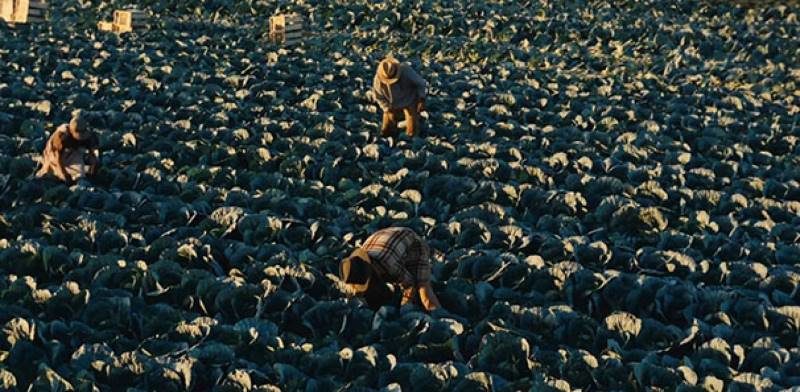
© The Weinstein CompanyFreddie Quell works at a cabbage farm alongside migrant workers in PT Anderson’s “The Master.”
When I
talked to him about the economic effects of immigration last month, Center for Global Development migration expert Michael Clemens mentioned that he was working on research on agricultural migrant workers. That research is finally out, in the form of a
report released by CGD and the Partnership for a New American Economy, a pro-immigration reform group started by Michael Bloomberg and Rupert Murdoch.
Clemens's study focuses on the agricultural industry in North Carolina, and more specifically on the North Carolina Growers Association (NCGA), which supplies manual laborers to North Carolina farms. The NCGA is the nation's largest user of the H-2A guest worker program,which is designed with agricultural workers in mind. Under that program's regulations, Clemens explains, NCGA "must submit an application to the US Department of Labor proving that it has actively recruited US natives and native workers will not take NCGA jobs."
That data is interesting, because it describes the labor market before any immigrant workers are recruited. That, as Clemens says, "allows us to assess the willingness of native workers to take farm jobs before they can even be offered to foreign workers, meaning that this study does not miss any impact caused by people who self-select out of an area or occupation because of competition with foreign workers."That willingness, he finds, is basically nonexistent. Every year from 1998 to 2012, at least 130,000 North Carolinians were unemployed. Of those, the number who asked to be referred to NCGA was never above 268 (and that number was only reached in 2011, when 489,095 North Carolinians were unemployed).
The share of unemployed asking for referrals never breached 0.09 percent.



















Comment: North America has become so accustomed to food abundance, they no longer value those that produce their food. Furthermore, Big Agra has such a stranglehold on the industry, they place producers in the wage bind they are in because they can demand a farmer's products at prices that barely keep the operations running. Buying farm produce locally as much as possible can help break this evil monopoly.