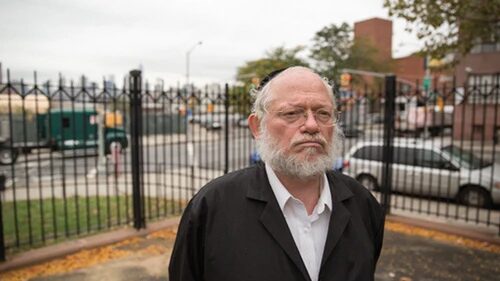
© CHRISTIAN STORMRABBI NUCHEM ROSENBERG, THE LONE WHISTLEBLOWER AMONG THE SATMAR, A POWERFUL HASIDIC SECT, WHO RECENTLY WAS THE VICTIM OF A BLEACH ATTACK IN WILLIAMSBURG, BROOKLYN
Rabbi Nuchem Rosenberg — who is 63 with a long, graying beard — recently sat down with me to explain what he described as a "child-rape assembly line" among sects of fundamentalist Jews. He cleared his throat. "I'm going to be graphic," he said.
A member of Brooklyn's Satmar Hasidim fundamentalist branch of Orthodox Judaism, Nuchem designs and repairs mikvahs in compliance with Torah Law. The mikvah is a ritual Jewish bathhouse used for purification. Devout Jews are required to cleanse themselves in the mikvah on a variety of occasions: Women must visit following menstruation, and men have to make an appearance before the High Holidays, such as Rosh Hashanah and Yom Kippur. Many of the devout also purify themselves before and after the act of sex and before the Sabbath.
On a visit to Jerusalem in 2005, Rabbi Rosenberg entered into a mikvah in one of the holiest neighborhoods in the city, Mea She'arim. "I opened a door that entered into a schvitz," he told me. "Vapors everywhere, I can barely see. My eyes adjust, and I see an old man, my age, long white beard, a holy-looking man, sitting in the vapors. On his lap, facing away from him, is a boy, maybe seven years old. And the old man is having anal sex with this boy."Rabbi Rosenberg paused, gathered himself, and went on: "This boy was speared on the man like an animal, like a pig, and the boy was saying nothing. But on his face — fear. The old man [looked at me]
without any fear, as if this was common practice. He didn't stop. I was so angry, I confronted him. He removed the boy from his penis, and I took the boy aside. I told this man, 'It's a sin before God, a
mishkovzucher. What are you doing to this boy's soul? You're destroying this boy!' He had a sponge on a stick to clean his back, and he hit me across the face with it. 'How dare you interrupt me!' he said. I had heard of these things for a long time, but now I had seen."




















Comment: Well, this development might make one think twice about getting on an air plane. Perhaps that's the point? Only those with enough private resources to hire competent employees will be able to travel.
The deliberate downgrading of competency requirements is affecting more than just the airline industry. The rot is becoming ubiquitous, all in the name of rainbows-and-unicorns 'inclusion':