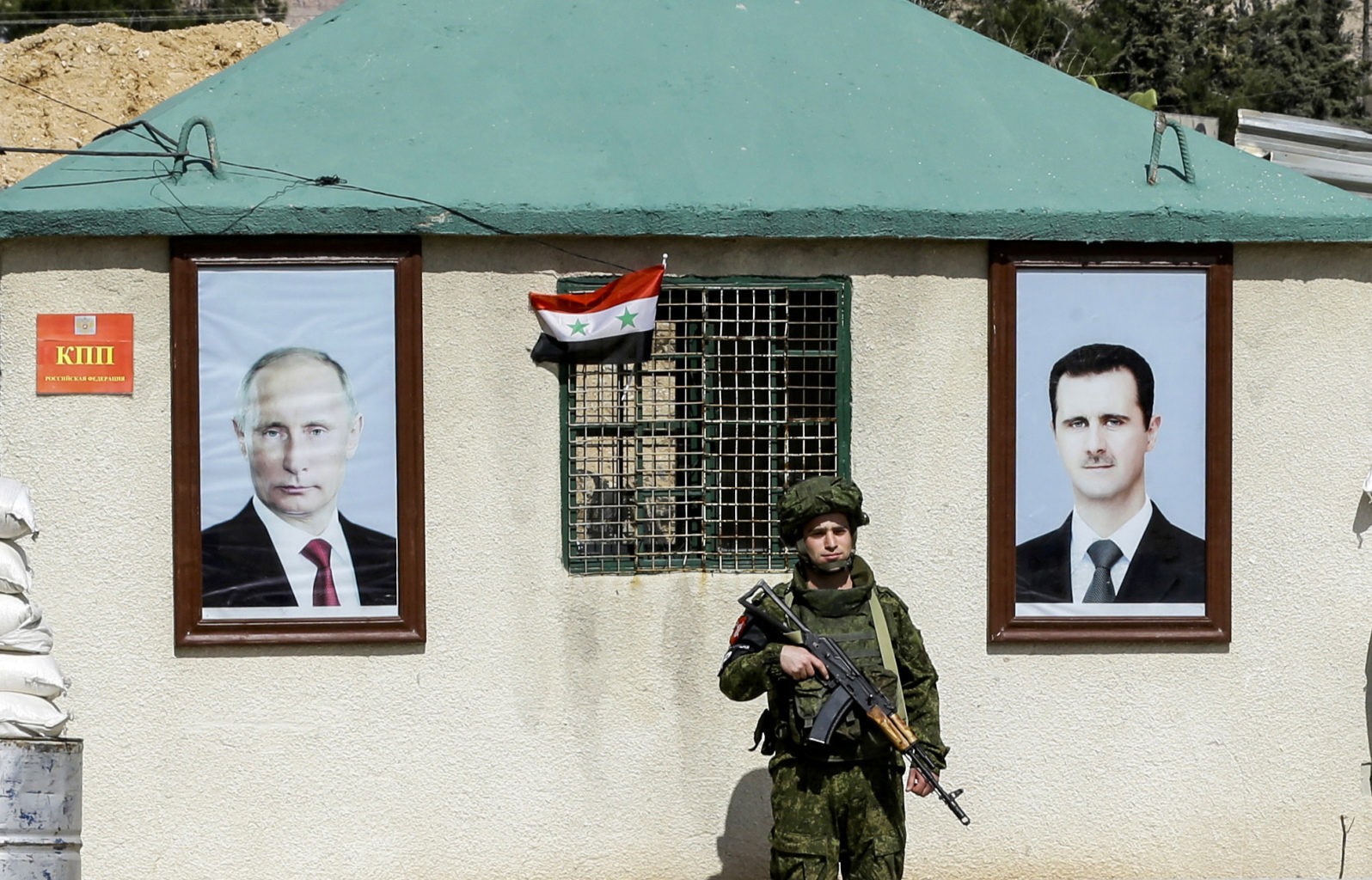
© LOUAI BESHARA/AFP/Getty ImagesA picture taken on March 1, 2018 shows a member of the Russian military police standing guard between the portraits of Syrian President Bashar al-Assad (R) and Russian President Vladimir Putin (L) hanging outside a guard-post at the Wafideen checkpoint on the outskirts of Damascus neighbouring the rebel-held Eastern Ghouta region.
Earlier this month, Syrian regime forces hoisted their flag above the southern town of Daraa and celebrated. Although there is more bloodletting to come, the symbolism was hard to miss. The uprising that
began in that town on March 6, 2011, has finally been crushed, and the civil war that has engulfed the country and destabilized parts of the Middle East as well as Europe will be over sooner rather than later. Bashar al-Assad, the man who was
supposed to fall in "a matter of time," has prevailed with the help of Russia, Iran, and Hezbollah over his own people.
Washington is too busy over the furor of the day to reflect on the fact that there are approximately 500,000 fewer Syrians today than there were when a group of boys spray-painted "The people demand the fall of the regime" on buildings in Daraa more than seven years ago. But now that the Syria conflict has been decided, it's worth thinking about the purpose and place of the United States in the new Middle East. The first order of business is to dispose of the shibboleths that have long been at the core of U.S. foreign policy in the region and have contributed to its confusion and paralysis in Syria and beyond.
There probably isn't anyone inside the Beltway who hasn't been told at some point in their career about the dangers of reasoning by analogy. But that doesn't mean such lessons have been regularly heeded. The Syrian uprising came at a fantastical time in the Middle East when freedom, it seemed, was breaking out everywhere. The demonstration of people power that began in Daraa-coming so soon after the fall of longtime leaders in Tunisia and Egypt-was moving. It also clouded the judgment of diplomats, policymakers, analysts, and journalists, rendering them unable to discern the differences between the region's Assads and Ben Alis or between the structure of the Syrian regime and that of the Egyptian one.








Comment: As credentials go, these authors take the biscuit. But thankfully Trump doesn't need the advice of deranged US columnists: Helsinki Peace Talk Between Nuclear Superpower Leaders Putin and Trump Offends America's Assholes and Morons
Also check out SOTT radio's: NewsReal: Treason, Really? Trump-Putin Summit Enrages The War Party