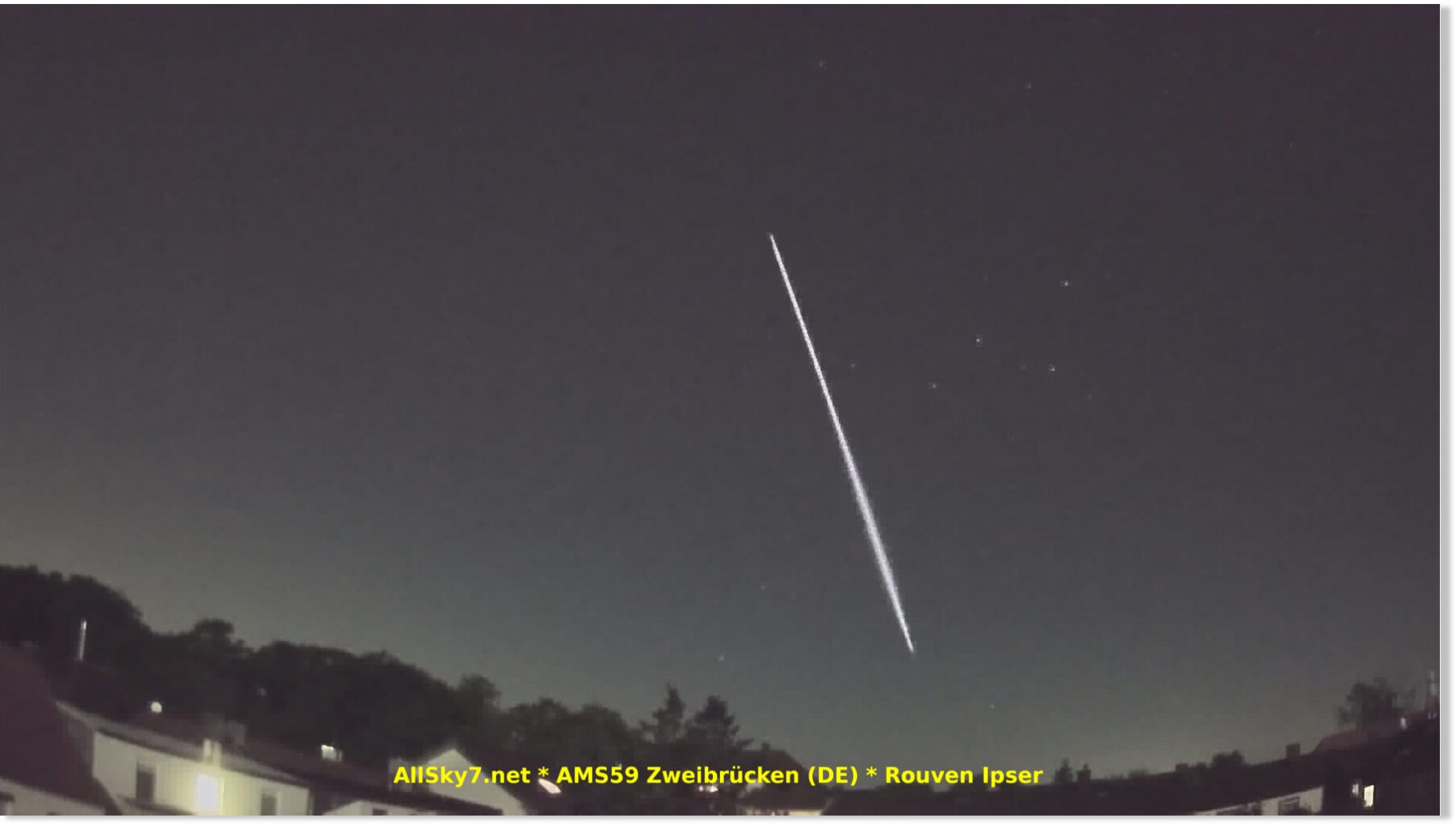
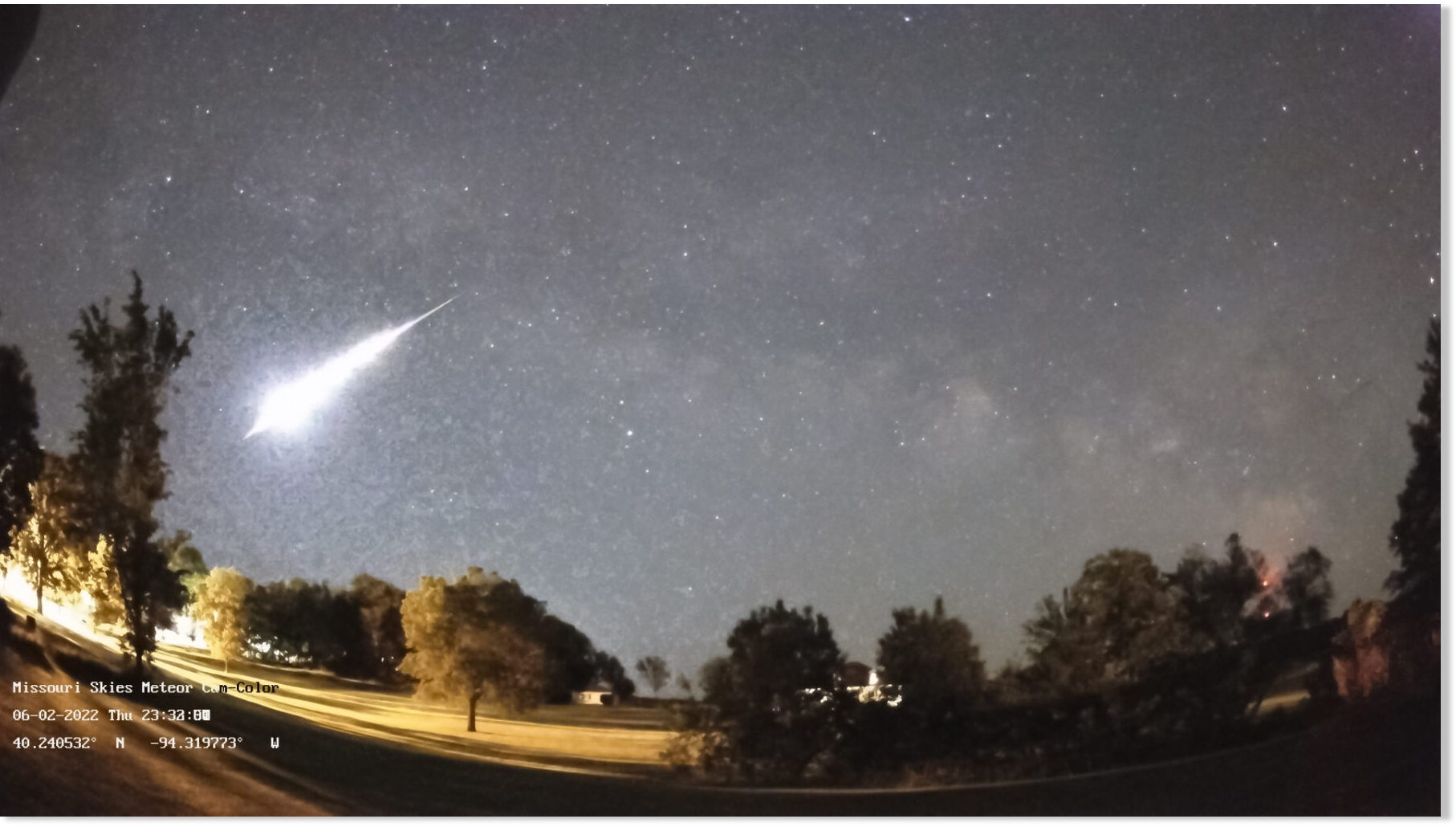
We received 13 reports about a fireball seen over Baden-Württemberg, Esch-sur-Alzette, Hessen, Limburg, Nordrhein-Westfalen, Région Wallonne, Rheinland-Pfalz and Vlaams Gewest on Monday, June 13th 2022 around 22:33 UT.
For this event, we received one video and 7 photos.
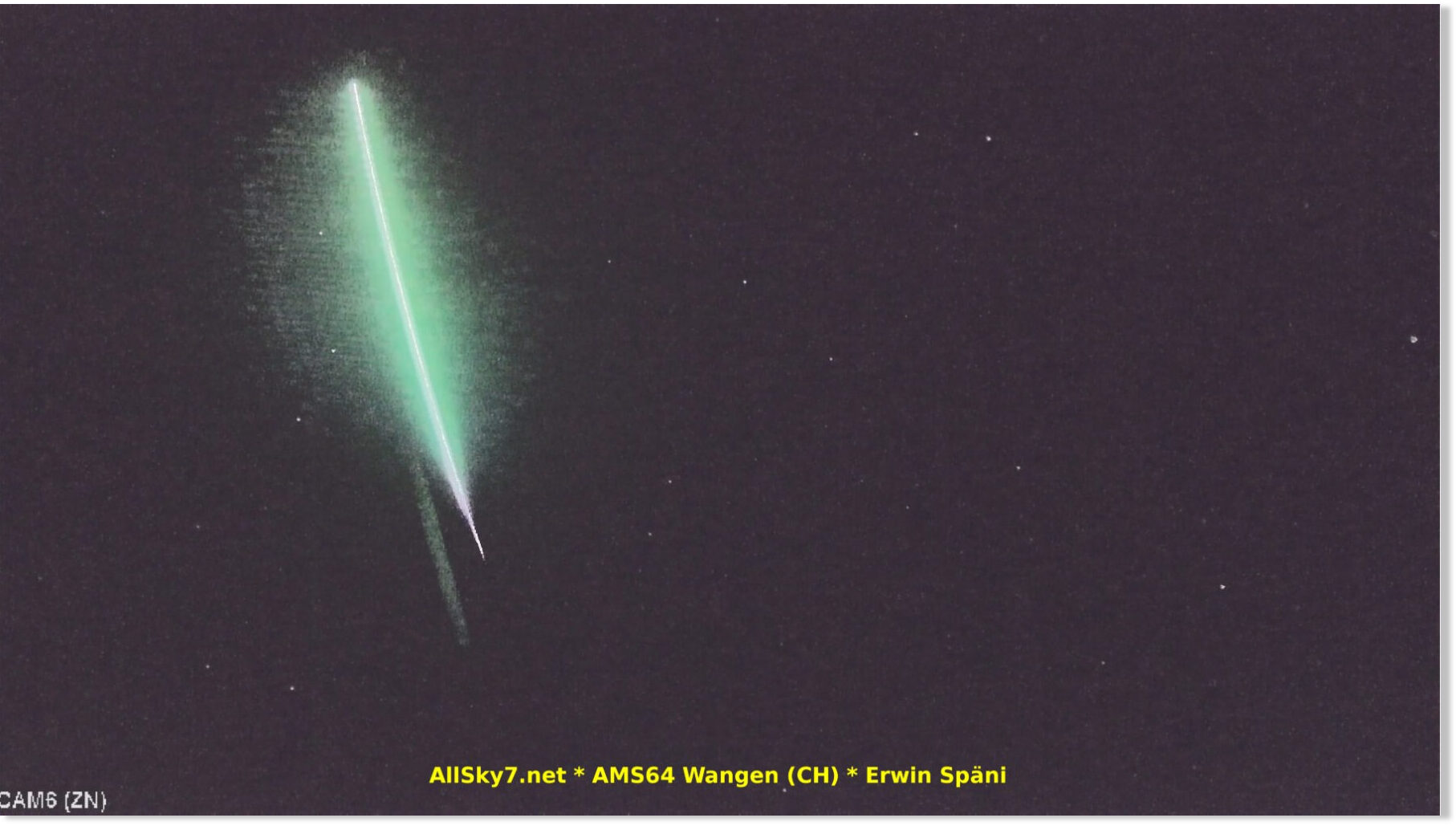
We received 43 reports about a fireball seen over Auvergne-Rhône-Alpes, Baden-Württemberg, Bayern, Berne, Bourgogne-Franche-Comté, Emilia-Romagna, Fribourg, Grand Est, Hessen, Lombardia, Région Wallonne, Rheinland-Pfalz, Saarland, Salzburg, Schwyz, Tirol, Vaud, Veneto and Vlaams Gewest on Saturday, June 11th 2022 around 22:44 UT.
For this event, we received one video and 10 photos.
This bright bolide was spotted over Spain on June 14, at 0:15 local time (equivalent to 22:15 universal time on June 13). The event was generated by a rock (a meteoroid) from an asteroid that hit the atmosphere at about 88,000 km/h. The fireball overflew Spain. It began at an altitude of about 88 km over the province of Valencia, moved northwest, and ended at a height of around 37 km over the locality of Henarejos (province of Cuenca).
This bright meteor was recorded in the framework of the SMART project, operated by the Southwestern Europe Meteor Network (SWEMN) from the meteor-observing stations located at Ayora, Huelva, La Hita, CAHA, OSN, La Sagra, and Sevilla. The event has been analyzed by the principal investigator of the SMART project: Dr. Jose M. Madiedo, from the Institute of Astrophysics of Andalusia (IAA-CSIC).
This bolide was spotted over Spain on June 10, at 2:11 local time (equivalent to 0:11 universal time). The fireball was observed by a number of casual eyewitnesses, who reported it on social networks.
The event was generated by a rock (a meteoroid) from a comet that hit the atmosphere at about 133,000 km/h. The fireball overflew the south of Spain. It began at an altitude of about 103 km over the province of Málaga, moved northwest, and ended at a height of around 64 km over the province of Sevilla.
This bright meteor was recorded in the framework of the SMART project, operated by the Southwestern Europe Meteor Network (SWEMN) from the meteor-observing stations located at Huelva, La Hita, CAHA, OSN, La Sagra, Sevilla, and El Aljarafe. The event has been analyzed by the principal investigator of the SMART project: Dr. Jose M. Madiedo, from the Institute of Astrophysics of Andalusia (IAA-CSIC).
This bolide was spotted over Spain on May 31, at 3:00 local time (equivalent to 1:00 universal time). The event was generated by a rock (a meteoroid) from comet 73P that hit the atmosphere at about 64,000 km/h. The fireball overflew the north of Spain. It began at an altitude of about 98 km over the province of Teruel, moved east, and ended at a height of around 75 km over the same province.
This bright meteor was recorded in the framework of the SMART project, operated by the Southwestern Europe Meteor Network (SWEMN) from the meteor-observing stations located at Calar Alto, Sierra Nevada, La Sagra (Granada), Ayora (Valencia), and La Hita (Toledo). The event has been analyzed by the principal investigator of the SMART project: Dr. Jose M. Madiedo, from the Institute of Astrophysics of Andalusia (IAA-CSIC).
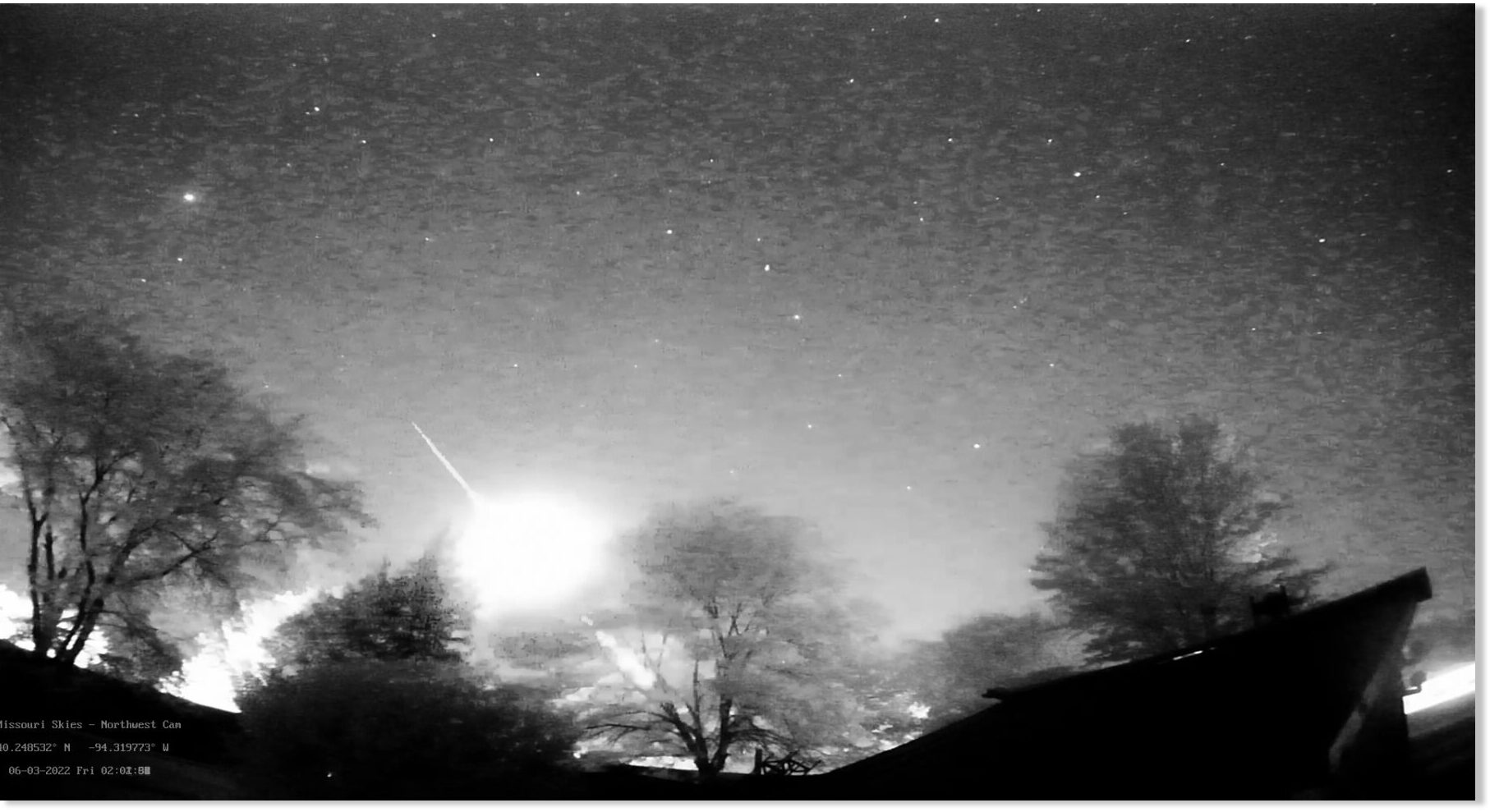
It even lit up the clouds...so resplendent was a remarkable bolide (bright meteor) that was seen around 11:45 p.m. on Saturday May 28 from various areas of Puerto Rico.
The Caribbean Astronomy Society (SAC) captured images of the fast meteor and explained that both the witnesses who observed it, as well as one of the SAC's color cameras.
They perceived that the meteor showed a somewhat greenish color, which suggests it was a space rock with metallic content.
The bright meteor was visible looking north and its trajectory moved even further towards the north of the Island, so the possibility that some fragment reached the mainland, since from somewhere to have survived the fragmentation, it must have occurred over the Atlantic Ocean.
This bolide was spotted over Spain on May 28, at 3:19 local time (equivalent to 1:19 universal time). The fireball was observed by casual eyewitnesses, who reported it on social networks.
The event was generated by a rock (a meteoroid) from a comet that hit the atmosphere at about 56,000 km/h. The fireball overflew the south of Spain. It began at an altitude of about 93 km over the province of Jaén, moved southeast, and ended at a height of around 59 km over the province of Almería.
This bright meteor was recorded in the framework of the SMART project, operated by the Southwestern Europe Meteor Network (SWEMN) from the meteor-observing stations located at Calar Alto, Sierra Nevada, Sevilla, La Sagra (Granada), Huelva, El Aljarafe, and La Hita (Toledo). The event has been analyzed by the principal investigator of the SMART project: Dr. Jose M. Madiedo, from the Institute of Astrophysics of Andalusia (IAA-CSIC).