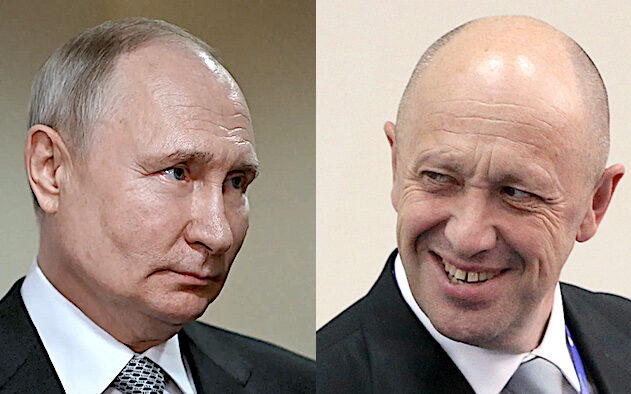
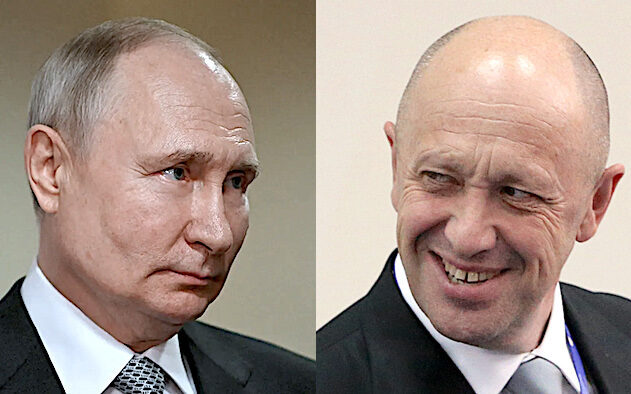
© Alexander Kazakov/Sputnik/Kremlin Pool/AP/Time.comRussian President Vladimir Putin • Ex-Wagner chief Yevgeny Prigozhin
There is much confusion and scratching of the head surrounding Russian President Vladimir Putin's seeming 'weakness', laxity, or permissiveness in hesitating to arrest two-day mutineer and Wagner PMC chief Yevgenii Prigozhin. Recent reports from Russia indicate that Prigozhin has been back in Russia, despite his supposed exile to Belarus along with some 10,000 Wagner fighters. Initially, in the wake of the mutiny's dissolution Russian President Vladimir Putin's spokesman stated to Russian journalists that Prigozhin was to go to Belarus as part of the deal hashed out between Putin and his former associate by Belarusian President Aleksandr Lukashenka. Reports and photographs of a camp or base being erected for the exiled or redeployed Wagner troops in Belarus were published. But now it emerges that Prigozhin and 35 Wagner commanders and staff met with Putin in the Kremlin on June 29th and discussed what had happened and what the future would be for Wagner and perhaps for Prigozhin himself. In the meeting, Putin stressed both legal issues as well as the mutiny's violation of an 'agreement' between himself and Prigozhin.
[1]Some propose that this boils down to some sort of softness in Putin's personality, at least towards long-time friends and associates. Others conjecture that this is evidence of Putin's political weakness, declining power, and failing control over his system, the so-called 'Sistema'.
There are at least three other important factors besides more situational ones such as political, military, and business considerations that help explain why Prigozhin and his co-conspirators have not been arrested. As a preface it must be said that we make a mistake if we expect Russian political actors to behave as, say, American, other Western, or even many non-Western politicians might.
Russia is a different country than ours, not really significantly better or worse than ours. That said, the three non-situational factors facilitating impunity that I would like to suggest are: (1) the relatively soft form of the Putin system's authoritarianism; (2) a tendency towards 'arbitrary' rule and limited emphasis on following the letter of the law, and (3) a cultural preference for unity or wholeness rather than disunity, pluralism, and conflict.















Comment: Heaven forbid kids learn the basics of practical skills.