
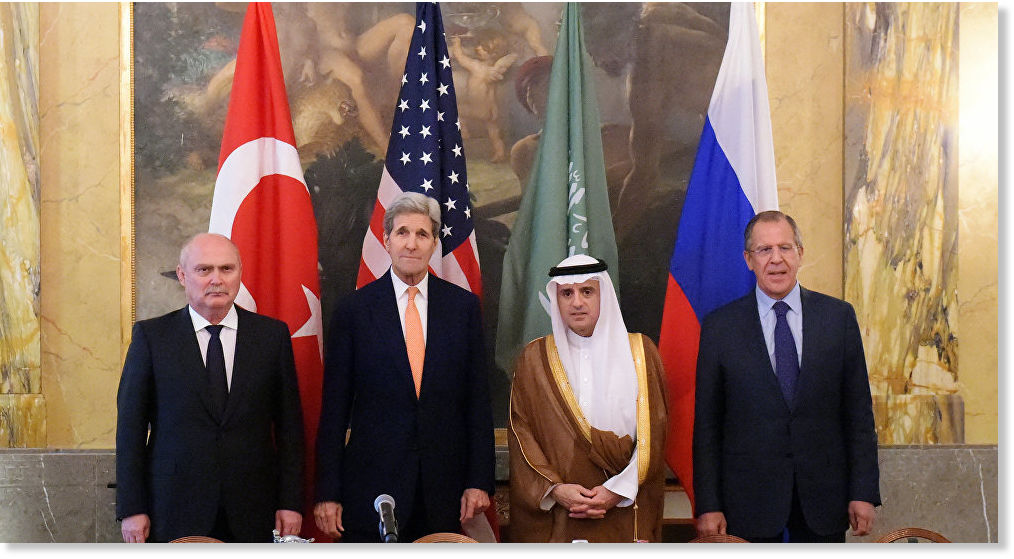
© Ministry of Foreign Affairs of the Russian Federation
No; it's 2015 and a Caliph simulacrum - Ibrahim, a.k.a. Abu Bakr al-Baghdadi — has prompted a gaggle of world powers, lesser powers and assorted minions to converge to Vienna to discuss how to defeat him.
Westphalians, we got a problem. None of this makes any sense if Iran is not at the table discussing a solution for the Syrian tragedy. Moscow knew it from the start. Washington — reluctantly — had to admit the obvious. But the problem was never Iran. The problem is the ideological matrix of goons who metastasize into Caliphs: Saudi Arabia.
Back — inevitably — to surrealism. Saudi Foreign Minister Adel al-Jubeir stated, "The view of our partners ... was that we should test the intentions of the Iranians and the Russians in arriving at a political solution in Syria, which we all prefer."
Translation: "Our partners" means "His Masters' Voice," Washington; and the beheading-addicted oil hacienda does not "prefer" a political solution; they want regime change and a House of Saud satrapy.












Comment: Numbers on a page. Account ability and accountability...two very different things. The last raised debt ceiling fight/deal was in February 2014 and cost the taxpayers $24B in shut-down expenses.