
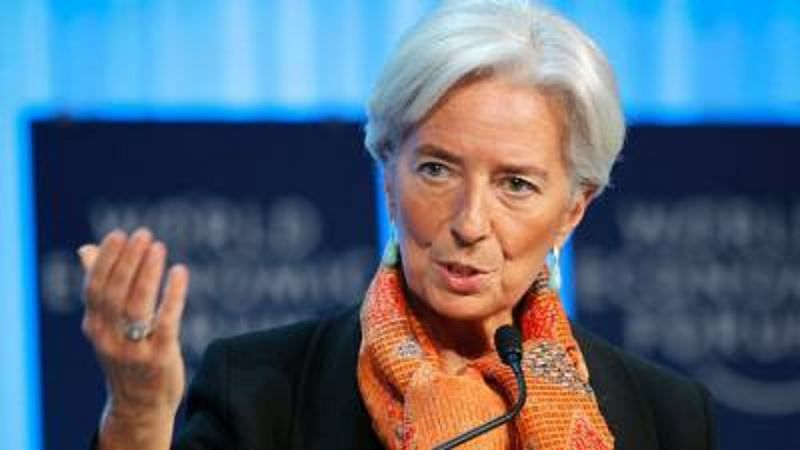
IMF Chief Christine Lagarde - Making up the rules as it suits her
Back in April I discussed for Russia Insider some of the legal arguments that have been made concerning the $3 billion debt Ukraine owes Russia, which is due to be repaid in December.
I said that Ukraine's argument that the debt was a "private" as opposed to a "public" debt looked in legal terms a hopeless one.
The point was that if Ukraine defaulted on a "public" debt, then according to its current rules the IMF cannot proceed with its bailout programme.
Ukraine has now made it utterly clear that it will default on the debt.
A cheeky suggestion from Putin - echoing a suggest that I made in my April article - that the IMF increase its lending by $3 billion so that Ukraine could pay the debt, has gone unheeded.
Instead, caught between the legal reality that the debt is a "public debt" and the political imperative to support Ukraine, it seems - according to comments by Russian Finance Minister Anton Siluanov and an article in the Wall Street Journal - that the IMF is going to change its rules so that it can go on supporting Ukraine even if it defaults on the debt.
As the Russians correctly say, this is a major precedent that will undermine further the IMF's credibility at a time when it is being increasingly challenged by the new financial institutions that China is setting up.
It seems a very big price to pay when the cost of avoiding having to make such a precedent is just $3 billion.
What that shows is how unwilling Western governments are to back Ukraine with money - even if doing so avoids putting them in a position where the IMF's credibility is being put at risk - exposing it as nothing more than an instrument of Western foreign policy.
There will now be a court case in London, which the Russians are certain to win - there being no defence to it.
How the Russians will enforce the Judgment they will obtain - and whether the IMF will become a third party in the case - remains to be seen.












Comment: As Mr. Mercouris points out, this course of action does no favors to the IMF's credibility, a point they must surely be aware of. So what could be the motivation causing the IMF to damage itself, just as the EU imposed sanctions on Russia that had serious economic blowback for European businesses?