"What happened here was the gradual habituation of the people, little by little, to being governed by surprise; to receiving decisions deliberated in secret; to believing that the situation was so complicated that the government had to act on information which the people could not understand, or so dangerous that, even if the people could understand it, it could not be released because of national security... This separation of government from people, this widening of the gap, took place so gradually and so insensibly, each step disguised (perhaps not even intentionally) as a temporary emergency measure or associated with true patriotic allegiance or with real social purposes. And all the crises and reforms (real reforms, too) so occupied the people that they did not see the slow motion underneath, of the whole process of government growing remoter and remoter."—Historian Milton Mayer, They Thought They Were Free: The Germans, 1933-45
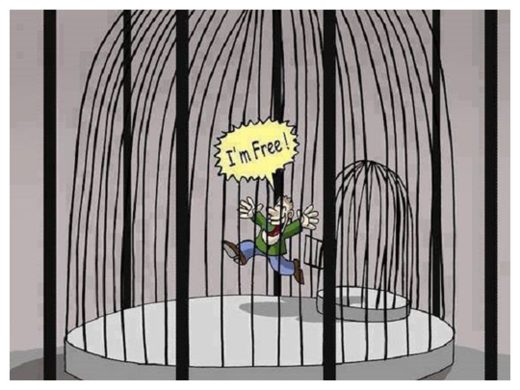
© A Government of Wolves
Brace yourself.
There is something being concocted in the dens of power, far beyond the public eye, and it doesn't bode well for the future of this country.Anytime you have an entire nation so mesmerized by the antics of the political ruling class that they are oblivious to all else, you'd better beware. Anytime you have a government that operates in the shadows, speaks in a language of force, and rules by fiat, you'd better beware. And anytime you have a government so far removed from its people as to ensure that they are never seen, heard or heeded by those elected to represent them, you'd better beware.
The world has been down this road before.
As historian Milton Mayer recounts in his seminal book on Hitler's rise to power,
They Thought They Were Free, "Most of us did not want to think about fundamental things and never had. There was no need to. Nazism gave us some dreadful, fundamental things to think about—we were decent people‑—and kept us so busy with continuous changes and 'crises' and so fascinated, yes, fascinated, by the machinations of the 'national enemies', without and within, that we had no time to think about these dreadful things that were growing, little by little, all around us."
We are at our most vulnerable right now.
The gravest threat facing us as a nation is not extremism—delivered by way of
sovereign citizens or
radicalized Muslims—
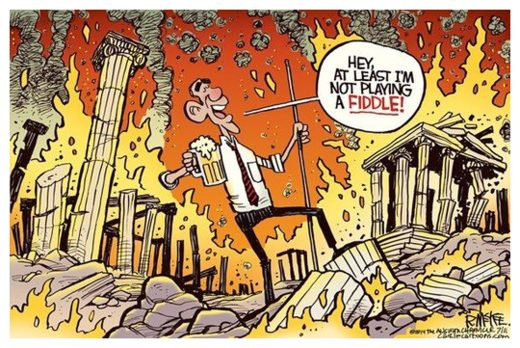
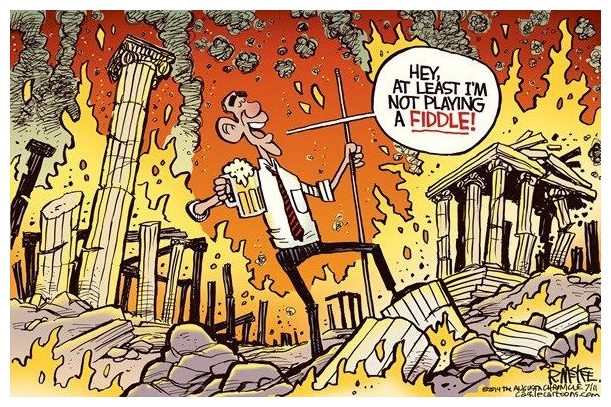
but despotism, exercised by a ruling class whose only allegiance is to power and money.Nero fiddled while
Rome burned.
© A Government of Wolves
America is burning, and all most Americans can do is switch the channel, tune out what they don't want to hear, and tune into their own personal
echo chambers.
We're in a national state of denial.
Yet no amount of escapism can shield us from the harsh reality that the danger in our midst is posed by an entrenched government bureaucracy that has no regard for the Constitution, Congress, the courts or the citizenry.
If the team colors have changed from blue to red, that's just cosmetic.
The playbook remains the same. The leopard has not changed its spots.
Scrape off the surface layers and you will find that the American police state is alive and well and continuing to wreak havoc on the rights of the American people.
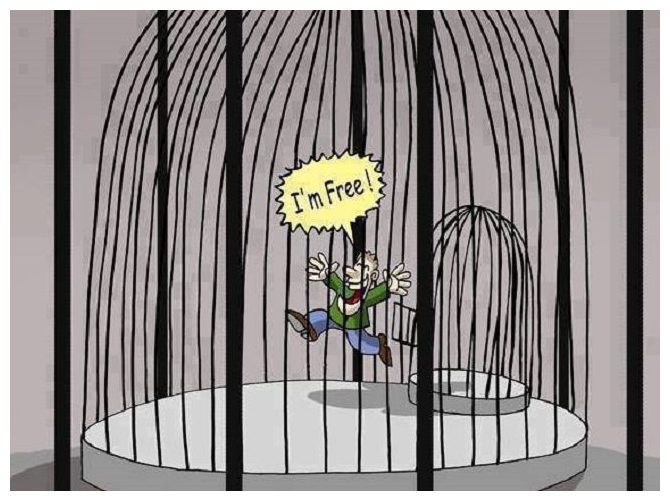
"We the people" are no longer living the American Dream.
We're living the American Lie.













Comment: More on this strange case: