Puppet MastersS


Stock Down

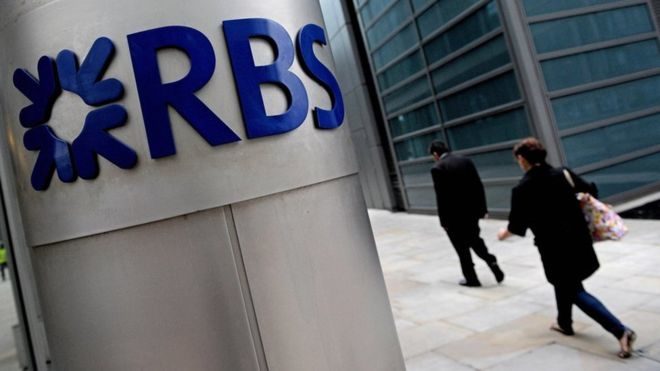
"Biggest banking bailout in the world": UK taxpayer loses £2.1 billion on RBS - After bilking £45 billion

RBS banj
© AFP
The British government sold a 2.5 billion pound ($3.3 billion) stake in Royal Bank of Scotland Group Plc, reducing its majority holding a decade after it bailed out the lender during the financial crisis.

The state sold 7.7 percent in the lender at 271 pence per share to institutional investors, it said in a statement on Tuesday. Shares in the Edinburgh-based bank fell 3.4 percent to 271.40 pence at 8:47 a.m. in London trading.

"I am pleased that the government has decided the time is now right to re-start the share sale process," RBS Chief Executive Officer Ross McEwan in a statement. "This is an important moment for RBS and an important step in returning the bank to private ownership."

The divestment is the first since 2015 and comes after the Edinburgh-based bank reached a preliminary settlement with U.S. authorities over the sale of toxic mortgage bonds, which had been weighing on the firm's valuation. The sale of 925 million shares will reduce the state holding to 62.4 percent from 70.1 percent, according to a statement from the government.

Comment: The legacy of one of the greatest robberies of public wealth in history continues to plague the Western world with analysts predicting another financial crash is imminent:


Cow Skull

James Corbett: Non-governmental organizations or NGOs are the Deep State's geopolitical Trojan horses (VIDEO)

NGOS Deep State
The Trojan horse was the earliest recorded military psyop. That psyop continues to be deployed on unsuspecting populations and it is just as useful as ever, but today's tricksters have donned the mantle of philanthropy, and their Trojan horses are not wooden statues but non-governmental organizations offering "aid" to foreign nations. In today's edition of The Corbett Report, we'll learn about how NGOs are the deep state's Trojan horses.


Chess

SOTT Focus: Trump's Outrageous New Trade Policies - Is There a Method to His Madness?

Donald J. Trump
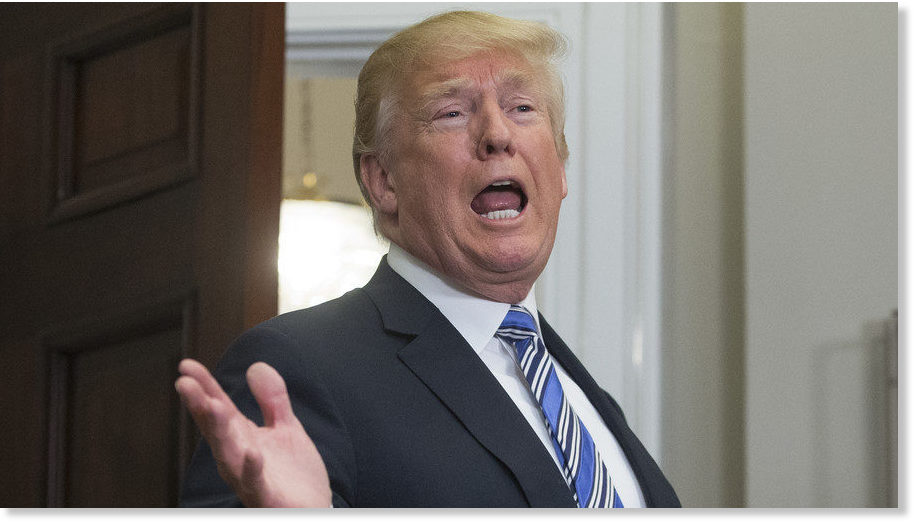
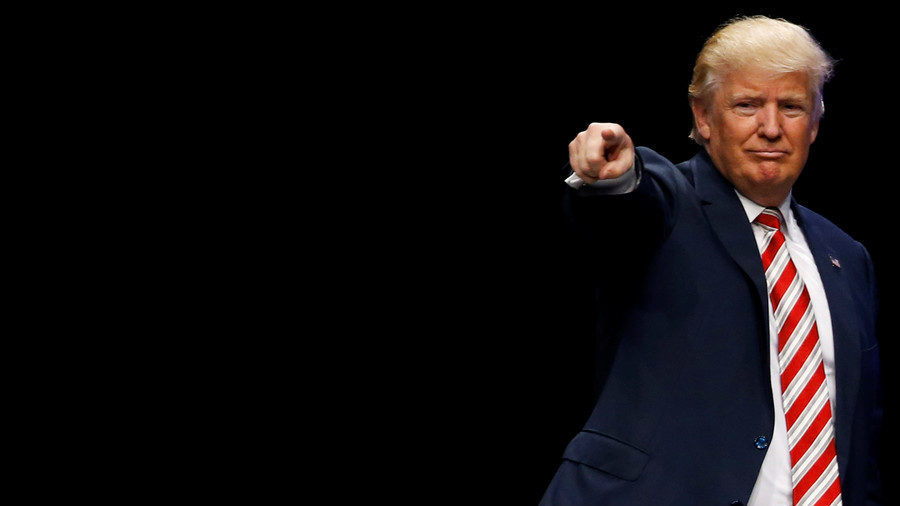
© Michael Reynolds / Global Look PressUS President Donald J. Trump, 08 March 2018.
It would be an understatement to suggest that Trump's decision to slap higher tariffs on practically everybody - has outraged almost everyone: most of the business community, foreign governments, media and experts from all fields.

President Donald Trump, it is said, is unleashing a global trade war, which is already beginning with promised retaliatory measures from our closest trading partners. Trump justified his action by claiming that steel and aluminum are strategic materials essential for national defense. In all likelihood national defense had little to do with his action. Rather, it is a ploy to put a "national security" halo around a measure being taken for economic reasons.

That doesn't mean it's the wrong move, however. It's important to put these measures into the context of long-term US trade policy. US trade policy since World War II could almost have been designed to undermine the economic interests of American workers and American producers. Starting with Germany and Japan, our defeated enemies, we offered them the proverbial deal they can't refuse: they get virtually tariff-free, nonreciprocal access to our huge domestic market to assist with their economies' recovery from wartime destruction; in return, we would take their sovereignty: control of their foreign and security policies, as well as their military and intelligence establishments, plus permanent bases on their territory.

Comment: For an in-depth discussion of the new trade wars, as well as their implications, tune in to this recent Behind the Headlines show:


Light Saber

Over 70 Syrian tribal leaders form coalition to expel illegal US and French forces from Syria

syrian tribal leaders coalition june 2018
The tribal leaders announced the formation of a popular resistance unit that will fight alongside the Syrian Arab Army in a bid to liberate all Syrian lands and all foreign forces in Syria.
The presence of US troops in Syria is escalating tensions between government forces and the Kurdish-dominated Syrian Democratic Forces (SDF), with some politicians and Syrian Army officers accusing the SDF of serving as "puppets" for the US and other western powers.

In excess of 70 Syrian tribal leaders met in the Aleppo Governorate, specifically the city of Deir Hafer, over the weekend to discuss plans and coordinate with one another to remove US forces from Syria, Al-Masdar News reported on Sunday.

Via a joint statement, the tribes, which are predominately Sunni Muslims, announced the formation of a coalition to oust US and French military personnel from Syria, in addition to liberating territory held by the SDF, provided Damascus is unable to negotiate a reconciliation deal with them.

Comment: See also:


Chess

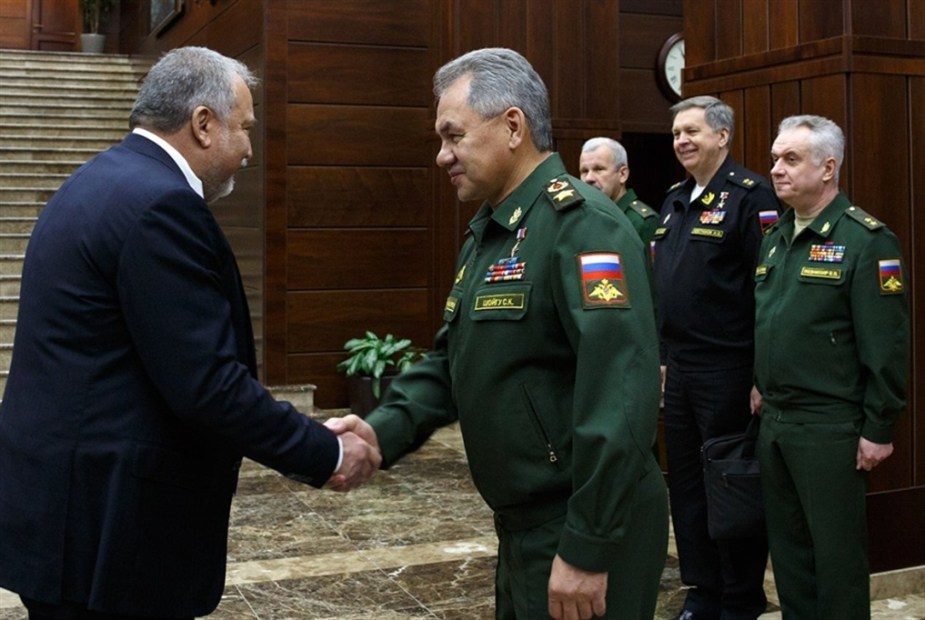
Art of the Deal: No Hezbollah or Iranians in op to liberate S. Syria - but only if US pulls out of al-Tanf

lieberman shoigu
Russia and Damascus (and its allies) have agreed on a plan for the Syrian Army to liberate what remained of the south of Syria- Qunietra and Daraa. The deal will be discussed this week between senior members (Vice Ministers) of the Russian, US and Jordanian establishments where Damascus and Tehran are blessing the Russian effort and negotiation skills. The deal is clear: either the US pulls out of Tanf crossing or else there will be no deal and the Syrian Army will ask for the support of its allies to liberate the south. The Russian ball has been kicked onto the US field and it is now up to Washington. It can either decide to go to war alongside Israel against Damascus's forces in the south, or it can pull out its occupation forces from the Syrian-Iraqi crossing.

The Syrian Army is gathering large forces to liberate the last pocket south of the capital Damascus where ISIS (under the name of Jaish Khaled Bin al-Waleed) and other jihadists and their allies occupy the part of southern of Syria bordering Israel and Jordan. Damascus and Amman are looking forward to seeing the Syrian Army regain the control of the borders and reopen the Naseeb crossing to restore one of the most important sources of income to both countries.

However, Israel is turning to Russia - and not the US - to ask for a guarantee that Iran and Hezbollah won't establish bases on the borders and create a situation where the Syrian borders will be used as a platform to attack Israel in the future.

Russia, Syria and Iran have all agreed on the next step to be taken to liberate the south and for all parties involved to be content. The Israeli demands to see only the Syrian army on its borders won't be met 'for free': there is a price to be paid and the price is the al-Tanf crossing currently occupied by the US forces.


Comment: In other words, if the U.S. wants Israel to be happy, it will have to abandon al-Tanf. And when was the last time the U.S. did anything to make Israel unhappy?


Eye 1

US mulls over whether it will help Saudi regime capture Yemen's port which is lifeline for 80% of people in need of aid

Hodeidah
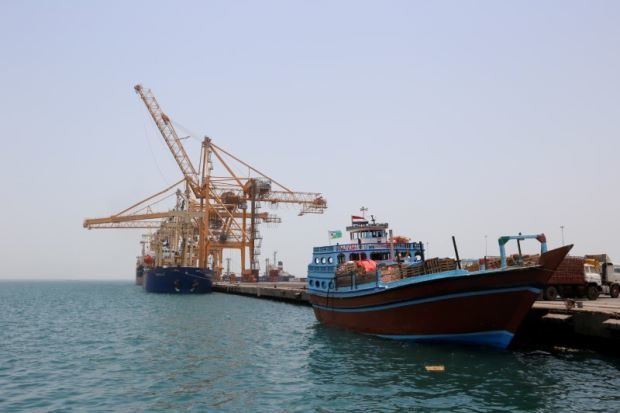
© Abduljabbar Zeyad / ReutersRed Sea port of Hodeidah
The Saudi-led coalition is reportedly seeking direct US support to recapture the port city of Hodeidah in Yemen. The battle for the humanitarian lifeline would spell disaster for the locals, human rights agencies warn.

For nearly a week, the Saudi-led coalition forces have been preparing to launch a large-scale offensive on Hodeidah, the fourth-largest city in Yemen, with a population of 400,000 people, in an effort to recapture the city's port which currently serves as one of the remaining humanitarian lifelines in the war-stricken country. However, before cutting what they call the "vein that the Houthis are benefiting from," the coalition decided to seek US support, the Wall Street Journal (WSJ) reported on Sunday.

Comment: Judging by the actions of the US elsewhere, it's probably only a matter of time before they come to the aid of the sadistic Saudi regime:


Clipboard

Head of IAEA confirms accesses to all needed nuclear sites in Iran

Yukiya Amano IAEA
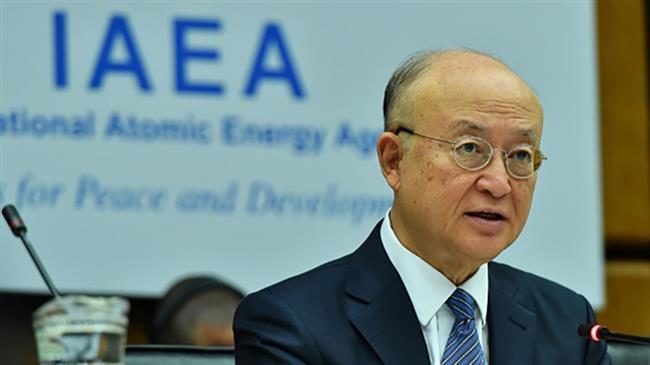
© iaea.orgIAEA Director General Yukiya Amano delivers his introductory statement to the Board of Governors' meeting in Vienna on June 4, 2018.
The head of the International Atomic Energy Agency (IAEA) has reaffirmed the agency's accesses to all the required nuclear sites in Iran, calling on Tehran to ensure "timely and proactive cooperation" with inspections under a 2015 nuclear agreement with world powers.

The IAEA Director General Yukiya Amano made the remarks in Vienna on Monday while speaking at the first meeting of the agency's Board of Governors since US President Donald Trump's move to withdraw from the landmark nuclear deal, officially known as the Joint Comprehensive Plan of Action (JCPOA).
"As stated in my latest report to the Board [of Governors], the agency has conducted complementary accesses under the Additional Protocol to all the sites and locations in Iran which we needed to visit," Amano said in his introductory statement to the Board of Governors.
"Timely and proactive cooperation by Iran in providing such access would facilitate implementation of the Additional Protocol and enhance confidence," he added.

In a speech to a quarterly meeting of the agency's Board of Governors in Vienna in March, Amano once again confirmed Iran's compliance with the 2015 nuclear agreement, warning that any collapse of the deal would be a "great loss."

Comment: See also:


Light Sabers

Turkish FM meets with Pompeo over US support of Kurdish rebels

Pompeo Cavusoglu Turkey US meeting
© Leah Millis / ReutersUS Secretary of State Mike Pompeo and Turkish Foreign Minister Mevlut Cavusoglu in Washington, DC, on June 4, 2018.
Turkey's foreign minister met with US Secretary of State Mike Pompeo in Washington, amid growing tensions between the two nations on issues ranging from the US embassy in Jerusalem to Ankara's purchase of Russian arms.

Cavusoglu described his meeting with Pompeo as "very successful," with Turkish media even reporting that Ankara believed progress had been made towards reaching an agreement over the disputed status of Syria's Kurdish militias.

Mevlut Cavusoglu arrived in Washington on Sunday for a two-day working visit - and there was plenty of work to be done. The foreign minister warned on Saturday that Turkey's relationship with the United States had reached a critical juncture.

Chess

US about to slap disobedient European firms with sanctions over Nord Stream 2 project

US President Donald Trump
© Jonathan Ernst / Reuters
The White House is on the verge of introducing penalties against companies engaged in the construction of the Nord Stream 2 gas pipeline, which will deliver Russian natural gas to the EU across the Baltic Sea.

The US government is planning to sanction European corporations that joined the pipeline project, which is led by Russian state-owned energy giant Gazprom, three sources close to the issue told Foreign Policy news magazine. Apart from Gazprom, the project is being undertaken by German energy firms Wintershall and Uniper, French multinational Engie, British-Dutch oil and gas giant Royal Dutch Shell, and Austrian energy company OMV.

"They will stop at nothing to block Nord Stream," one of the sources told the media, referring to key figures in the current White House administration.

Comment: See also:


Yoda

Putin signs law applying counter-sanctions to US and its vassal states

Putin
© Mikhael Klimentyev / Sputnik
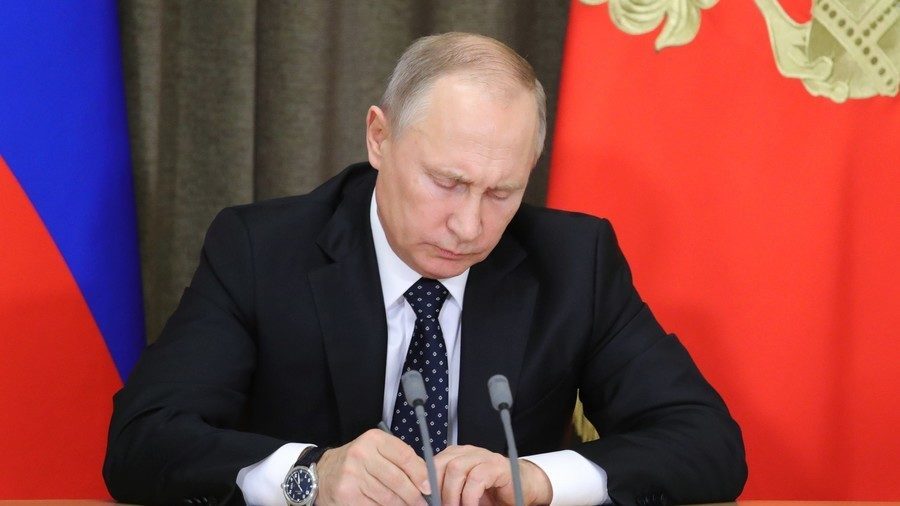
Russian President Vladimir Putin has signed a law stipulating implementation of counter-sanctions against the US and its allies.

The legislation is to be applied to any state or person for "hostile actions" against Russia. It allows Russian authorities to cut international cooperation with foreign states, and to impose import and export restrictions among other countermeasures. Trade embargos will not extended to certain goods, however, that are imported by Russian citizens for personal use.

Contrary to public fears, the countersanctions do not apply to imported essential items, for which no replacements are produced in Russia or other countries.