
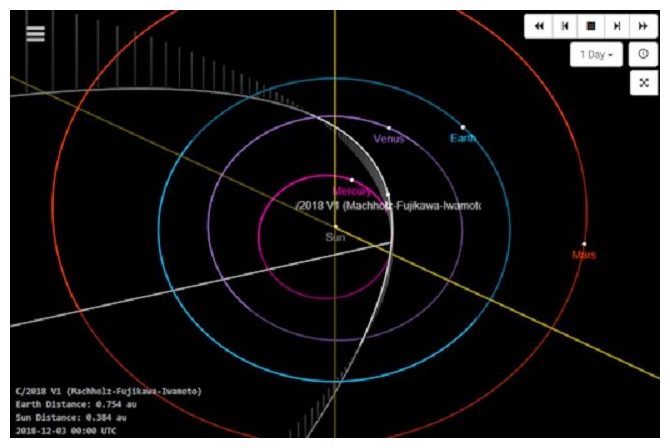
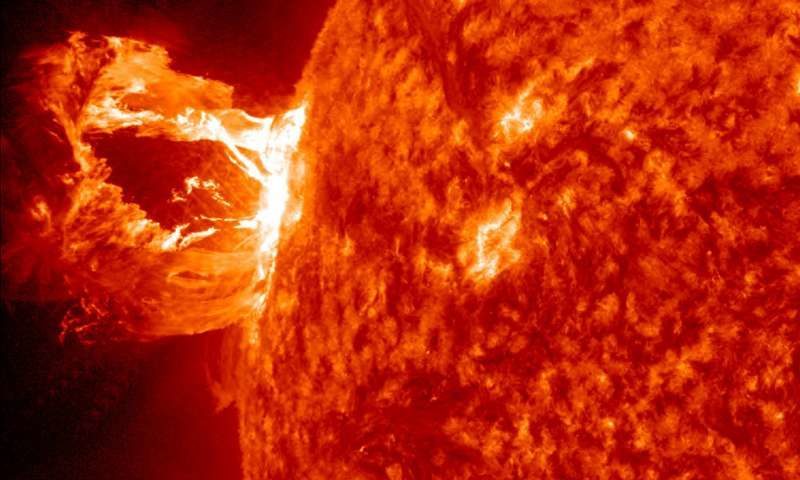
© NASA
The new comet has been designated C/2018 V1 (Machholz-Fujikawa-Iwamoto).
- D. Machholz reported his VISUAL DISCOVERY on Nov. 7.531 UT with a 0.47-m reflector (113x). He also observed the comet with similar appearance on Nov. 8.533
- Shigehisa Fujikawa found the object (with no description provided) on Nov. 7.82 UT on a CCD image obtained with a 120-mm-f.l. f/3.5 lens. His discovery was reported to the Central Bureau's TOCP webpage, which produced the provisional designation TCP J12192806-0211143.
- Masayuki Iwamoto discovered the new object on images obtained on Nov. 7.841 with a 10-cm f/4.0 Pentax SDUF II telephoto lens and a Canon EOS 6D camera; Iwamoto called it a possible comet of mag 10 with approximate position R.A. = 12h19m30s, Decl. = -2d11' (equinox 2000.0) and his observations was reported on TCP J12192806-0211143 TOCP webpage. He added that he also observed it one minute later and detected no movement.
Prompted by the Iwamoto's remark in the TOCP webpage about the possible cometary nature of this transient I decided to perform follow-up measurements of this object. The telescope I chose was T14 astrograph in New Mexico due to its wide field FOV (155.8 x 233.7 arc-mins). In fact as only 1 astrometric position was available at that time and my observation was scheduled 16 hours after it was taken, in case of a comet it was important to have as much field as possible around that only reported astrometry point.
As it happens, it was a comet and I found it about 51 arcmin from the reported astrometry available (60 arcmin is 1 degree). Single unfiltered 60 second exposure, obtained remotely on 2018, November 08.5 from H06 (iTelescope network) through a 0.10-m f/5 reflector + CCD, shows that this object is a comet with a diffuse coma about 2 arcmin in diameter.















Comment: Thinking about the more philosophical implications of this finding, one inevitably comes to the question of why: Why would the body evolve to pass stress information on to offspring. From an evolutionary perspective, it makes sense that this kind of information would be beneficial for the offspring to have as a means of predicting what types, or at the very least how much, the child is likely going to experience over the course of its life. Whether the mechanism is beneficial, or perhaps a leftover mismatch to our modern environment which ends up being a detriment, remains to be seen.
See also: