Science & TechnologyS


Sun

What will the Sun look like when it dies?

Image
© NASA/ESA/HEIC/Hubble Heritage/STScI/AURASun-like stars end their lives as shimmering planetary nebula, such as the Cat's Eye Nebula.
Planetary nebulae are the final butterfly-like state that heralds the end of a Sun-like star's energy-generating life. They form when stars up to eight times the mass of the Sun begin to die, bloating into red giants before shedding as much as half their mass as gas and dust nebulae.

The Sun itself will begin its death throes in about 5 billion years, when it starts to swell into a red giant star. Though it's not clear exactly what its planetary nebula will look like - its shape will likely be sculpted by factors such as the Sun's future magnetic field - observations of the 1600 or so known planetary nebulae suggest our star will go out in a blaze of glory.

Info

Physicists finally create 'textbook' atom

Image
© NASA/WMAP Science TeamThe technique to create the textbook atom was inspired by Lagrange points (pictured) - regions of space where gravity from different sources cancels out.
Think of an atom, and chances are you'll picture something that looks like a tiny solar system. You'd be wrong, but never fear: researchers have engineered an atom that looks just like you think it should.

When the atomic nucleus was discovered a century ago, the solar system analogy was obvious. The nucleus's mass and charge would force electrons to circle it, just as the sun's gravity holds orbiting planets. But quantum mechanics pooped the party, maintaining that electrons would smear out over large areas of space.

Now Tom Gallagher's team at the University of Virginia in Charlottesville have trapped electrons and made them parade around a nucleus. Their inspiration came from Lagrange points - regions of space where gravity from different sources cancels out. They achieved a similar effect with an electron by using microwaves to counteract the force of the nucleus. This created an electron pocket like a Lagrange point, which they guided around the nucleus by rotating the microwave source (Physical Review Letters, vol 102, p 103001).

Laptop

Internet Could Become Environmental Watchdog

Oslo - The Internet could provide an early warning system for environmental damage, imitating an online watchdog that gives alerts about outbreaks of disease, scientists said on Thursday.

An automated trawl of blogs, videos, online news and other sources could yield bits of information to fill in a bigger picture of problems such as global warming, pollution, deforestation or over-fishing, they said.

Chalkboard

Navy scientist announces possible cold fusion reactions

A U.S. Navy researcher announced today that her lab has produced "significant" new results that indicate cold fusion-like reactions.

If the work by analytical chemist Pamela Mosier-Boss and her colleagues is confirmed, it could open the door to a cheap, near-limitless reservoir of energy.

That's a big if, however.

Today's announcement at the national meeting of the American Chemical Society comes in the same location - Salt Lake City - as one of science's most infamous episodes, the announcement 20 years ago by chemists Stanley Pons and Martin Fleischmann that they had produced cold fusion.

Chalkboard

Study: brain switches off rationality when given 'expert advice'

Image
© Mark Henderson, Science Editor
Financial advice can make us take leave of our senses, according to research that shows how the brain sets aside rationality when it gets the benefit of supposedly expert opinion.

When a bank manager or investment adviser recommends a financial decision, the brain tends to abdicate responsibility and defer to their authority with little independent thought, a study has suggested.

Such expert advice suppresses activity in a neural circuit that is critical to sound decision-making and value judgments, scientists in the US have found.

Their results may explain why people are so apt to follow experts' recommendations blindly, when a little reflection might be sufficient to suggest an alternative course of action.

People are likely to be especially susceptible to uncritical trust of experts in times of economic uncertainty, such as during the current recession, the scientists said.

Blackbox

The human brain is on the edge of chaos

Cambridge-based researchers provide new evidence that the human brain lives "on the edge of chaos", at a critical transition point between randomness and order. The study, published March 20 in the open-access journal PLoS Computational Biology, provides experimental data on an idea previously fraught with theoretical speculation.

Self-organized criticality (where systems spontaneously organize themselves to operate at a critical point between order and randomness), can emerge from complex interactions in many different physical systems, including avalanches, forest fires, earthquakes, and heartbeat rhythms.

According to this study, conducted by a team from the University of Cambridge, the Medical Research Council Cognition & Brain Sciences Unit, and the GlaxoSmithKline Clinical Unit Cambridge, the dynamics of human brain networks have something important in common with some superficially very different systems in nature. Computational networks showing these characteristics have also been shown to have optimal memory (data storage) and information-processing capacity. In particular, critical systems are able to respond very rapidly and extensively to minor changes in their inputs.

"Due to these characteristics, self-organized criticality is intuitively attractive as a model for brain functions such as perception and action, because it would allow us to switch quickly between mental states in order to respond to changing environmental conditions," says co-author Manfred Kitzbichler.

Info

Sagas reveal Vikings were 'first oceanographers'

Image
© Bridgeman Art Library/GettyNorse pioneers chose where to settle by following signs from the god Thor, but the practice was based on sound science too.

When Hallstein son of Thorolf Mostbeard found a suitable homestead on Iceland, he sacrificed to Thor, imploring the god to provide the ceremonial high seat posts he needed to complete his great hall. Evidently Thor heard: a mighty log washed ashore, big enough to supply seat posts for all the settlers round about. Years earlier, when Hallstein's father and other Norse pioneers sailed for Iceland, they had found themselves in the opposite fix. They had brought seat posts from home but needed a good place to settle. As they approached Iceland, they tossed their precious posts overboard and followed them to the places Thor supposedly chose for them. But the two prayers had something in common: the same sound ocean science underlay them both.

Old Kveldulf knew it was time to get out of Norway. He had pushed his luck by refusing to swear allegiance to Harald Tanglehair - a king not to be trifled with. When the king slew his son Thorolf, Kveldulf went berserk. He and his surviving son Skallagrim ambushed two of the king's emissaries, killing them and 50 companions, and fled to sea.

Sherlock

Scientists Discover a Hidden "Memory" Switch in Our Brains

Mind
© Unknown
If you've ever been educated, and the fact that you're reading this means that you either have or are extremely good at guessing, you've tried to find a way to enhance your memory. Reading things ten times, flash cards, enough coffee to accelerate an elephant to eighty-eight miles an hour - and none of them work. Now scientists may have found an all-purpose "memory on" switch hiding in your head.

A team of German an UK researchers have applied magnetoencephalographic techniques to look inside the very living brain of dozens of people, and if that fact doesn't impress you chalk one up to "humans can get used to anything." These people have machines that can scan your mind and draw maps! Sure, those maps are like urban planners trying to document a computer chip, not really sure of which does what or how to represent it, but we can still see some general functions from all the data acquired.

Saturn

New Technology to Speed Search for Earth's Twin

The Kepler is a one-ton satellite set to be blasted into orbit around the Sun, far away from all the distracting background noise of Earth - in any aspect of the search for intelligent life, it's important to be as far from American Idol as possible. The probe will make over six billion stellar measurements in order to detect any Earth-alikes hiding in the stars.

At the moment our main method of planet-detection is the "wobble method", which sounds awfully unscientific for an interplanetary investigation. It's based on observing how much the planet pulls its host star - the problem being that stars are very big, while planets are pretty small, so we've only found unusually huge and close-in planets this way. Planets which couldn't possibly support life as we know it.

Frog

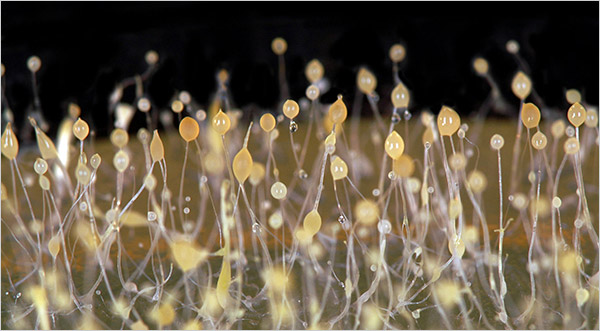
Oozing Through Texas Soil, a Team of Amoebas Billions Strong

organized amoebas
© Owen Gilbert/Rice UniversityAs One - A field of genetically identical amoebas in Texas raises the possibility that cells might organize on much larger scales than once thought.
After producing superlatives like the world's biggest statue of a jackrabbit and the nation's most unpopular modern-day president, Texas can now boast what may be its most bizarre and undoubtedly its slimiest topper yet: the world's largest known colony of clonal amoebas.

Scientists found the vast and sticky empire stretching 40 feet across, consisting of billions of genetically identical single-celled individuals, oozing along in the muck of a cow pasture outside Houston.

"It was very unexpected," said Owen M. Gilbert, a graduate student at Rice University and lead author of the report in the March issue of Molecular Ecology. "It was like nothing we'd ever seen before."

Scientists say the discovery is much more than a mere curiosity, because the colony consists of what are known as social amoebas. Only an apparent oxymoron, social amoebas are able to gather in organized groups and behave cooperatively, some even committing suicide to help fellow amoebas reproduce. The discovery of such a huge colony of genetically identical amoebas provides insight into how such cooperation and sociality might have evolved and may help to explain why microbes are being found to show social behaviors more often than was expected.