Science & TechnologyS


Hourglass

Archaeologist: Oldest Cyprus temple discovered

An Italian archaeologist claimed Friday to have discovered Cyprus' oldest religious site, which she said echoes descriptions in the Bible of temples in ancient Palestine.

Maria Rosaria Belgiorno said the 4,000-year-old triangular temple predates any other found on the east Mediterranean island by a millennium.

"For sure it's the most ancient religious site on the island," she told The Associated Press from her home in Rome. "This confirms that religious worship in Cyprus began much earlier than previously believed."

But authorities on the island say they cannot confirm her claim before further study.

"That the site is dated to around 2,000 B.C. is certain, but the interpretation that it's a temple or a sacred site has yet to be confirmed," Cyprus Antiquities Department official Maria Hadjicosti told state radio.

Telescope

Zooming in on Mars in glorious 3D

3d mars
© NASA/JPL/University of ArizonaDark, crescent-shaped dunes in a crater called Herschel show that the wind there blows mainly from north to south.
Get out your 3D spectacles! Hundreds of new red-cyan anaglyph images of Mars were recently released by the HiRISE camera on NASA's Mars Reconnaissance Orbiter (MRO). Although other Mars missions have taken 3D images, HiRISE is the most powerful camera to ever orbit another planet. It resolves features as small as 1 metre across - roughly the scale of a person.

Telescope

What to see in the sky this week

Image
© Sky and TelescopeWatch the crescent Moon passing the Pleiades and Hyades at nightfall. This scene is drawn for the middle of North America. European observers: move each Moon symbol a quarter of the way toward the one for the previous date. The blue 10° scale is about the size of your fist held at arm's length.
Some daily events in the changing sky for March 27 - April 4.

Friday, March 27

Venus is at inferior conjunction (between Earth and the Sun), passing 8° north of the Sun. See this article.

Saturday, March 28

As twilight gives way to night, look to the right of the crescent Moon in the west for the stars of little Aries (just outside the frame in this illustration). Higher to the Moon's upper left is the Pleiades star cluster.

Sunday, March 29

In late dusk, the Pleiades are about 7° above the crescent Moon (seen at the time of dusk for North America), as shown at right.

Monday, March 30

This evening the Pleiades are about 7° below the Moon.

Better Earth

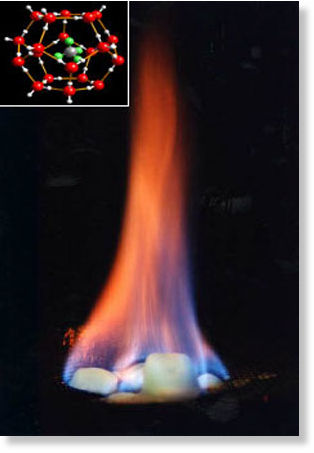
Ice that burns could be a green fossil fuel

Image
© USGS"Ice that burns" could provide enormous amounts of energy, but can it be made environmentally friendly?
Natural gas locked up in water crystals could be a source of enormous amounts of energy - and if a new technology delivers what scientists are claiming, then it could even be emissions-free too.

To the naked eye, clathrate hydrate looks like regular ice. However, while it is made up partly of water, the water molecules are organised into "cages", which trap individual molecules of methane inside them.

Compared to other fossil fuels, methane - also known as natural gas - releases less carbon dioxide per unit of energy generated. Nevertheless, burning it still releases carbon dioxide and thus drives climate change.

However, according to research presented this week at the national meeting of the American Chemical Society, a new method of extracting the methane could effectively make it a carbon-neutral fossil fuel.

Sherlock

Genetic Code Mashups to Create New Species

Image
Scientists have found that DNA can be randomly rearranged because of odd repeating structures that have been noticed in the genetic code of higher animals. Unfortunately this is one of those things that's good for the species as a whole (because of diversification) but extremely bad for the individuals (because of cancer, cancer and more cancer).
Researchers smashed up the DNA of yeast cells using high energy X-Rays. How a team dedicated to creating mutant super-bread obtains funding is not made clear, but observation of the irradiated cells yielded interesting results: as the nuked microorganisms quite literally tried to pull themselves together, they didn't put things back the way they were.

The repeated sections of DNA can cause broken pieces to be mixed and matched between entirely new chromosomes. This method of mutation is quite extreme, but such aberrations can happen without nuclear blasting (it just takes longer) and form part of the all-important biological diversification process. You know, the reason we aren't all just a layer of single-celled sludge.

Meteor

Asteroid tracked from space to Earth

Image
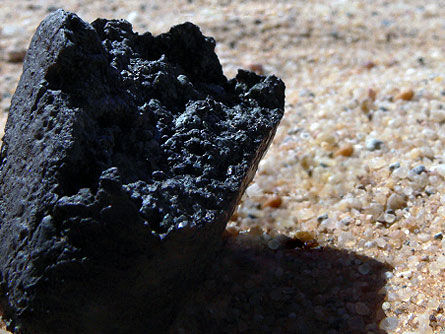
© NatureA meteorite from an unusually well-tracked asteroid lies in the Nubian Desert in northern Sudan. The deep black color tells researchers that the rock is rich in carbon.
They saw it coming, and they got what was coming to them. For the first time, researchers not only detected an asteroid in space, but also tracked its progress and then collected its debris after it crashed to Earth.

The car-sized asteroid, dubbed 2008 TC3, landed in northern Sudan on October 7, 2008, scientists report in the March 25 Nature. The study combines for one asteroid data that are usually separate: Comparing data from observations of the asteroid in while it was space with analysis of its meteorite fragments on Earth will yield new insights into asteroids, the scientists say.

Meteor

Meteorite hunters 'strike gold' in Sudan

Image
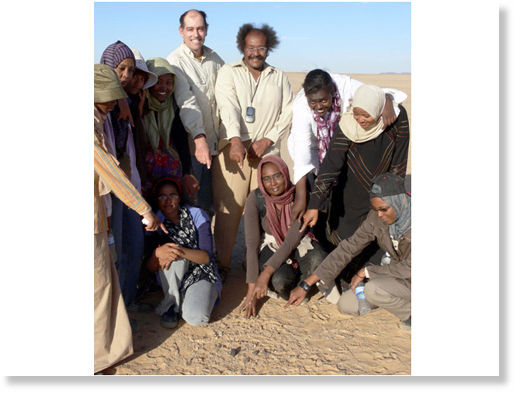
© P Jenniskens/SETI Institute/NASAPeter Jenniskens of NASA's Ames Research Center and Muawia Shaddad of the University of Khartoum (standing, centre) and volunteers combed the Nubian Desert in the Sudan to find remnants of asteroid 2008 TC3. This meteorite was found 8 December 2008 during the first of three search campaigns.
Last October, astronomers found the first asteroid on a certain collision course with Earth, observing the 4-metre-long rock as it hurtled towards the planet and then exploded in the sky some 37 kilometres above the Nubian Desert in Sudan.

At the time it was unclear whether the blast would leave anything but dust behind, but a team of scientists and volunteers has managed to recover fragments of the 80-tonne asteroid, called 2008 TC3, during several searches that began in December (see First tracked space rock recovered after impact). So far, meteorites weighing a total of about 5 kg have been found.

They will provide a crucial piece of ground truth to test how well observations of asteroids in space match up with their actual compositions.

Magic Hat

What Can Magicians Teach Us about the Brain?

Neuroscience can learn a lot by tapping the intuitive knowledge of magicians as new sources for inspiration and study.

Image
A magician tosses a ball into the air once, twice, three times. Suddenly, the ball vanishes in mid-flight. What happened?

Don't worry, the laws of physics haven't been broken. Magicians do not have supernatural powers; rather, they are masters of exploiting nuances of human perception, attention, and awareness. In light of this, a recent Nature Reviews Neuroscience paper, coauthored by a combination of neuroscientists (Stephen L. Macknik, Susana Martinez-Conde, both at the Barrows Neurological Institute) and magicians (Mac King, James Randi, Apollo Robbins, Teller, John Thompson), describes various ways magicians manipulate our perceptions, and proposes that these methods should inform and aid the neuroscientific study of attention and awareness.

Better Earth

Life-friendly worlds may snap, crackle and pop

Image
© G Bacon (STScI) / NASAThis artist's concept shows a gas giant planet orbiting the cool red dwarf star Gliese 876.
Alien worlds that are friendly to life could reveal themselves by radio signals crackling from their magnetic fields.

When struck by high energy particles in the solar wind, an exoplanet's magnetic field may produce radio signals from auroras in the planet's atmosphere. While current telescopes have yet to pick up these crackles, it's an area worth exploring, argue Joseph Lazio at the Naval Research Laboratory in Washington DC and colleagues in a paper submitted to Astro2010.

Because a magnetic field helps to preserve atmospheres and oceans, a magnetosphere may signify that a planet has complex surface life. "This is something we think is worth studying at a modest level," says Lazio, "the payoff could be immense."

Saturn

Moon shadows on Saturn rings are a sign of spring

The Cassini spacecraft has captured its first snapshots of moon shadows on Saturn's rings. The shadows are a sign that the Sun will soon cross Saturn's equator, bringing spring to the planet's northern hemisphere for the first time in almost 30 years.