Science & TechnologyS


Question

Discovery of second repeating fast radio burst raises new questions

Fast Radio Burst
© Di Li/NAOCThe Five-hundred-meter Aperture Spherical radio Telescope (FAST, below) and the Jansky Very Large Array (JVLA, middle) under the night sky.
An international team of astronomers have discovered a second persistently active fast radio burst, posing questions about the nature of the mysterious phenomena.

Fast radio bursts (FRBs) are intense, brief flashes of radio-frequency emissions, lasting on the order of milliseconds. The phenomenon was discovered in 2007, by graduate student David Narkevic and his supervisor Duncan Lorimer. The source of these highly energetic events is a mystery, but clues as to their nature are being gradually collected.

The new source, Fast radio burst 20190520B, was detected with the Five hundred-meter Aperture Spherical radio Telescope (FAST) in Guizhou, China, on May 20, 2019 and found in data in November that year, a new study reports.

Follow-up observations by the Jansky Very Large Array (VLA) program led by Caltech found weaker, constant radio emissions associated with the FRB, also allowing the Subaru telescope in Hawaii to localize the source to be within the fringes of a dwarf galaxy nearly 3 billion light-years from Earth.

Notably it is the second discovered repeating FRB to be associated with a persistent radio source (PRS), following the localization of FRB 121102 in 2012.

"The big surprise for me was realizing that the new FRB seems to be such a perfect 'twin' to an earlier discovery," Casey Law, an astronomer at Caltech and a co-author who led the VLA program, told Space.com.

"Perhaps some would have preferred to say that the first such association [between an FRB and radio source] was a coincidence, because it was hard to explain. Now the second example shows that this is a real and critical part of the life of an FRB."

Butterfly

More Turbulence at the Base of the Tree of Life

Tree
Here is a new open-access paper, published in Frontiers in Microbiology, that is instructive: "Eukaryogenesis: The Rise of an Emergent Superorganism." Author Philip J. L. Bell begins:
Although it is widely taught that all modern life descended via modification from a last universal common ancestor (LUCA), this dominant paradigm is yet to provide a generally accepted explanation for the chasm in design between prokaryotic and eukaryotic cells. Counter to this dominant paradigm, the viral eukaryogenesis (VE) hypothesis proposes that the eukaryotes originated as an emergent superorganism and thus did not evolve from LUCA via descent with incremental modification. [Emphasis added.]
The "chasm in design"? For a theory (i.e., the universal Tree of Life, rooted in LUCA — universal common descent, or UCD) whose empirical strength is so great that it cannot be doubted, UCD certainly is doubted a lot.

Doubted by biologists, in fact, with no known interest in intelligent design.

Comment: See also:


Galaxy

The Venus Cloud Discontinuity mystery

Venus
© Luigi MorroneA towering wall of acid clouds is racing through the atmosphere of Venus. Luigi Morrone photographed it from Agerola, Italy, on June 4th
"It's called the Venus Cloud Discontinuity," says Morrone, who is part of an international network of amateur astronomers who have been tracking the massive structure. "I used a 14-inch Celestron telescope to record the discontinuity twice in 20 minutes."

The Venus Cloud Discontinuity is a relatively new discovery, photographed by Japan's Venus orbiter Akatsuki in 2016 and first spotted by JAXA scientist Javier Peralta. The massive structure cuts vertically across Venus's equator, stretching almost 5000 miles from end to end, and circles the planet faster than 200 mph, making one lap every ~5 Earth days.

Researchers following up on the discovery soon stumbled onto another surprise. Older photographs of Venus showed it, too. "[The Cloud Discontinuity] is a recurrent phenomenon that has gone unnoticed since at least the year 1983," they wrote in a May 2020 Geophysical Research Letter.

Comment: See also: 'Monster' quake recorded on Mars by NASA's InSight, largest quake ever detected on another planet


Info

Does a 'mirror world of particles' explain the crisis in cosmology?

Mirror Universe
© Universe Today
The idea of a mirror universe is a common trope in science fiction. A world similar to ours where we might find our evil doppelganger or a version of us who actually asked out our high school crush. But the concept of a mirror universe has been often studied in theoretical cosmology, and as a new study shows, it might help us solve problems with the cosmological constant.

The Hubble constant, or Hubble parameter, is a measure of the rate at which our universe expands. This expansion was first demonstrated by Edwin Hubble, using data from Henrietta Leavitt, Vesto Slipher, and others. Over the next several decades, measurements of this expansion settled on a rate of about 70 km/sec/Mpc. Give or take quite a bit. Astronomers figured that as our measurements became precise, the various methods would settle on a common value, but that didn't happen. In fact, in the past several years measurements have become so precise they outright disagree. This is sometimes known as the cosmic tension problem.

At this point the observed values of the Hubble constant cluster into two groups. Measurements of fluctuations in the cosmic microwave background point toward a lower value, around 67 km/sec/Mpc, while observations of objects such as distant supernovae yield a higher value around 73 km/sec/Mpc. Something clearly doesn't add up, and theoretical physicists are trying to figure out why. This is where the mirror universe might come in.

Info

Time crystals 'impossible' but obey quantum physics

The rotating refrigerator at Aalto University.
© Aalto University/Mikko RaskinenThe rotating refrigerator at Aalto University.
Scientists have created the first "time-crystal" two-body system in an experiment that seems to bend the laws of physics.

It comes after the same team recently witnessed the first interaction of the new phase of matter.

Time crystals were long believed to be impossible because they are made from atoms in never-ending motion. The discovery, published in Nature Communications, shows that not only can time crystals be created, but they have potential to be turned into useful devices.

Time crystals are different from a standard crystal - like metals or rocks - which is composed of atoms arranged in a regularly repeating pattern in space.

First theorised in 2012 by Nobel Laureate Frank Wilczek and identified in 2016, time crystals exhibit the bizarre property of being in constant, repeating motion in time despite no external input. Their atoms are constantly oscillating, spinning, or moving first in one direction, and then the other.

Info

Scientists shine new light on role of Earth's orbit in the fate of ancient ice sheets

Scientists have finally put to bed a long-standing question over the role of Earth's orbit in driving global ice age cycles.

Ice Sheet
© Cardiff University
In a new study published today in the journal Science, the team from Cardiff University has been able to pinpoint exactly how the tilting and wobbling of the Earth as it orbits around the Sun has influenced the melting of ice sheets in the Northern Hemisphere over the past 2 million years or so.

Scientists have long been aware that the waxing and waning of massive Northern Hemisphere ice sheets results from changes in the geometry of Earth's orbit around the Sun.

There are two aspects of the Earth's geometry that can influence the melting of ice sheets: obliquity and precession.

Obliquity is the angle of the Earth's tilt as it travels around the Sun and is the reason why we have different seasons.

Precession is how the Earth wobbles as it rotates, much like a slightly off-centre spinning top. The angle of this wobble means that sometimes the Northern Hemisphere is closest to the Sun and other times the Southern Hemisphere is closest, meaning that roughly every 10,000 years one hemisphere will have warmer summers compared to the other, before it switches.

Comet

New Comet C/2022 F2 (NEOWISE)

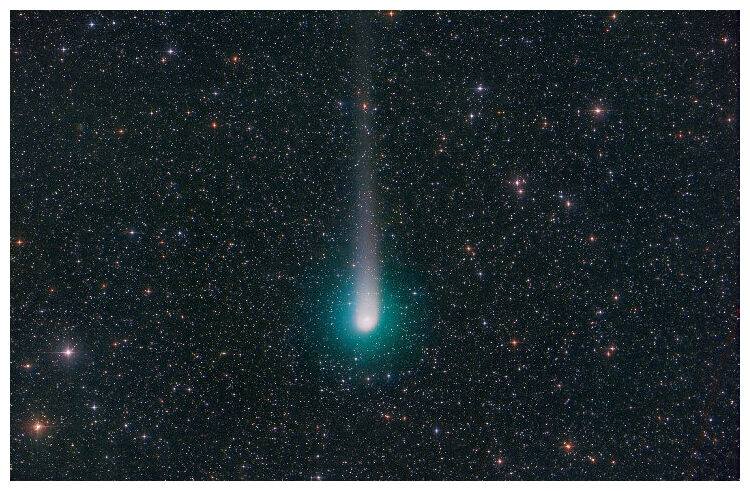
CBET 5113 & MPEC 2022-G83, issued on 2022, April 06, announce the discovery of a comet (magnitude ~17) in infrared exposures obtained during Mar. 30-Apr. 1 UT with the Near-Earth Object Wide-field Infrared Survey Explorer (or NEOWISE; formerly the WISE earth-orbiting satellite). The new comet has been designated C/2022 F2 (NEOWISE).

Stacking of 60 unfiltered exposures, 30 seconds each, obtained remotely on 2022, April 3.3 from X02 (Telescope Live, Chile) through a 0.61-m f/6.5 astrograph + CCD, shows that this object is a comet with a central condensation inside a coma of diameter 19" and a hint of a broad tail 13" long in p.a. 283 degrees, with magnitude of 17.5-17.7 in an aperture of radius 5".5 (Observers E. Bryssinck, M. Rocchetto, E. Guido, M. Fulle, G. Milani, G. Savini, A. Valvasori).

Our confirmation image (click on the images for a bigger version)
C/2022 F2
© Remanzacco Blogspot

Arrow Down

Getting a wireless network under the skin to talk to the brain

How can we get an artificial hand or foot to communicate with the brain? NTNU researchers want to use the fat layer just under our skin.
Brain Implant
© ColourboxA brain implant could provide electrical stimuli to the centre that processes the artificial sensory impression. No, it won’t look like this.
Imagine that you had to have your arm amputated and now you have to manage with an artificial hand. You can move it around, push things, press a light switch.

But you can't use your fingers to feel things, to sense whether what you are touching is hot or cold, or if you are grasping something too hard or not enough.

Now researchers at NTNU are working to develop solutions where the brain will be able to capture sensory impressions from a prosthesis, process them and use them to control movements, almost as if it were a normal hand. The NTNU approach won't require imbedded batteries and wires.

Scientist in Lab
© Ingebjørg HestvikBiological signal processing: Ali Khalegi, Sandra Yuste Murios and Ilangko Balasingham at NTNU’s Department of Electronic Systems. They have now started testing artificial nerve signals on monkeys.

Info

Astronomers detect a new radio source of unknown origin

Unknown Source FRB
© Balzan et al., 2022.Three-color HST image of NGC 2082 overlaid with ASKAP and ATCA contours. The inset image in the bottom-left provides a zoom in of J054149.24–641813.7, showing the absence of any optical counterpart.
During radio continuum observations of a spiral galaxy known as NGC 2082, Australian astronomers have discovered a mysterious bright and compact radio source, which received designation J054149.24-641813.7. The origin and nature of this source is unknown and requires further investigation. The finding is reported in a paper published May 23 on the arXiv pre-print repository.

In general, radio sources are various objects in the universe that emit relatively large amounts of radio waves. Among the strongest sources of such emission are pulsars, certain nebulas, quasars, and radio galaxies.

Now, a team of astronomers led by Joel Balzan of Western Sydney University in Australia, report the finding of a new radio source, whose true nature is still uncertain. While observing NGC 2082 using Australian Square Kilometer Array Pathfinder (ASKAP), Australia Telescope Compact Array (ATCA) and Parkes radio telescope, they identified a strong point radio source positioned 20 arcseconds from the galaxy center. NGC 2082 is a G-type spiral galaxy in the Dorado constellation, located some 60 million light years away from the Earth, with a diameter of approximately 33,000 light years.

"We present radio continuum observations of NGC 2082 using ASKAP, ATCA and Parkes telescopes from 888 MHz to 9,000 MHz. Some 20 arcsec from the center of this nearby spiral galaxy, we discovered a bright and compact radio source, J054149.24-641813.7, of unknown origin," the researchers wrote in the paper.

Russian Flag

Russia releases images of 'unstoppable' Tsirkon hypersonic missile at sea test

Tsirkon hypersonic cruise missile
© Defense Ministry videoA Tsirkon hypersonic cruise missile was launched from the frigate "Admiral Gorskhov" on May 28.
Unlike previous test shootings of the new supersonic cruise missile in the Russian north, Saturday's launch happened from the Barents Sea towards a target in the White Sea. Previous tests have either been from the White Sea, across the Kola Peninsula to a target in the Barents Sea, or, like with the submarine test last fall, from one location in the Barents Sea to another.

According to Russia's Defense Ministry, the missile successfully hit the target located about a thousand kilometers away. The information is not verified by any independent sources. The press service of Russia's Northern Fleet is not allowed to answer questions from foreign journalists, including the Barents Observer.