
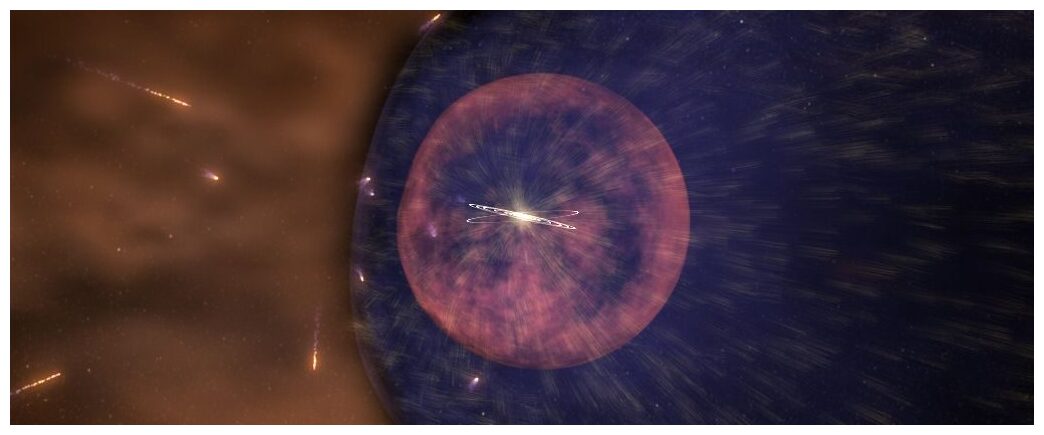
© NASAAn illustration showing the Solar System inside the heliosphere, with the termination shock and heliopause represented by two bubbles, one inside the other.
Data from a spacecraft orbiting Earth has revealed ripple structures in the termination shock and heliopause: shifting regions of space that mark one of the boundaries between the space inside the Solar System, and what's outside - interstellar space.
The results show that it's possible to get a detailed picture of the boundary of the Solar System and how it changes over time.
This information will help scientists better understand a region of space known as the heliosphere, which pushes out from the Sun and shields the planets in our Solar System from cosmic radiation.
There are a variety of ways the Sun affects the space around it. One of those is the solar wind, a constant supersonic flow of ionized plasma. It blows out past the planets and the Kuiper Belt, eventually petering out in the great emptiness between the stars.
The point at which this flow falls below the speed at which sound waves can travel through the diffuse interstallar medium is called the termination shock, and the point at which it is no longer strong enough to push back against the very slight pressure of interstellar space is the heliopause.
Both Voyager probes have crossed the heliopause and are, effectively, now cruising through interstellar space, providing us the first in situ measurements of this shifting boundary. But there's another tool out in Earth orbit that has been helping scientists map the heliopause since it commenced operations in 2009: NASA's Interstellar Boundary Explorer (IBEX).
















Comment: See also: