
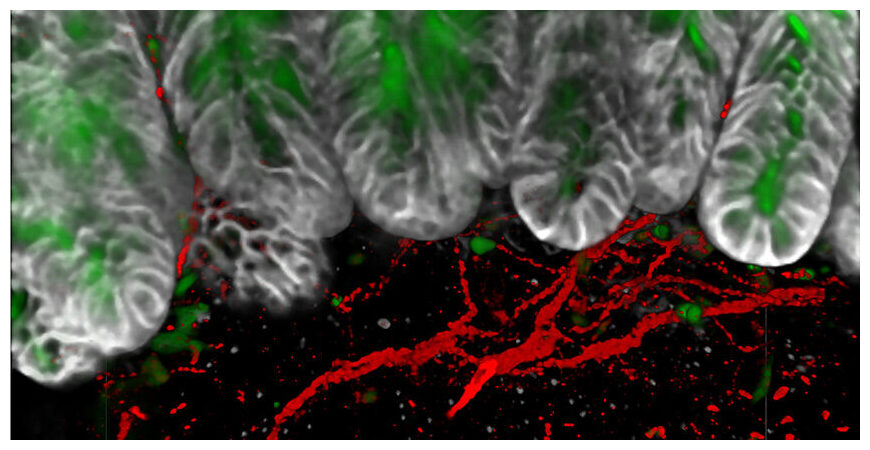
© Chiu Lab/HMSHMS researchers have identified the molecular conversation that occurs between pain neurons (red) in the gut and intestinal goblet cells (green) as a mechanism involved in protective pain signaling that shields the gut from damage.
But what if pain is more than a mere alarm bell? What if pain is in itself a form of protection?
A new study led by researchers at Harvard Medical School suggests that may well be the case in mice.
The research, published Oct. 14 in Cell, shows that pain neurons in the mouse gut regulate the presence of protective mucus under normal conditions and stimulate intestinal cells to release more mucus during states of inflammation.
The work details the steps of a complex signaling cascade, showing that pain neurons engage in direct cross talk with mucus-containing gut cells, known as goblet cells.
"It turns out that pain may protect us in more direct ways than its classic job to detect potential harm and dispatch signals to the brain. Our work shows how pain-mediating nerves in the gut talk to nearby epithelial cells that line the intestines," said study senior investigator Isaac Chiu, associate professor of immunobiology in the Blavatnik Institute at HMS. "This means that the nervous system has a major role in the gut beyond just giving us an unpleasant sensation and that it's a key player in gut barrier maintenance and a protective mechanism during inflammation."
















Comment: See also: