Science & TechnologyS


Bug

Study finds sea spiders can regrow whole body parts, not just limbs

sea spider
Young sea spiders have been found to have remarkable powers of regeneration
Sea spiders can regrow body parts after amputation and not just limbs, according to a study released on Monday that may pave the way for further scientific research into regeneration.

"Nobody had expected this," said Gerhard Scholtz of Humboldt University in Berlin, senior author of the study published in the Proceedings of the National Academy of Sciences. "We were the first to show that this is possible."

It is well documented that many different types of arthropods such as centipedes, spiders, and other insects can regrow limbs after a loss.

"Crabs can even automatically get rid of their limbs if they are attacked," Scholtz said. "They replace it by a new limb."

Satellite

Record-breaking detection of radio signal from atomic hydrogen in extremely distant galaxy

radio signal hydrogen 9 billion light years
© Swadha PardesiIllustration showing detection of the lensed 21 cm atomic hydrogen emission signal from a distant galaxy.
Astronomers from McGill University in Canada and the Indian Institute of Science (IISc) in Bengaluru have used data from the Giant Meterwave Radio Telescope (GMRT) in Pune to detect a radio signal originating from atomic hydrogen in an extremely distant galaxy. The astronomical distance over which such a signal has been picked up is the largest so far by a large margin. This is also the first confirmed detection of strong lensing of 21 cm emission from a galaxy. The findings have been published in the Monthly Notices of the Royal Astronomical Society.

Atomic hydrogen is the basic fuel required for star formation in a galaxy. When hot ionized gas from the surrounding medium of a galaxy falls onto the galaxy, the gas cools and forms atomic hydrogen, which then becomes molecular hydrogen, and eventually leads to the formation of stars. Therefore, understanding the evolution of galaxies over cosmic time requires tracing the evolution of neutral gas at different cosmological epochs.

Bizarro Earth

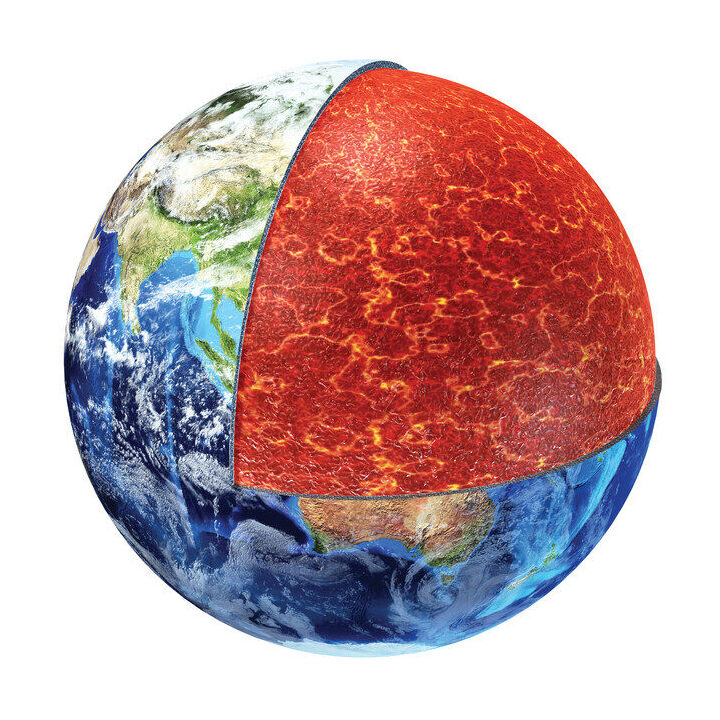
A seismic climate connection?

Seismic Connection
© CFact Org
I will be brief ( relatively).

In a paper coming out, "Increased Mid-Ocean Seismic Activity: Fact or Artifact?" Dr. Arhtur Viterito has confirmed my suspicions that geothermal input from the increased seismic activity is a leading cause of the warming, if not the almost total cause. As much as the co2 crowd keeps pointing to the rise in temperature and increased emissions they ignore the fact that the air temperature go virtually nowhere without the oceanic warming and the input of WV in the air, The oceans are not warming via co2 feedback. Arguments about co2's effect on the air ignore the oceanic warming. So what is warming the ocean? Dr Viterito supplies the smoking gun to my suspicions.

Temperature Chart
© CFact Org
This is the last 40 plus years of temperatures (brown) and seismic activity The 2 super Ninos can clearly be seen which would make sense given the amount of WV put in the air by the tropics But the steady increase in seismic activity is clearly linked. If one wants to argue its co2 with that correlation then how is it not this GIVEN THIS WOULD ACTUALLY AFFECT the INPUT OF ENERGY INTO THE OCEAN , which in turn would warm the air in the way we are observing due to the nature of water vapor.

There is next to no one looking at this, Why are we looking at co2. and ignoring the main source of energy in the earths climate?

Fireball 4

Monster meteorite found in Antarctica is among the largest in 100 years

large meteorite recovered antarctica
© Maria ValdesThe 16.8 lb (7.6 kg) space rock found in an Antarctic ice field.
Antarctica has a lot going for it when it comes to meteorite hunting. The dark rocks stand out against the icy landscape. Its dry climate keeps weathering to a minimum. And even when meteorites sink into the ice they are often returned to the surface by the churning of the glaciers.

In spite of these ideal conditions, finding sizeable chunks of space rock is rare.

A group of researchers have just returned from the ice-covered continent with five new meteorites that include an unusually large specimen.

The big find in this haul weighs in at 7.6 kilograms (16.8 pounds), placing it in the top 100 in terms of size for meteorites recovered in Antarctica over the past century. Considering some 45,000 have been recovered in that time, that's saying something.

Chalkboard

The Green Games: Hydrogen will not save us. Here's why.

Sabine Hossenfelder

Hydrogen
Replacing fossil fuel with hydrogen seems like an ideal solution to make transportation environmentally friendly and to provide a backup for intermittent energy sources like solar and wind. But how environmentally friendly is hydrogen really? And how sustainable is it, given that hydrogen fuel cells rely on supply of rare metals like platinum and iridium? In this video, we have collected all the relevant numbers for you.


Many thanks to Jordi Busqué for helping with this video http://jordibusque.com/

00:00 Intro
00:49 Hydrogen Basics
03:39 The Hydrogen Market
06:04 The Colours Of Hydrogen
12:11 Water Supply
13:34 The Cold Start Problem
14:05 Rare Metal Shortages
15:55 Hydrogen Embrittlement
16:45 Summary
18:16 Protect Your Privacy with NordVPN

HT/P Gosselin


Comment: Warming to misanthropy
"the Precautionary Principle, a favorite tool of environmentalists to bypass the need for facts as the basis of decision-making."
― Tim Ball, The Deliberate Corruption of Climate Science


Comet

Electric Universe: 'Sunward spike' ion 'tail' appears on Comet E3 ZTF

Comet E3 (ZTF)
© Bill WilliamsMulti-tailed Comet E3 (ZTF)!
Taken by Bill Williams on January 20, 2023 @ Chiefland Astro Village, Florida, USA
Astrophotography alert! Comet ZTF (C/2022 E3) is developing an anti-tail, and tonight may be the best time to photograph it. Unlike ordinary comet tails, which are blown away from the sun by solar wind and radiation pressure, anti-tails point toward the sun. That sounds impossible, yet Bill Williams just photographed the anti-tail of Comet ZTF from his observatory in Chiefland, Florida:

"Comet ZTF has developed an anti-tail in addition to its dust and ion tails!" says Williams. "Just how many tails can a comet have?"

Briefly, three. Comets sometimes grow an ephemeral third tail, the "anti-tail." It's an optical illusion seen when Earth crosses a comet's orbital plane. At that moment, the edge of the comet's fan-shaped dust tail looks like an sunward pointing spike.


Comment: No, it is not an 'optical illusion'. It is a sunward spike, as described by James McCanney.


"It's happening tonight," says longtime comet observer Paul Robinson of Longmont, CO. "On the evening of Jan. 22nd in the Americas, Earth crosses the orbit of Comet ZTF, which should produce a good spike. Photographers will not want to miss this!"

Comment: It's notable that the comet has become much brighter and faster than predicted; could there be more surprises in store?


Bulb

Light pollution worsening, new study reveals

milky way
© K. Ulaczyk/J. Skowron/OGLE/Astronomical Observatory, ,University of WarsawThe Milky Way as seen from observatory in Poland. A phenomenon called "skyglow" is stealing our celestial view, and the impact is far more dramatic when observed by the unaided human eye.
Light pollution has robbed eight out of 10 Americans, and nearly a third of all humans, of a view of our own home galaxy, according to new research out Thursday. The problem is something called "skyglow," which is the cumulative, diffuse brightening of the light sky from artificial light sources.

A new study published in the journal Science uses crowdsourced data from a program called Globe at Night, which is run by the National Science Foundation-funded NOIRLab, a network of observatories. It finds that skyglow as perceived by human eyes is more of a problem compared with satellite measurements of artificial light on Earth.

Brain

New brain research appears to support free will

hiker in woods free will
© Vladislav Babienko via Unsplash
Philosopher Alessandra Buccella and experimental psychologist Tomáš Dominik, both at Chapman University, offer some interesting support for free will. Many commentators interpreted Benjamin Libet's experiments that showed that the brain's readiness to make a decision (readiness potential) often preceded the subject's conscious awareness of the choice that had been made.

There! they said, that proves that there is no free will:
To many observers, these findings debunked the intuitive concept of free will. After all, if neuroscientists can infer the timing or choice of your movements long before you are consciously aware of your decision, perhaps people are merely puppets, pushed around by neural processes unfolding below the threshold of consciousness.

"Free will is only an illusion if you are, too" — Alessandra Buccella, Tomáš Dominik, Scientific American (January 16, 2023)
The trouble is, the movements that researchers have studied in these classic experiments did not matter personally to the experimental subjects:

Info

A 500-year-old 'paradox' by Leonardo da Vinci has finally been solved, study says

A mystery of fluid physics first noticed by da Vinci has puzzled scientists for centuries, and we now have an answer.
STATUE OF LEONARDO DA VINCI.
More than 500 years ago, Leonardo da Vinci was watching air bubbles float up through water — as you do when you're a Renaissance-era polymath — when he noticed that some bubbles inexplicably started spiraling or zigzagging instead of making a straight ascent to the surface.

For centuries, nobody has offered a satisfying explanation for this weird periodic deviation in the motion of some bubbles through water, which has been called "Leonardo's paradox."

Now, a pair of scientists think they may have finally solved the longstanding riddle by developing new simulations that match high-precision measurements of the effect, according to a study published on Tuesday in Proceedings of the National Academy of Sciences.

The results suggest that bubbles can reach a critical radius that pushes them into new and unstable paths due to interactions between the flow of water around them and the subtle deformations of their shapes.

"The motion of bubbles in water plays a central role for a wide range of natural phenomena, from the chemical industry to the environment," said authors Miguel Herrada and Jens Eggers, who are fluid physics researchers at the University of Seville and the University of Bristol respectively, in the study. "The buoyant rise of a single bubble serves as a much-studied paradigm, both experimentally and theoretically."

Brain

'Universal language network' identified in the brain

brain
© Christine Daniloff/MIT/iStock imageThe brain's language processing network is mostly located in the left hemisphere.
Japanese, Italian, Ukrainian, Swahili, Tagalog and dozens of other spoken languages cause the same "universal language network" to light up in the brains of native speakers. This hub of language processing has been studied extensively in English speakers, but now neuroscientists have confirmed that the exact same network is activated in speakers of 45 different languages representing 12 distinct language families.

Senior author Evelina Fedorenko, an associate professor of neuroscience at MIT and a member of MIT's McGovern Institute for Brain Research, said in a statement:
"This study is very foundational, extending some findings from English to a broad range of languages. The hope is that now that we see that the basic properties seem to be general across languages, we can ask about potential differences between languages and language families in how they are implemented in the brain, and we can study phenomena that don't really exist in English."
For example, speakers of "tonal" languages, such as Mandarin, convey different word meanings through shifts in their tone, or pitch; English isn't a tonal language, so it might be processed slightly differently in the brain.

The study, published Monday (July 18) in the journal Nature Neuroscience, included two native speakers of each language, who underwent brain scans as they performed various cognitive tasks. Specifically, the team scanned the participants' brains using a technique called functional magnetic resonance imaging (fMRI), which tracks the flow of oxygenated blood through the brain. Active brain cells require more energy and oxygen, so fMRI provides an indirect measure of brain cell activity.