Science & TechnologyS


Info

Earth's anisotropic inner core structure driven by dipole geomagnetic field

Earth's inner core and geomagnetic field.
© IGCASEarth's inner core and geomagnetic field.
A geomagnetic field is generated in Earth's interior and extends into outer space to protect Earth from cosmic radiation and the charged particles of solar wind. The magnetic field is generated by the convection of charged molten iron fluids in Earth's outer core.

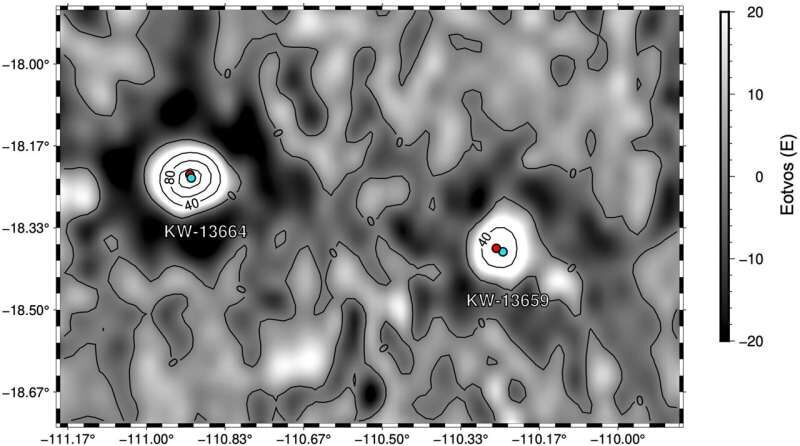
In contrast to the convective homogenous outer core, Earth's inner core is inhomogeneous and anisotropic. The seismic velocity in the polar direction is ~2-3% faster than that in the equatorial direction.

Recently, researchers led by Profs. LI Heping and HE Yu from the Institute of Geochemistry of the Chinese Academy of Sciences (IGCAS) have revealed that Earth's anisotropic inner core structure is driven by the dipole geomagnetic field.

The study was published in Nature Communications on March 24.

Last year, a study published in Nature revealed that Earth's inner core is not a normal solid but a composition of solid iron and liquid-like light elements (hydrogen, oxygen, and carbon), which is also known as a superionic state.

Roses

Plants scream when stressed or hurt — they're 'rather noisy': study

forest
© Getty Images/iStockphoto“Apparently, an idyllic field of flowers can be a rather noisy place. It’s just that we can’t hear the sounds,” study coauthor Lilach Hadany quipped.
Mum's the word.

Thirsty or stressed plants emit popping sounds undetectable to the human ear, according to research published Thursday in the journal Cell.

Tel Aviv University scientists used special microphones to record ultrasonic sounds produced by tomato and tobacco plants inside a sound-protected box and a greenhouse.

The researchers say they developed machine learning models to identify the condition of the plants, including if they were dehydrated or diseased, based on the detected sounds.

"From previous studies we know that vibrometers attached to plants record vibrations. But do these vibrations also become airborne soundwaves — namely sounds that can be recorded from a distance? Our study addressed this question, which researchers have been debating for many years," study coauthor Lilach Hadany said in a statement.

Researchers say they put the plants in a box in a basement with no background noise, placing ultrasonic microphones about 10 centimeters away from each specimen.

Comment: Why not? There doesn't seem to be much point in doing that if they weren't communicating something. See also:


Better Earth

Magnetic storms can destroy up to a quarter of the Earth's ozone layer, new study reveals

Ozone hole
FILE PHOTO: Ozone hole September 2021: This year's Antarctic ozone hole is already among the 25% largest in recorded history and is still growing.
Physicists from St. Petersburg State University (SPbGU) and other Russian universities, together with scientists from the Davos Physical and Meteorological Observatory, have proved that during magnetospheric storms, up to 25% of the entire ozone layer of the Earth can be destroyed during a day.

The ozone layer is part of the stratosphere that blocks ultraviolet rays that have a detrimental effect on all living organisms. The largest ozone hole on Earth is located over Antarctica. As of October 2022, its size was approximately 23.2 million square meters. km.

"During geomagnetic disturbances (changes in the Earth's magnetic field, usually manifested during magnetospheric storms), the concentration of radicals increases in the polar atmosphere. This leads to the destruction of ozone at the heights of the mesosphere during the day. The maximum detected destruction was 14-25% at an altitude of about 75 km," said Irina Mironova, head of the section "Magnetosphere and the influence of energetic particles on the atmosphere" of the Laboratory for the Study of the Ozone Layer and Upper Atmosphere of St. Petersburg State University (quoted by RIA Novosti).

Comment: See also: Ozone hole of 2021 finally closing, 3rd longest-lasting & 11th largest on record


Sun

The sun has developed a 'coronal hole' 20 times the size of Earth

coronal hole
© NASA
The sun has developed a massive "hole" 20 times larger than Earth, marking the second such occurrence in a week. The coronal hole is unleashing solar winds of 2.9 million km/h towards the Earth, which will hit our planet on Friday.

Scientists are carefully monitoring the situation to assess if the winds will impact our planet's magnetic field and satellites - with the potential for knock-on effects on the internet, mobile phone networks and GPS.

Coronal holes are usually harmless, experts say, and are usually found near the sun's poles. They are cooler, less dense areas of the star and appear during the less active stage of the sun's 11-year cycle.

"Coronal holes are magnetically open areas that are one source of high-speed solar wind," NASA says. "They appear dark when viewed in many wavelengths of extreme ultraviolet light, such as seen here. At times, the solar wind can generate aurora at higher latitudes on Earth."

Comment: Previously: Auroras shine unusually far south in the US amid strongest solar storm since 2017


Chalkboard

Mathematicians have finally discovered an elusive 'einstein' tile

eeinstein tile tellessation no repeat pattern
© D. Smith, J.S. Myers, C.S. Kaplan and C. Goodman-StraussA 13-sided tile called “the hat” forms a pattern that covers an infinite plane yet it cannot repeat, making it a long-sought shape known as an “einstein.” A sample of that pattern is shown here.
A 13-sided shape called 'the hat' forms a pattern that never repeats

A 13-sided shape known as "the hat" has mathematicians tipping their caps.

It's the first true example of an "einstein," a single shape that forms a special tiling of a plane: Like bathroom floor tile, it can cover an entire surface with no gaps or overlaps but only with a pattern that never repeats.

"Everybody is astonished and is delighted, both," says mathematician Marjorie Senechal of Smith College in Northampton, Mass., who was not involved with the discovery. Mathematicians had been searching for such a shape for half a century. "It wasn't even clear that such a thing could exist," Senechal says.

Although the name "einstein" conjures up the iconic physicist, it comes from the German ein Stein, meaning "one stone," referring to the single tile. The einstein sits in a weird purgatory between order and disorder. Though the tiles fit neatly together and can cover an infinite plane, they are aperiodic, meaning they can't form a pattern that repeats.

Info

Brightest gamma-ray burst ever detected defies explanation

Scientists are taking a closer look at the afterglow left by the brightest gamma-ray burst ever recorded, and what they see doesn't fit with any theoretical models.
gamma-ray burst
© NASA's Goddard Spa ce Flight CenterA NASA illustration showing the typical evolution of a long gamma-ray burst — the most common type of GRB.
The brightest gamma-ray burst ever detected is revealing new mysteries as scientists study it in greater detail.

In two new papers - one published today in The Astrophysical Journal Letters, and another published on the preprint server arXiv and submitted for publication in the journal Nature Astronomy - astronomers found that the evolution of the radio waves released by an enormous stellar explosion seen in 2022 was slower than models predicted, raising questions about how the release of energy evolves during ultra-powerful gamma-ray bursts.

"[I]t is very difficult for existing models to replicate the slow evolution of the energy peaks that we observed," James Leung, a doctoral student at the University of Sydney who co-authored the Nature Astronomy paper, said in a statement. "This means we have to refine and develop new theoretical models to understand these most extreme explosions in the Universe."

Gamma-ray bursts (GRBs) are brief, bright flashes of gamma-ray light that are thought to be the most powerful explosions in our universe since the Big Bang. GRBs are released during extreme stellar explosions or supernovas, when a dying star runs out of fuel and collapses into a neutron star or even a black hole. The brightest burst ever seen, known as GRB 221009A, was first detected on Oct. 9, 2022 by gamma-ray and X-ray telescopes. The likely supernova that caused the burst was 2.4 billion light-years away from Earth.

Robot

Russian company unveils ChatGPT competitor

artificial intelligence
© Getty Images / MF3d
The new AI tool is geared towards business and government projects, Sistemma has said.

Moscow-based company Sistemma has created its own competitor to OpenAI's ChatGPT, which runs entirely on domestic servers and in the Russian language. The project was unveiled on Sunday on the IT company's official site.

The AI is called SistemmaGPT (Generative Pre-trained Transformer) and is based on the company's own developments, along with Stanford University research. The chatbot is intended for Russian businesses and government agencies.

Sistemma claims that its AI can write high-quality texts and possesses "encyclopedic knowledge." The company also claims that the chatbot can "create tutorials, write essays, programming code, resumes or just support a conversation while pretending to be a celebrity." It can find and analyze data in real time and create development strategies and business projects while adapting to their clients and local context.

Comment: See also:


Telescope

STEVE appears over Bozeman, Montana during most intense geomagnetic storm in nearly 6 years

STEVE (Strong Thermal Emission Velocity Enhancement araura borialis
© Joseph Shaw via SpaceweathergallerySteve over Bozeman, Montana March 203, 2023
Steve Quayle is a friend of mine who helps me a lot in my life and online. Thank you!

On March 23-24, during an unexpected G4 severe geomagnetic storm - the most intense in nearly 6 years - not every light in the sky was the aurora borealis. There was also STEVE...

And the mysterious sky phenomenon appeared just over Steve Quayle's hometown: Bozeman, Montana. This is no coincidence! This is a divine tribute!

STEVE (Strong Thermal Emission Velocity Enhancement) looks like an aurora, but it is not. The phenomenon is caused by hot (3000°C) ribbons of gas flowing through Earth's magnetosphere at speeds exceeding 6 km/s (13,000 mph). These ribbons appear during strong geomagnetic storms, revealing themselves by their soft purple glow.

Network

New experiment translates quantum information between technologies in an important step for the quantum internet

niobium superconducting cavity
© Aishwarya KumarA niobium superconducting cavity. The holes lead to tunnels which intersect to trap light and atoms.
Researchers have discovered a way to "translate" quantum information between different kinds of quantum technologies, with significant implications for quantum computing, communication, and networking.

The research was published in the journal Nature on Wednesday. It represents a new way to convert quantum information from the format used by quantum computers to the format needed for quantum communication.

Photons — particles of light — are essential for quantum information technologies, but different technologies use them at different frequencies. For example, some of the most common quantum computing technology is based on superconducting qubits, such as those used by tech giants Google and IBM; these qubits store quantum information in photons that move at microwave frequencies.

But if you want to build a quantum network, or connect quantum computers, you can't send around microwave photons because their grip on their quantum information is too weak to survive the trip.

Bullseye

Eminent Oxford scientist says wind power "fails on every count"

damaged wind turbine
© Antelope County News
It could be argued that the basic arithmetic showing wind power is an economic and societal disaster in the making should be clear to a bright primary school child. Now the Oxford University mathematician and physicist, researcher at CERN and Fellow of Keble College, Emeritus Professor Wade Allison has done the sums. The U.K. is facing the likelihood of a failure in the electricity supply, he concludes. "Wind power fails on every count," he says, adding that governments are ignoring "overwhelming evidence" of the inadequacies of wind power, "and resorting to bluster rather than reasoned analysis".

Professor Allison's dire warnings are contained in a short paper recently published by the Global Warming Policy Foundation. He notes that the energy provided by the Sun is "extremely weak", which is why it was unable to provide the energy to sustain even a small global population before the Industrial Revolution with an acceptable standard of living. A similar point was made recently in more dramatic fashion by the nuclear physicist Dr. Wallace Manheimer. He argued that the infrastructure around wind and solar will not only fail, "but will cost trillions, trash large portions of the environment and be entirely unnecessary".