Science & TechnologyS


Info

Physicists discover that gravity can create light

supermassive black hole consuming a star
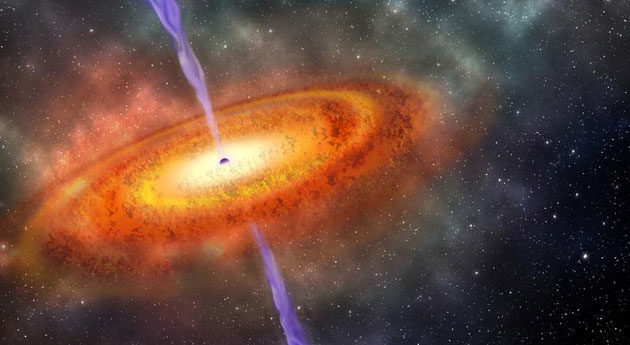
© Carl Knox (OzGrav, ARC Centre of Excellence for Gravitational Wave Discovery, Swinburne University of Technology)A star is being consumed by a distant supermassive black hole. Astronomers call this a tidal disruption event (TDE). As the black hole rips apart the star, two jets of material moving with almost the speed of light are launched in opposite directions. One of the jets was aimed directly at Earth.
Researchers have discovered that in the exotic conditions of the early universe, waves of gravity may have shaken space-time so hard that they spontaneously created radiation.

The physical concept of resonance surrounds us in everyday life. When you're sitting on a swing and want to go higher, you naturally start pumping your legs back and forth. You very quickly find the exact right rhythm to make the swing go higher. If you go off rhythm then the swing stops going higher. This particular kind of phenomenon is known in physics as a parametric resonance.

Your legs act as an external pumping mechanism. When they match the resonant frequency of the system, in this case your body sitting on a swing, they are able to transfer energy to the system making the swing go higher.

These kinds of resonances happen all over the place, and a team of researchers have discovered that an exotic form of parametric resonance may have even occurred in the extremely early universe.

Perhaps the most dramatic event to occur in the entire history of the universe was inflation. This is a hypothetical event that took place when our universe was less than a second old. During inflation our cosmos swelled to dramatic proportions, becoming many orders of magnitude larger than it was before. The end of inflation was a very messy business, as gravitational waves sloshed back and forth throughout the cosmos.

Magnify

Three species of extremely primitive spider discovered in China

spider
© Zhang Y, Chen Z, Li D, Xu XA female Songthela longhui, one of three mesothelean spiders identified in China: Mesothelean spiders diverged from all other spiders long before the first dinosaurs - three species of these living fossils have just been identified in western Hunan province.
Three new species of an ancient, secretive group of spiders, all native to Hunan province in China, have been described. These "mesothelean" spiders diverged from other arachnid families about 300 million years ago and have strange, primitive features not found in the vast majority of living spiders.

Most spider species on Earth today belong to one of two groups: the heavy-bodied mygalomorph spiders - such as tarantulas and the notoriously venomous funnel-web spiders - and the tens of thousands of araneomorph spider species, many of which spin intricate, sticky webs.

Approximately 100 spider species belong to a poorly understood third group that fall under the suborder Mesothelae. The mesothelean spiders diverged from other spiders back when the planet's rainforests were full of giant arthropods and the very first reptiles. Today, the sole remaining mesothelean spider family retains some physical features of the first spiders. Unlike all other spiders, mesotheleans have a segmented abdomen with plates on top, much like a shrimp tail or a bee's rump. Their silk-spewing spinnerets are uniquely slung below the centre of their abdomen, rather than positioned at the rearmost tip.

Comment: See also:


Control Panel

Zombie no more: The unbelievable comeback of analog computing

floppy disks analog computing
© StockXchange
Computers have been digital for half a century. Why would anyone want to resurrect the clunkers of yesteryear?

When old tech dies, it usually stays dead. No one expects rotary phones or adding machines to come crawling back from oblivion. Floppy diskettes, VHS tapes, cathode-ray tubes — they shall rest in peace. Likewise, we won't see old analog computers in data centers anytime soon. They were monstrous beasts: difficult to program, expensive to maintain, and limited in accuracy.

Or so I thought. Then I came across this confounding statement:
Bringing back analog computers in much more advanced forms than their historic ancestors will change the world of computing drastically and forever.
Seriously?

I found the prediction in the preface of a handsome illustrated book titled, simply, Analog Computing. Reissued in 2022, it was written by the German mathematician Bernd Ulmann — who seemed very serious indeed.

Question

Does Earth have a new Quasi-Moon?

New Moon
© NASA / JPL-Caltech469219 Kamoʻoalewa also has an orbit around the Sun that keeps it as a constant companion of Earth.
Astronomers have discovered an asteroid that orbits the Sun with Earth, earning it the moniker "quasi-moon."

Recently discovered asteroid 2023 FW13 has created a bit of a stir among asteroid watchers. It turns out to be on an orbit that is not only in a 1:1 resonance with the Earth, but follows a path that actually circles Earth — albeit on an orbit that is so eccentric that it sweeps out halfway to Mars and in halfway to Venus.

There's no formal definition for objects such as this, which are sometimes called quasi-moons or quasi-satellites. They follow a path around Earth, but usually for no more than a few decades. Perhaps the best known of these objects, known as Kamoʻoalewa, was found in 2016, and is considered the smallest, closest, and most stable known quasi-satellite. It has an orbit that has been in a stable resonance with Earth for almost a century, and will remain so for centuries to come, according to calculations by Paul Chodas (Jet Propulsion Laboratory).

But this newfound asteroid, if preliminary orbital calculations are correct, will handily eclipse that record. Some estimates say it has circled Earth since at least 100 BC and will likely continue to do so until around AD 3700. If that's correct, 2023 FW13 would be the most stable quasi-satellite of Earth ever found.

Telescope

NASA's Webb scores another ringed world with new image of Uranus

planet uranus moons rings
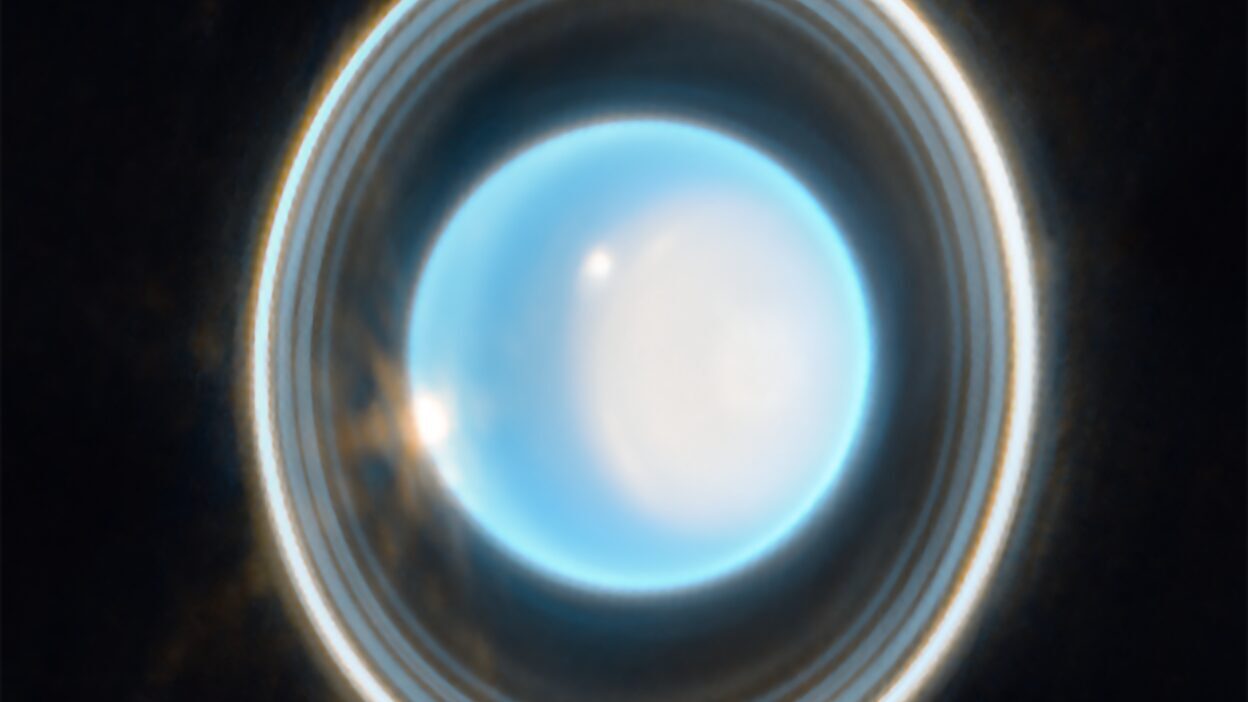
© NASA, ESA, CSA, STScI, Joseph DePasqualeUranus and its brightest moons.
Following in the footsteps of the Neptune image released in 2022, NASA's James Webb Space Telescope has taken a stunning image of the solar system's other ice giant, the planet Uranus. The new image features dramatic rings as well as bright features in the planet's atmosphere. The Webb data demonstrates the observatory's unprecedented sensitivity for the faintest dusty rings, which have only ever been imaged by two other facilities: the Voyager 2 spacecraft as it flew past the planet in 1986, and the Keck Observatory with advanced adaptive optics.

The seventh planet from the Sun, Uranus is unique: It rotates on its side, at roughly a 90-degree angle from the plane of its orbit. This causes extreme seasons since the planet's poles experience many years of constant sunlight followed by an equal number of years of complete darkness. (Uranus takes 84 years to orbit the Sun.) Currently, it is late spring for the northern pole, which is visible here; Uranus' northern summer will be in 2028. In contrast, when Voyager 2 visited Uranus it was summer at the south pole. The south pole is now on the 'dark side' of the planet, out of view and facing the darkness of space.

Galaxy

Hubble spots possible runaway black hole creating a trail of stars

hubble black hole create stars
© NASA, ESA, Pieter van Dokkum (Yale); Image Processing: Joseph DePasquale (STScI)This Hubble Space Telescope archival photo captures a curious linear feature that is so unusual it was first dismissed as an imaging artifact from Hubble's cameras. But follow-up spectroscopic observations reveal it is a 200,000-light-year-long chain of young blue stars. A supermassive black hole lies at the tip of the bridge at lower left. The black hole was ejected from the galaxy at upper right. It compressed gas in its wake to leave a long trail of young blue stars. Nothing like this has ever been seen before in the universe. This unusual event happened when the universe was approximately half its current age.
NASA has warned that there's an 'invisible monster on the loose', in the form of a 'runaway' black hole.

The supermassive black hole is barrelling through the universe so quickly that if it were in our solar system, it could travel the 237,674-mile journey from Earth to the Moon in just 14 minutes.

Weighing as much as 20million suns, it has left a trail of stars in its wake, measuring 200,000-light-years - twice the diameter of the Milky Way. Scientists outlined the findings for the possible black hole in a study led by Yale University.

Comment: More information from NASA which is planning more observations of the phenomenon:
This intergalactic skyrocket is likely the result of multiple collisions of supermassive black holes. Astronomers suspect the first two galaxies merged perhaps 50 million years ago. That brought together two supermassive black holes at their centers. They whirled around each other as a binary black hole.

Then another galaxy came along with its own supermassive black hole. This follows the old idiom: "two's company and three's a crowd." The three black holes mixing it up led to a chaotic and unstable configuration. One of the black holes robbed momentum from the other two black holes and got thrown out of the host galaxy. The original binary may have remained intact, or the new interloper black hole may have replaced one of the two that were in the original binary, and kicked out the previous companion.

When the single black hole took off in one direction, the binary black holes shot off in the opposite direction. There is a feature seen on the opposite side of the host galaxy that might be the runaway binary black hole. Circumstantial evidence for this is that there is no sign of an active black hole remaining at the galaxy's core. The next step is to do follow-up observations with NASA's James Webb Space Telescope and the Chandra X-ray Observatory to confirm the black hole explanation.

[...]

NASA's upcoming Nancy Grace Roman Space Telescope will have a wide-angle view of the universe with Hubble's exquisite resolution. As a survey telescope, the Roman observations might find more of these rare and improbable "star streaks" elsewhere in the universe. This may require machine learning using algorithms that are very good at finding specific weird shapes in a sea of other astronomical data, according to van Dokkum.

The research paper will be published on April 6 in The Astrophysical Journal Letters.


Info

A mini-heart in a Petri dish

A team at the Technical University of Munich (TUM) has induced stem cells to emulate the development of the human heart. The result is a sort of "mini-heart" known as an organoid. It will permit the study of the earliest development phase of our heart and facilitate research on diseases.
Mini - Heart
© Alessandra Moretti / TUMThese "epicardioids" - organoids made from pluriopotent stem cells - are just 0.5 millimeters in size. Researchers can use them to mimic the development of the human heart in the laboratory and study hereditary heart diseases.
The human heart starts forming approximately three weeks after conception. This places the early phase of heart development in a time when women are often still unaware of their pregnancy. That is one reason why we still have little knowledge of many details of how the heart is formed. Findings from animal studies are not fully transferable to humans. An organoid developed at TUM could prove helpful to researchers.

A ball of 35,000 cells

The team working with Alessandra Moretti, Professor of Regenerative Medicine in Cardiovascular Disease, has developed a method for making a sort of "mini-heart" using pluripotent stem cells. Around 35,000 cells are spun into a sphere in a centrifuge. Over a period of several weeks, different signaling molecules are added to the cell culture under a fixed protocol. "In this way, we mimic the signaling pathways in the body that control the developmental program for the heart," explains Alessandra Moretti. The group has now published its work in the journal Nature Biotechnology.

Fish

Record set as scientists observe fish at more than 27,000ft off the coast of Japan

deepest fish snail fish
Footage from higher up showed the same snailfish species but adults and in larger numbers
Scientists have set a new record for the deepest fish ever observed at more than 27,000ft below sea level.

A juvenile type of snailfish was filmed swimming at 27,349ft - nearly the same height as Mount Everest - in the Izu-Ogasawara Trench, south of Japan.

Lead scientist Professor Alan Jamieson said the snailfish could be at the maximum depth any fish can survive and probably did so because of trench's warm waters.

Although the snailfish was not caught to fully identify its species type, similar snailfish were captured higher up at a depth of 26,319ft which set the record for the deepest fish ever caught.

Laptop

Twitter reveals some of its source code, including its recommendation algorithm

twitter release source code free bird
© Bryce Durbin / Bryce Durbin / TechCrunch
As repeatedly promised by Twitter CEO Elon Musk, Twitter has opened a portion of its source code to public inspection, including the algorithm it uses to recommend tweets in users' timelines.

On GitHub, Twitter published two repositories containing code for many parts that make the social network tick, including the mechanism Twitter uses to control the tweets users see on the For You timeline. In a blog post, Twitter characterized the move as a "first step to be[ing] more transparent" while at the same time "[preventing] risk" to Twitter itself and people on the platform.

On a Twitter Spaces session today, Musk clarified:
"Our initial release of the so-called algorithm is going to be quite embarrassing, and people are going to find a lot of mistakes, but we're going to fix them very quickly."

"Even if you don't agree with something, at least you'll know why it's there, and that you're not being secretly manipulated ... The analog, here, that we're aspiring to is the great example of Linux as an open source operating system ... One can, in theory, discover many exploits for Linux. In reality, what happens is the community identifies and fixes those exploits."

Galaxy

Bits of Saturn's rings are falling onto the planet and heating it up, new study suggests

saturn
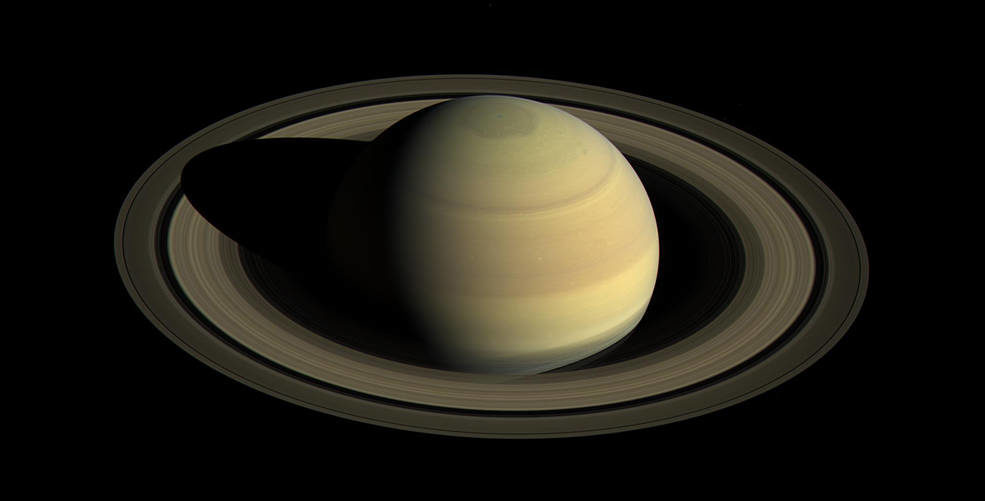
© NASA, ESA, Lotfi Ben-Jaffel (IAP & LPL)A composite image showing hydrogen on Saturn. Observations from five spacecraft over 40 years have shown that as Saturn's rings slowly disintegrate, the particles fall into the planet's atmosphere and heat it.
Saturn's rings are heating up the planet. Forty years' worth of observations have shown that particles from the rings are hailing down into the atmosphere, slamming into the hydrogen there and heating it up - but there's also too much hydrogen, and we don't know why.

Lotfi Ben-Jaffel at the Paris Institute of Astrophysics and his colleagues made this discovery using archival data from the two Voyager probes, which flew past Saturn in 1980 and 1981, the International Ultraviolet Explorer, which was a space telescope that operated from 1978 to 1996, and the Cassini spacecraft, which orbited Saturn from 2004 to 2017. All of those observations were taken with different types of instruments, though, so they couldn't be directly compared.

To fix that, Ben-Jaffel and his team took new observations of Saturn using the Hubble Space Telescope. They then calibrated all of the archival measurements so that the UV brightnesses matched what Hubble measured, allowing the light spectrum from each spacecraft to be compared with the others.

Comment: Could it be that Saturn is 'heating up' for the same reason that activity on other planets also seems to be on the increase?