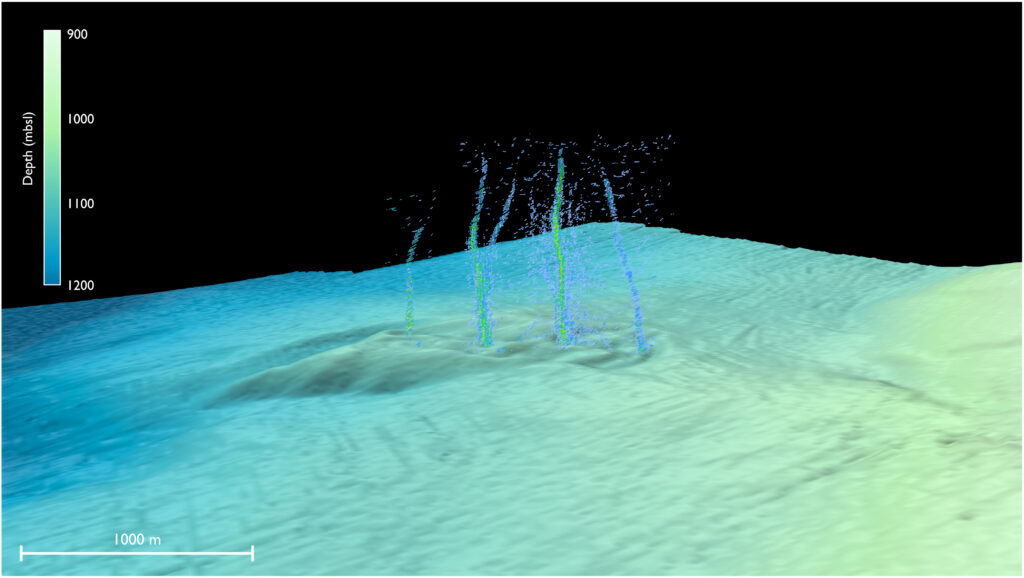
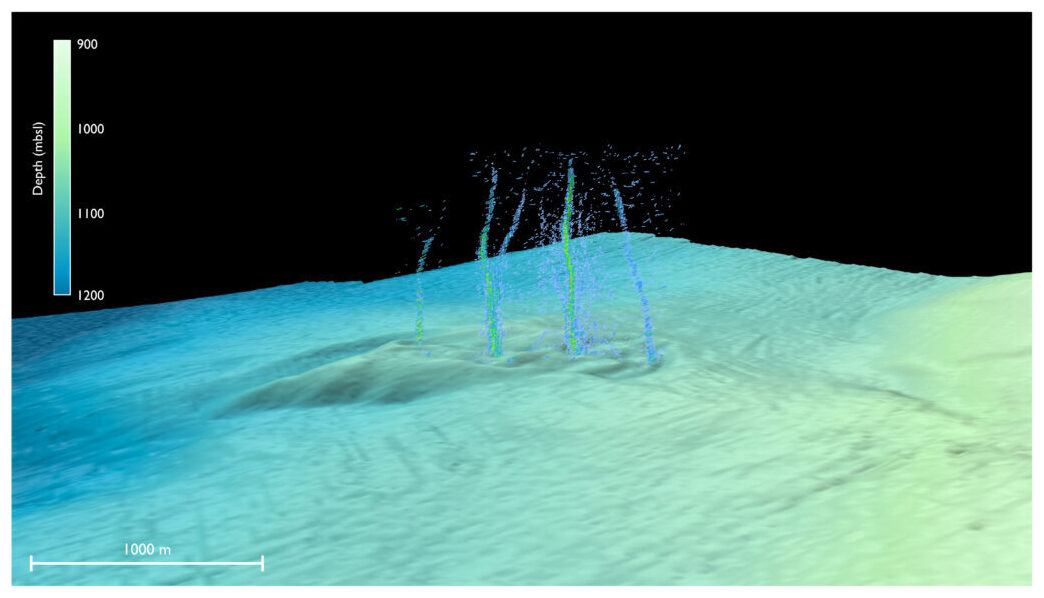
© Philip et al./Science AdvancesThis sonar image of the Pythias Oasis site shows bubbles rising from the seafloor about two-thirds of a mile deep and 50 miles off Newport, Oregon. These bubbles are a byproduct of a unique site where warm, chemically distinct fluid gushes from the seafloor. Researchers believe this fluid comes directly from the Cascadia megathrust zone, or plate boundary, and helps control stress buildup between the two plates.
The field of plate tectonics is not that old, and scientists continue to learn the details of earthquake-producing geologic faults.
The Cascadia Subduction Zone — the eerily quiet offshore fault that threatens to unleash a magnitude-9 earthquake in the Pacific Northwest — still holds many mysteries.A study led by the University of Washington discovered seeps of warm, chemically distinct liquid shooting up from the seafloor about 50 miles off Newport, Oregon. The
paper, published Jan. 25 in
Science Advances, describes the unique underwater spring the researchers named
Pythia's Oasis. Observations suggest the spring is sourced from water 2.5 miles beneath the seafloor at the plate boundary, regulating stress on the offshore fault.
The team made the discovery during a weather-related delay for a cruise aboard the RV Thomas G. Thompson. The ship's sonar showed unexpected plumes of bubbles about three-quarters of a mile beneath the ocean's surface. Further exploration using an underwater robot revealed the bubbles were just a minor component of warm, chemically distinct fluid gushing from the seafloor sediment.
"They explored in that direction and what they saw was not just methane bubbles, but water coming out of the seafloor like a firehose. That's something that I've never seen, and to my knowledge has not been observed before," said co-author
Evan Solomon, a UW associate professor of oceanography who studies seafloor geology.
The feature was discovered by first author
Brendan Philip, who did the work as a UW graduate student and now works as a White House policy advisor.
Observations from later cruises show the fluid leaving the seafloor is 9 degrees Celsius (16 degrees Fahrenheit) warmer than the surrounding seawater. Calculations suggest the
fluid is coming straight from the Cascadia megathrust, where temperatures are an estimated 150 to 250 degrees Celsius (300 to 500 degrees Fahrenheit).














Comment: