
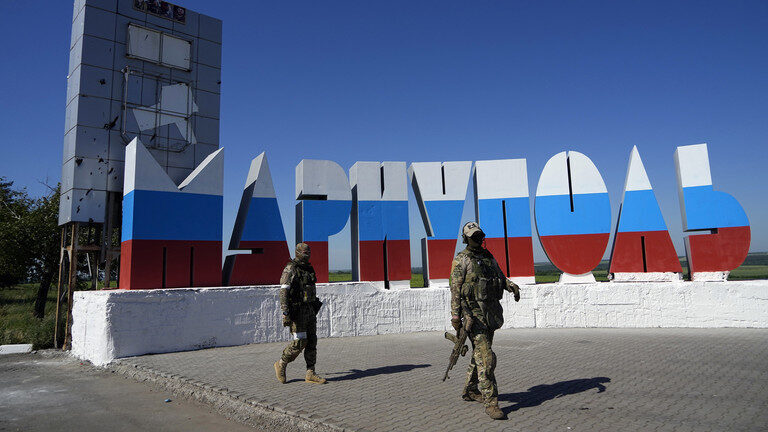
© APFILE PHOTO: Russian soldiers walk past a repainted sign outside Mariupol, Russia, June 12, 2022
The share of Ukrainians willing to make territorial concessions to Russia in exchange for a peace deal has almost doubled since early summer, according to a new survey. However, a significant majority still believe that Ukraine can beat Russia on the battlefield with more Western weapons.
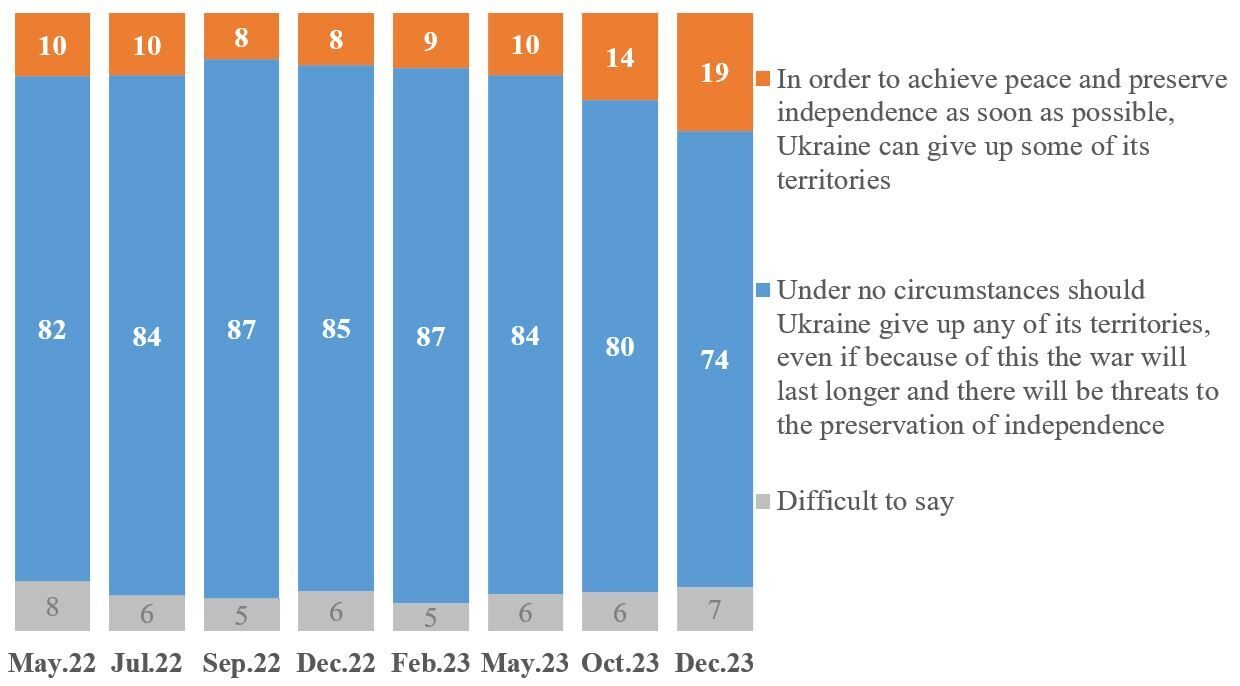
The poll, carried out by the Kiev International Institute of Sociology and released on Thursday, found that 19% of respondents would favor such a deal, up from 10% in May; 74% insisted that "under no circumstances should Ukraine give up any of its territories," while 7% were unsure.
Comment: There is a lot of commentary to this rather short article. It is an effort to place the survey and its results in the context of the ongoing conflict and its future prospects.
Of those who would back a peace deal, 71% said that Ukraine would be able to win a military victory if it received enough weapons from the West. Among those who oppose a deal, belief in the supremacy of Western arms was even stronger, with 93% agreeing that "with proper support from the West, Ukraine can achieve success."
Comment: The poll report explains:
Respondents who support territorial concessions are indeed more pessimistic in their views - 22% among them believe that Russia is too strong and even adequate help from the West will not help. However, the majority (71%) of those who are ready for territorial concessions believe that with proper support from the West, Ukraine will be able to achieve success.What this means is that 22 % of the 19 % think "that Russia is too strong and even adequate help from the West will not help". This is about 4 % of the total number of people interviewed, while the 71 % of the 19 % is 13-14 % of the total.
Overall there is support for continued war. At least that is what the numbers would indicate. RT does not dispute them, but assumes they are representative. The difference between the Russian perspective and the Ukrainian interpretation, is that RT says the cup is fuller, in terms of support for peace, while the Ukrainian side says the cup is as good as full, in terms of support for continued conflict.
A fellow editor gave this comment:
"Interesting information comes from the first graph on the poll site.
Graph 1. With which of these statements regarding possible compromises to achieve peace with Russia do you agree to a greater extent?It can be assumed that honesty etc. stayed more or less the same between May 2022 and Dec 2023. The 'best' results for the Ukies' war lords they got in Sept 2022: the lowest % of undecided as well as pro-peace citizens, and the highest % for continuation of the war no matter what. Since then, it was getting worse and worse. Slowly, but still."© KYIV INTERNATIONAL INSTITUTE of SOCIOLOGY
The pollsters surveyed 1,031 adults in Ukraine and in parts of four formerly Ukrainian regions claimed by Kiev.
Comment: About the sampling they write:
From November 29 to December 9, 2023, the Kyiv International Institute of Sociology (KIIS) conducted its own all-Ukrainian public opinion survey "Omnibus". By the method of computer-assistedtelephoneinterviews(CATI) based on a random sample of mobile phone numbers (with random generation of phone numbers and subsequent statistical weighting), 1,031 respondents living in all regions of Ukraine (except AR of Crimea) were interviewed. The survey was conducted with adult (aged 18 and older) citizens of Ukraine who, at the time of the survey, lived on the territory of Ukraine (within the boundaries controlled by the authorities of Ukraine until February 24, 2022). The sample did not include residents of territories that were not temporarily controlled by the authorities of Ukraine until February 24, 2022 (AR of Crimea, the city of Sevastopol, certain districts of the Donetsk and Luhansk oblasts), and the survey was not conducted with citizens abroad.If you received a call from "Kiev International Institute of Sociology" how many would just hang up? In fact, how many declined to participate. And if you answered, how honest would you be? The question arises, since in some EU countries, all calls are logged for the purpose of preventing terrorism. Why should the practice of logging calls exclude a place like Ukraine?
An interesting perspective is that millions of people have left Ukraine, they are still Ukrainians, but they no longer have mobile phone number in Ukraine. How many of those that fled the war, including in many cases their own mobilization, would support more of it. A guess is that less would do so than among those that remain in Ukraine.
In the study there was also:
On the other hand, the categories of respondents regarding the readiness of territorial concessions have opposite views on the strategy of actions in the event of a significant decrease in support for the West. Among respondents who are ready for territorial concessions, 69% would consider it expedient to stop hostilities with serious security guarantees (28% are in favor of continuing hostilities). At the same time, among respondents who are against any territorial concessions, even under the condition of a significant limitation of aid, 70% are in favor of the continuation of hostilities (and 22% are in favor of their cessation).To understand where the Ukrainians are coming from, there is first of all the change of support since May. A couple of prominent people in Ukraine have changed their way of expressing themselves since May, here are some headlines:
Boris Johnson derailed Ukraine peace deal - key Zelensky ally The article comment has many links to articles that point in the same direction.
Zelensky exposed: Former advisor reveals how Ukrainian president thinks he is omnipotent
"Infantry pours blood in liters": Arestovich breaks all Ukrainian propaganda (VIDEO)
West 'screwed over' Ukraine - ex -Zelensky aide
Time for peace talks - former Zelensky adviser
Hotel Ukraine: 'Sure, check-out any time, but you can never leave'
And what is the plan of the Western parties? How to understand the NATO-Western perspective. There was from the Estonian Ministry of Defense a report published on December 13, 2023. Estonia is a country with 1.3 million people and 45,000 km2. Its capital Tallinn is about 300 km from Sankt Petersburg, and just 90 km from Helsinki, the capital of the brand new NATO country, Finland.
In their press release, they write at the end:
Ukraine's victory and Russia's defeat in this war is achievable. In fact, this war can be won within the next three years or less, by adjusting and increasing the Euro-Atlantic community's military production output and assistance to Ukraine, and imposing the perspective of an intolerable level of attrition on Russia.Ukraine's continued war effort, pushed by NATO will not "come at a fraction of the cost in comparison to the alternative consequences." What would have happened if Ukraine and Russia had agreed in March 2022? But as just mentioned, Boris Johnson derailed Ukraine peace deal - key Zelensky ally
A renewed strategy for providing the Armed Forces of Ukraine the necessary training and military equipment will bring about the conditions for defeating Russia's imperialist theory of victory. With Ukraine's admirable fighting spirit and the transatlantic community's unparalleled military-technological advantage and resources, Ukraine's victory will come at a fraction of the cost in comparison to the alternative consequences.
The reality is that for US and aligned forces, Ukrainians are important to secure world dominion.
Furthermore, accelerated and scaled-up investments into defence industrial production that are critical for Ukraine will fundamentally contribute to NATO's credibility, ability and readiness to provide for the deterrence and defence of the Euro-Atlantic area and beyond.If Ukraine can not even decide when it wants to make peace, what independence, sovereignty and freedom of Ukraine, do the report writers have in mind, when they write:
This military strategy will make way for a renewed and enduring vision of peace and strength, in conjunction with a revived Ukraine that is independent, sovereign, free in its entirety, and prospering as a fresh member of both the European Union and NATO.There is only one plan:
Ending Russia's war in Ukraine with Ukraine's victory and Russia's defeat is the single possible first step towards this aimIn the report itself: Setting Transatlantic Defence up for Success: A Military Strategy for Ukraine's Victory and Russia's Defeat (9.5 MB, PDF) one finds other indications for the global importance assigned to the war in Ukraine, and not for the sake of Ukraine and Ukrainians, but for the benefit of US and western allies.
The global security environment is spiralling downwards at a rapid pace. Freedom and democracies are increasingly threatened across continents. The Euro-Atlantic community faces a multitude of crises, which are increasingly declining into security challenges, that neither the United States nor Europe could tackle alone. (p. 4/24)A winning point for using Ukrainian soldiers is the price, just €3500 per trained soldier, especially if that includes transport, housing, food, and clothing.
By the end of 2023, European training efforts under the EU Military Assistance Mission in support of Ukraine (EUMAM) and the UK-led Operation Interflex will have collectively trained 60,000 Ukrainian troops. With additional training provided by the United States and the greater coalition, the total Western effort since Russia's full-blown invasion in February 2022 has therefore reached close to 100,000 personnel over 20 months. The 30,000- troop European effort is estimated to have cost slightly over €100 million, placing the total cost estimate as low as approximately €350 million (or €3500 per trained soldier). (p. 12/24)On the next page, the impression is that the Armed Forces of Ukraine with a bit of money and training can become a "highly cost-effective and attainable toolbox for promoting Ukraine's success on the battlefield."
While the needs for basic and specialist training persist, it is a matter of priority to expand the scope of the AFU in order to allow turning overall manpower into an even more lethal fighting power.An excerpt that highlights the usefulness of cheap, disposable Ukrainian soldiers in the scheme of Western hegemony is:
Each of these lines of effort can bring enormous improvement to AFU in support of scaling the reach and effect of its operations, for a modest amount of resources and within a relatively short timeframe. In return, it will provide a highly cost-effective and attainable toolbox for promoting Ukraine's success on the battlefield. (p. 13/24)
From a historic and strategic perspective, this cost to the Euro-Atlantic community of further arming and training Ukraine and accelerating investments into defence is both affordable and sustainable. The defeat of Russian forces in Ukraine and the maximal attrition of its military is also a direct means of lowering the threshold of what is needed to achieve conventional deterrence in Europe. And lastly, the increased investment commitments into defence will directly translate into accelerated and expanded defence-industrial output that is urgently required to address the threats and adversarial powers across the globe. (p. 22/24)If one imagines the same understandings are being promoted in Ukraine and if the Ukrainians take in the narrative in the same optimistic way as the report lays out, no wonder the responses in the poll.
The news article continues:
Ukrainian President Vladimir Zelensky has maintained since the start of the conflict that his military will retake all of Ukraine's former territories, including Crimea. However, his long-promised summer counteroffensive failed to land Ukraine more than a handful of frontline villages and resulted in the loss of over 125,000 troops and 16,000 pieces of heavy equipment, according to the latest figures from the Russian Defense Ministry.
Comment: 125,000 Ukrainian troops is not an argument for peace. The "Estonian" report, is not concerned about Ukrainian losses, but about Russian:
The objective therefore should be to inflict a sustained rate of attrition of at least 50,000 killed and severely wounded Russian troops per six months to consistently degrade the quality of Russian force, preventing Russia from regenerating offensive combat power - which Ukraine has so far successfully achieved.The West can simply not conceive of living in a world where they would not be able to dictate their conditions to everyone else as they please. For them, what does not fit, needs to be managed, or regime changed.
Additional quantitative and qualitative training of Ukraine's troops, together with the necessary military assistance, will further increase Russia's attrition, forcing Russia to enact full national mobilisation - accelerating the desired attrition rate and increasing the risk of domestic strife for the Russian regime. (p.11/24)
The report expects a total victory by 2026 at the latest.
Guided by this reinforced vision and strategy, 2024 will be a year of strategic build-up and defence for both Ukraine and the Euro-Atlantic community. It will continue to systematically attrite Russian economy, finances, manpower and equipment, before the pace and outlook of defeat for Russia will rapidly accelerate through 2025 as the United States' and Europe's defence-industrial output reaches new levels. With that ever-growing and strengthening resolve, Ukraine will indeed win and Russia will lose by 2026 the latest. (p. 22/24)Germany must be in on it, or forced to be in on the above plan to keep UAF fighting in Ukraine. Recently there was: Germany warns it may declare an emergency in order to ram Ukraine funds through parliament
At the same time, there have been headlines like:
UK preparing to push Ukraine toward peace talks - media
US-German 'peace talks plot' shows West on brink of losing Ukraine
Ukraine 'concerned' by Western push for peace talks - security chief
Kiev will only sign peace agreement if Russia pays 'reparations' - Ukrainian minister
US, EU officials broach topic of peace negotiations with Ukraine - NBC
Seymour Hersh: Russia, Ukraine peace deal already underway
Mexico's president urges end to 'irrational' Ukraine war, wants Russia at peace talks
Top NATO official apologizes for 'peace proposal' whereby Ukraine trades territory for membership
If one considers the above stirs in the direction of peace, and compare them both with the plans in the "Estonian" report, as well as the results of the poll, then any "peace" at this time would probably mean a frozen conflict, a strategic pause, a time out, a cease fire, until Western powers and battle-willing Ukrainians are ready for more conflict, just as what followed Minsk 1 and 2.
The news article continues:
With the offensive halted, Zelensky is heading into 2024 with US Republicans blocking President Joe Biden's promised $60 billion military aid package until at least mid-January. Existing US military aid is dwindling, and Zelensky has reportedly been instructed by the Pentagon to conserve what equipment remains.
Comment: The above news, does not bode well for realizing the ambitions laid out in the "Estonian" report. Recently there has also been:
Ukraine living on borrowed time - ex-NATO commander
West has 'backstabbed' Ukraine - Lukashenko
Zelensky's global begging tour is an obscene fiasco
400,000 Ukrainians killed in action explains a whole lot
Ukraine conflict will end 'in months' - Chechen leader
Ukraine asking US for military aid that doesn't exist - NYT but at the same time:
The Pentagon's rush to deploy AI-enabled weapons may kill us all
Applying the Pentagon push for AI-enabled weapons to the intent of the "Estonian" report and its goal, could then be to boost AI-enabled weapons when the Ukrainians run out, and turn the conflict into one of AI against humans.
Any future peace deal between Moscow and Kiev will be worse for Ukraine than the agreement proposed by the Kremlin before the conflict. In early 2022, Russia called on NATO to provide legally binding guarantees that Ukraine would not become a member of the bloc, and demanded that Ukraine abide by the 2015 Minsk agreements, which guaranteed autonomy to the regions of Donetsk and Lugansk.
Donetsk, Lugansk, Kherson, and Zaporozhye have all now seceded from Ukraine and joined the Russian Federation, and the Kremlin maintains that any potential settlement must take these new "territorial realities" into account. Russian President Valdimir Putin said on Thursday that Moscow seeks the "de-Nazification and demilitarization of Ukraine" as well as "neutral status" for the country, and will not stop its military operation until these goals are achieved.




"Over the course of the operation, over 3.8 million personnel of the Axis powers—the largest invasion force in the history of warfare—invaded the western Soviet Union along a 2,900-kilometer (1,800 mi) front, with 600,000 motor vehicles and over 600,000 horses for non-combat operations. The offensive marked a massive escalation of World War II, both geographically and with the Anglo-Soviet Agreement, which brought the USSR into the Allied coalition. The operation opened up the Eastern Front, in which more forces were committed than in any other theater of war in human history. The area saw some of history’s largest battles, most horrific atrocities, and highest casualties (for Soviet and Axis forces alike), all of which influenced the course of World War II and the subsequent history of the 20th century."
Note to Zelensky & Co: HITLER LOST.