
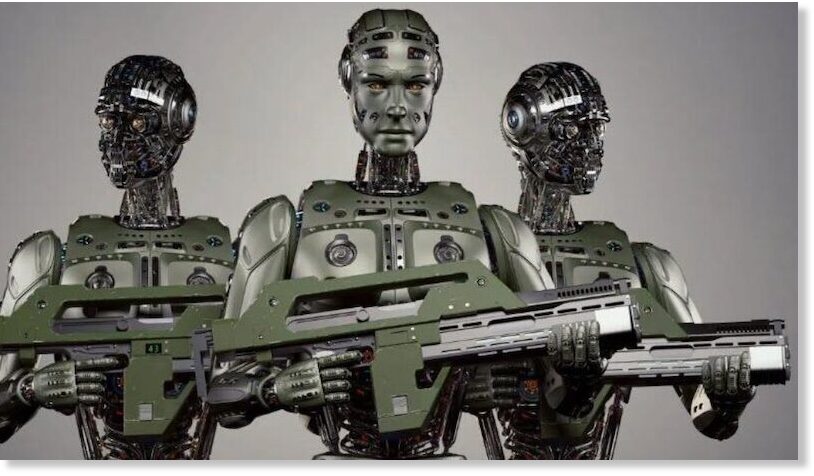
The recent boardroom drama over the leadership of OpenAI — the San Francisco-based tech startup behind the immensely popular ChatGPT computer program — has been described as a corporate power struggle, an ego-driven personality clash, and a strategic dispute over the release of more capable ChatGPT variants. It was all that and more, but at heart represented an unusually bitter fight between those company officials who favor unrestricted research on advanced forms of artificial intelligence (AI) and those who, fearing the potentially catastrophic outcomes of such endeavors, sought to slow the pace of AI development.
At approximately the same time as this epochal battle was getting under way, a similar struggle was unfolding at the United Nations in New York and government offices in Washington, D.C., over the development of autonomous weapons systems — drone ships, planes, and tanks operated by AI rather than humans. In this contest, a broad coalition of diplomats and human rights activists have sought to impose a legally binding ban on such devices — called "killer robots" by opponents — while officials at the Departments of State and Defense have argued for their rapid development.
At issue in both sets of disputes are competing views over the trustworthiness of advanced forms of AI, especially the "large language models" used in "generative AI" systems like ChatGPT. (Programs like these are called "generative" because they can create human-quality text or images based on a statistical analysis of data culled from the Internet). Those who favor the development and application of advanced AI — whether in the private sector or the military — claim that such systems can be developed safely; those who caution against such action, say it cannot, at least not without substantial safeguards.
Without going into the specifics of the OpenAI drama — which ended, for the time being, on November 21 with the appointment of new board members and the return of AI whiz Sam Altman as chief executive after being fired five days earlier — it is evident that the crisis was triggered by concerns among members of the original board of directors that Altman and his staff were veering too far in the direction of rapid AI development, despite pledges to exercise greater caution.
As Altman and many of his colleagues see things, humans technicians are on the verge of creating "general AI" or "superintelligence" — AI programs so powerful they can duplicate all aspects of human cognition and program themselves, making human programming unnecessary. Such systems, it is claimed, will be able to cure most human diseases and perform other beneficial miracles — but also, detractors warn, will eliminate most human jobs and may, eventually, choose to eliminate humans altogether.
"In terms of both potential upsides and downsides, superintelligence will be more powerful than other technologies humanity has had to contend with in the past," Altman and his top lieutenants wrote in May. "We can have a dramatically more prosperous future; but we have to manage risk to get there."
For Altman, as for many others in the AI field, that risk has an "existential" dimension, entailing the possible collapse of human civilization — and, at the extreme, human extinction. "I think if this technology goes wrong, it can go quite wrong," he told a Senate hearing on May 16. Altman also signed an open letter released by the Center for AI Safety on May 30 warning of the possible "risk of extinction from AI." Mitigating that risk, the letter avowed, "should be a global priority alongside other societal-scale risks, such as pandemics and nuclear war."
Nevertheless, Altman and other top AI officials believe that superintelligence can, and should be pursued, so long as adequate safeguards are installed along the way. "We believe that the benefits of the tools we have deployed so far vastly outweigh the risks, but ensuring their safety is vital to our work," he told the Senate subcommittee on privacy, technology and the law.
Washington Promotes the "Responsible" Use of AI in Warfare
A similar calculus regarding the exploitation of advanced AI governs the outlook of senior officials at the Departments of State and Defense, who argue that artificial intelligence can and should be used to operate future weapons systems — so long as it is done so in a "responsible" manner.
"We cannot predict how AI technologies will evolve or what they might be capable of in a year or five years," Amb. Bonnie Jenkins, under secretary of state for arms control and nonproliferation, declared at a Nov. 13 UN presentation. Nevertheless, she noted, the United States was determined to "put in place the necessary policies and to build the technical capacities to enable responsible development and use [of AI by the military], no matter the technological advancements."
Jenkins was at the UN that day to unveil a "Political Declaration on Responsible Military Use of Artificial Intelligence and Autonomy," a US-inspired call for voluntary restraints on the development and deployment of AI-enabled autonomous weapons. The declaration avows, among other things, that "States should ensure that the safety, security, and effectiveness of military AI capabilities are subject to appropriate and rigorous testing," and that "States should implement appropriate safeguards to mitigate risks of failures in military AI capabilities, such as the ability to... deactivat[e] deployed systems, when such systems demonstrate unintended behavior."
None of this, however, constitutes a legally binding obligation of states that sign the declaration; rather, it simply entails a promise to abide by a set of best practices, with no requirement to demonstrate compliance with those measures or risk of punishment if found to be in non-compliance.
Although several dozen countries — mostly close allies of the United States — have signed the declaration, many other nations, including Austria, Brazil, Chile, Mexico, New Zealand, and Spain, insist that voluntary compliance with a set of US-designed standards is insufficient to protect against the dangers posed by the deployment of AI-enabled weapons. Instead, they seek a legally binding instrument setting strict limits on the use of such systems or banning them altogether. For these actors, the risks of such weapons "going rogue," and conducting unauthorized attacks on civilians, is simply too great to allow their use in combat.
"Humanity is about to cross a major threshold of profound importance when the decision over life and death is no longer taken by humans but made on the basis of pre-programmed algorithms. This raises fundamental ethical issues," Amb. Alexander Kmentt, Austria's chief negotiator for disarmament, arms control, and nonproliferation, told The Nation.
For years, Austria and a slew of Latin American countries have sought to impose a ban on such weapons under the aegis of the Convention on Certain Conventional Weapons (CCW), a 1980 UN treaty that aims to restrict or prohibit weapons deemed to cause unnecessary suffering to combatants or to affect civilians indiscriminately. These countries, along with the International Committee of the Red Cross and other non-governmental organizations, claim that fully autonomous weapons fall under this category as they will prove incapable of distinguishing between combatants and civilians in the heat of battle, as required by international law. Although a majority of parties to the CCW appear to share this view and favor tough controls on autonomous weapons, decisions by signatory states is made by consensus and a handful of countries, including Israel, Russia, and the United States, have used their veto power to block adoption of any such measure. This, in turn, has led advocates of regulation to turn to the UN General Assembly — where decisions are made by majority vote rather than consensus — as an arena for future progress on the issue.
Comment: We are already seeing AI being used by Israel's IDF in Gaza: 'The Gospel': how Israel uses AI to select bombing targets in Gaza
On October 12, for the first time ever, the General Assembly's First Committee — responsible for peace, international security, and disarmament — addressed the dangers posed by autonomous weapons, voting by a wide majority — 164 to 5 (with 8 abstentions) — to instruct the secretary-general to conduct a comprehensive study of the matter. The study, to be completed in time for the next session of the General Assembly (in fall 2024), is to examine the "challenges and concerns" such weapons raise "from humanitarian, legal, security, technological, and ethical perspectives and on the role of humans in the use of force."
Although the UN measure does not impose any binding limitations on the development or use of autonomous weapons systems, it lays the groundwork for the future adoption of such measures, by identifying a range of concerns over their deployment and by insisting that the secretary-general, when conducting the required report, investigate those dangers in detail, including by seeking the views and expertise of scientists and civil society organizations.
"The objective is obviously to move forward on regulating autonomous weapons systems," Ambassador Kmentt indicated. "The resolution makes it clear that the overwhelming majority of states want to address this issue with urgency."
What will occur at next year's General Assembly meeting cannot be foretold, but if Kmentt is right, we can expect a much more spirited international debate over the advisability of allowing the deployment of AI-enabled weapons systems — whether or not participants have agreed to the voluntary measures being championed by the United States.
At the Pentagon, It's Full Speed Ahead
For officials at the Department of Defense, however, the matter is largely settled: the United States will proceed with the rapid development and deployment of numerous types of AI-enabled autonomous weapons systems. This was made evident on August 28, with the announcement of the "Replicator" initiative by Deputy Secretary of Defense Kathleen Hicks.
Noting that the United States must prepare for a possible war with China's military, the People's Liberation Army (PLA), in the not-too-distant future, and that US forces cannot match the PLA's weapons inventories on an item-by-item basis (tank-for-tank, ship-for-ship, etc.), Hicks argued that the US must be prepared to overcome China's superiority in conventional measures of power — its military "mass" — by deploying "multitude thousands" of autonomous weapons.
"To stay ahead, we're going to create a new state of the art — just as America has before — leveraging attritable [i.e., disposable], autonomous systems in all domains," she told corporate executives at a National Defense Industrial Association meeting in Washington. "We'll counter the PLA's mass with mass of our own, but ours will be harder to plan for, harder to hit, harder to beat."
In a follow-up speech, delivered on September 6, Hicks provided (slightly) more detail on what she called all-domain attritable autonomous (ADA2) weapons systems. "Imagine distributed pods of self-propelled ADA2 systems afloat...packed with sensors aplenty.... Imagine fleets of ground-based ADA2 systems delivering novel logistics support, scouting ahead to keep troops safe.... Imagine flocks of [aerial] ADA2 systems, flying at all sorts of altitudes, doing a range of missions, building on what we've seen in Ukraine."
As per official guidance, Hicks assured her audience that all these systems "will be developed and fielded in line with our responsible and ethical approach to AI and autonomous systems." But except for that one-line one nod to safety, all the emphasis in her talks was on smashing bureaucratic bottlenecks in order to speed the development and deployment of autonomous weapons. "If [these bottlenecks] aren't tackled," she declared on August 28, "our gears will still grind too slowly, and our innovation engines still won't run at the speed and scale we need. And that, we cannot abide."
And so, the powers that be — in both Silicon Valley and Washington — have made the decision to proceed with the development and utilization of even more advanced versions of artificial intelligence despite warnings from scientists and diplomats that the safety of these programs cannot be assured and that their misuse could have catastrophic consequences. Unless greater effort is made to slow these endeavors, we may well discover what those consequences might entail.
Michael T. Klare, The Nation's defense correspondent, is professor emeritus of peace and world-security studies at Hampshire College and senior visiting fellow at the Arms Control Association in Washington, D.C. Most recently, he is the author of All Hell Breaking Loose: The Pentagon's Perspective on Climate Change.



Reader Comments
Been digging deep into anthropology, philosophy, Red Queen Dynamics Hypothsis, Mimetic Theory by Rene Girard & interestingly the origin of Rome & its mythological story about the two founding brothers Romulus & Remus. The story is central to a myth about two twin brothers found by a She-wolf (“Lupa” is a Latin vulgate slang term that just coincidentally means whore/prostitute hence what the EL-ite already know as the “Whore of Babylon” since we know that Babylon was also a term used for “Roma” (all of it is esoteric occulted stuff that is deeply steeped in myth & truth.) it takes layers of filtering sifting through the detritus layers to find the seeds/kernals of truth.
You & perhaps a few others here would find this link below interesting perhaps regarding Mimetic Theory. The reason why I keep digging here is that I already know the EL-ite need a scapegoat. ‘AI” is the SCAPEGOAT 100%. Sort of “the Devil Made Me do It” dogma/gestalt. This also fits the niche for the Terminator scrip Rise of the Machines which coincidentally took over humanity plot. Seems to fit the niche imo.
As always YMMV. BUT, it is viable & I can easily see the nexus points.
What is Mimetic Theory? [Link]
René Girard’s mimetic theory began with an understanding about desire and blossomed into a grand theory of human relations. Based on the insights of great novelists and dramatists – Cervantes, Shakespeare, Stendhal, Proust, and Dostoevsky – Girard realized that human desire is not a linear process, as often thought, whereby a person autonomously desires an inherently desirable object (Meredith desires McDreamy). Rather, we desire according to the desire of the other (many women are attracted to McDreamy, suggesting to Meredith that he is irresistible). We rely on mediators or models to help us understand who and what to desire. The problem, however, is that imitative desire leads to conflicts because a model can quickly become a rival who competes with us for the same object.Mimetic desire leads to escalation as our shared desire reinforces and enflames our belief in the value of the object. This escalation contains the potential for a war of all against all. According to Girard, the primary means for avoiding total escalation came through what he calls the scapegoat mechanism, in which conflict is resolved by uniting against an arbitrary other who is excluded and blamed for all the chaos. With the guilty party gone, the conflict ends and peace and social order return to the community. Achieving social order in this way is only possible, however, if the excluding parties unanimously believe that the person or group expelled is truly guilty or dangerous.Girard’s examination of different “myths of origin” revealed that scapegoats, regardless of their actual crime, have carried the weight of all of the community’s transgressions. Read inside out, these stories reveal much about primitive society’s attempt to curtail violence and restore order in a fragile world with no civil structures. All of human culture, according to Girard, is built upon the edifice of scapegoating and ritual repetition. This reading of culture, inspired by an insight into of the innocence of the victim made available in the Jewish and Christian scriptures, has made possible an increased awareness of this mechanism and its aftereffects, so as to interrupt these processes and achieve a different kind of peace.In summary, we can say that mimetic theory consists of three interconnected movements: mimetic desire, the scapegoating mechanism, and revelation. It will be helpful to revisit these movements in more detail, beginning with desire.
Mimetic Desire
Mimetic desire operates as a subconscious imitation of another’s desire. The same unconscious pull explains both friendship and rivalry. For example, let’s say that I am a graduate student in the field of psychology, and I am desperate to work with the highly esteemed professor in our department, Dr. Jones. Dr. Jones seems to have it all – respect, a thriving research lab, and many collaborations with the world-renowned psychologist, Dr. Smart. For a good year, I work hard to be just like Dr. Jones – I copy her research methods, attend similar conferences, and work at a pace that mirrors Dr. Jones’. As time goes on, my research practice takes off, and soon it is I and not Dr. Jones who is being asked to headline conferences with Dr. Smart. It’s not long before Dr. Jones, who had taken pride in my successes, comes to think of me as a rival for opportunities to work with Dr. Smart. Dr. Jones may even accuse me of a new desire – that of wanting to destroy her career and she may soon act to undermine my career rather than encourage it. Collaboration has turned to rivalry and friendship into enmity.René Girard called this a “mimetic rivalry” to highlight the movement from a model-subject to a model-obstacle relationship. This shift occurs when desires converge on an object that cannot be shared (such as a job, a first place prize, or a lover) or that the rivals are unwilling to share (such as fame or working with Dr. Smart). It’s important to note that the two rivals are now models for one another, enflaming each other’s desire to work with Dr. Smart by desiring to possess it exclusively. Each is now a model-obstacle for the other, something both would vehemently deny. Each will claim that their desire is autonomous and the other has betrayed their friendship out of plain wickedness. Girard has pointed out that the problem is not that desires are mimetic, but that in clinging to the mirage of our own originality we become prone to blaming others rather than recognize our complicity in mimetic rivalries. Desire: Research Applications
The Scapegoat Mechanism
The second movement in mimetic theory is that of the scapegoat mechanism. As rivals become more and more fascinated with each other, friends and colleagues may be mimetically drawn into the conflict as rival coalitions form. What began as a personal battle may escalate into a Hobbesian battle of all against all, threatening the cohesion and peace of an entire community. One way of solving this problem is to find someone to blame for the conflict that all the rival coalitions can unite against. This unfortunate person may or may not be guilty. All that’s required for the scapegoating solution to work is that his guilt is universally agreed upon and that when he is punished or expelled from the community, he will not be able to retaliate. The proof of his guilt is found in the peace that now returns to the community, obtained by virtue of the unanimity against him.Mimetic theory allows us to see that the peace thus produced is violent, comes at the expense of a victim, and is built upon lies about the guilt of the victim and the innocence of the community. This mechanism functioned at the origins of the human species, when this peace appeared as if by magic and was attributed to a visitation from an ambiguous god who came first as the terrible cause of the conflict but then was revealed to be its cure. Prohibitions emerged to forbid the imitative behaviors which lead to conflict, rituals developed that consist of a well-controlled mime of the redemptive violence against a victim (originally human, later animal and so on), and myths were born as the stories that tell of how we became a people as the result of a visitation from the gods. This method of controlling violence with violence can be found in the rites and myths spread all over our planet and gave rise to human culture.Scapegoating also operates in individuals at the level of identity. We all construct identities over against someone or something else. I’m a woman, not a man. I’m a liberal not a conservative. I’m an atheist not a believer. And most problematically, I’m good not bad. When we need some other person or group to be bad so we can maintain our sense of ourselves as good by comparison, we have engaged in scapegoating. We are using others to solidify our identity the same way a community uses a scapegoat to solve its internal conflict. The Scapegoat Mechanism: Research Applications
Revelation When a community in the throes of conflict obtains peace through the violent expulsion of a scapegoat, they cannot perceive that it is their own unanimous violence which produced the peace. This blindness on the part of the participants with respect to what they are really doing – killing an innocent victim – is the one essential element required for the scapegoating mechanism to work. Girard points out that to have a scapegoat is not to know you have one. In other words, participants in the scapegoating mechanism hold an authentic belief in the guilt of the victim, a guilt seemingly demonstrated by the restoration of peace.Girard thinks that the power of Christianity lies in “unveiling” the scapegoat mechanism. Here unveiling is, quite literally, pulling back the curtain to see that, behind all the smoke and sounds is just a small man, pulling the levers. The gospels have the same structure as myths, but an entirely different perspective—a key issue for Girard. In myths we are given a scapegoat whose death promises both to heal fractured communities and to appease the gods. Yet in the gospel story we gradually learn that God is the victim , and that the victim’s blood only appeased humans, not God. Having a real event told in this particular way intends to foster conversion. Though we think of the gospels as telling a story about God, Girard follows Simone Weil in showing that the gospels are as much about us (humans) as about God. And the true power of the story, or the conversion, lies in the permanent alteration in the way we read not only the gospel story, but everything else. Instead of reading through a sacrificial lens, we read through a forgiving lens, realizing that we, both on an individual and on a social level, have been involved in a multi-generational process of victimizing and expelling others. And that God has nothing to do with this violence.Mimetic theory begins with the human shape of desire and does not leave the human even when it engages with theology. The turn to theology in its third movement is not an escape from the terrestrial realm. All of its “theological” insights can be seen working themselves out on the anthropological level. Girard thought humans had been so deeply habituated into patterns of escalating violence, and the scapegoat mechanism to be so perfectly self-justifying, that he concluded it necessary for there to be some real, supernatural interruption to achieve human redemption.
The absence of evidence is not evidence of absence …. Correlation does not necessarily equal causation…
The eyes only see what the brain is prepared to comprehend…
Cheers VonCraq & all the best to you & yours for the Holidays 🌞🔥🦅🥂
Mimetic Desires refer to how we form our desires based on the desires of others around us , aka, our models. That is, we want things because others want them. e.g. Social-cultural Icons Elon Musk, Bezos, Gates, Zukerturd et al.
A Complete Introduction to Mimetic Theory by René Girard [Link]
What is Mimetic Theory ? [Link]
Cheers Bud 🤡💩🎪
Ciao !! Happy Saturnalia, best to all that can sit at your feet and learn this Yule season.
I’m sharing for those as yourself who are genuine critical thinkers & understand the terra firma.
Timothy Hogan : The Temple of Secret Initiates & The Knights Templar [Link] and here [Link] and here [Link]
There’s several videos he’s spilling the beans about so they might not be around for too long. He’s claiming that they do not follow Roman Catholic Church & he’s revealing Arc of the Covenant - he claims there are 10 of them & they know where 6 are at. Claims to have seen one of the Arc & Covenant’s. Talks about Manna - Pyramids as power generators etc.
Very interesting stuff to say the least. 👆
Thank you for that & Happy Saturnalia Day to you & yours as well.
Bonus: Here’s some Holiday Music for you
Kyrie Eleison Templar Chants | Crusade Music | Crucem Sanctam Subiit [Link] 🌞🦅🔥🦉🦋 (Turn it up ! )
Cheers & Namaste’ - Deus Vult
Thank you...
Your knowledge has humbled me. So with that said... the student us always ready, when the teacher wants to appear.
But I boil all that theoretical psychology down to two words: pride jealousy. Both destructive to human behavior.
FYI, "El" is the end of each angel named in the book of Enoch. Hmmm should lead to so.e interesting thoughts.
Here’s some food for thought and a very simple example. An idiot could simply follow Larry Fink’s BlackRock / BlackStone / Vanguard / State Streets stick trades and be profitable beyond measure. You could create your own hybrid algorithm based on advance or decline line margin. People - peers would automatically call you a genius. That how absurd this reality really is.
Literally, fiat lux would be translated as "let light be made" (fiat is the third person singular present passive subjunctive form of the verb facio, meaning "to do" or "to make"). The Douay–Rheims Bible translates the phrase, from the Vulgate, as "Be light made. And light was made."
Take this same epistemological truth above & apply it to “Fiat Currency” now.
Competition of the sprawl to be a relevant voice / force drives the crazy train when they control the playing field. With so many ignorant you have to decide at what point do I withdraw, slow down, become passive, engage & take my shots exposing it or stay in existence making peace with it. I have been doing it for several years now & live one state left over from you in the panhandle. I see the ignorance you speak of every single day especially among the young. I live a simple frugal uncomplicated life now. Live in nature every day away from Super Cities I grew up in. My parents & grandparents didn’t see it but gave me a great upbringing that helped me later put it together.
My suggestion is to read more Emerson/Thoreau if you want a simpler appreciation for life, beauty, divine grace & nature. Read Sci-Fi if you want fantasy turned into the fabricated synthesized Demiurge dystopia dysfunctional current projected reality. You will mirror & reflect what you absorb. Feed the Wolf spirit or virtues you already know not the Wolf spirit of the vices.
Other’s like you, me hear your voice & understand.
Hope you find peace - a quantum of solace in this synthesized chaos. This grand experiment is a Sea change - frontier of Neo-Ro-merica or going to be a renassance of returning to old values. The PTSB are Burning down the house and trying to blame it on the matches.
Out of the ashes rises the Phoenix.
Cheers & Namaste’ 🦅🔥🦋🌞🥂🦉
..........
..........
where have you been? Much has been happening and need your esoteric opinion. I confess I fall short.
and I confess I was condescending in confronting you about creator-DNA-created etc.
I have been missing you mind and take on events and their deeper meaning such as Tucker/Putin, Is-Ra-El and it's scapegoat slaughter of Palestinians.
scapegoating has just blown up into many sacrificial goats...
well, I hope your well...
and hope you get back into the deep discussions.
To illustrate how tuned into frequency & vibration I am as a former cryptologist specialist I’ll attempt to show you to help illuminate the path you seek answers to.
rebus (n.)a puzzle or riddle consisting of words or phrases represented by pictures of objects whose names resemble in sound the words or phrases intended, c. 1600, apparently from Latin rebus (and meaning literally "by means of objects"), ablative plural of res "thing, object" (see re). According to French sources (Gilles Ménage, "Les origines de la langue françoise," 1650), principally from the phrase de rebus quæ geruntur "of things which are going on," in reference to the satirical pieces composed by Picardy clerks at carnivals, subtle satires of current events using pictures to suggest words, phrases or things. Or this use of the Latin word might be from the representations being non verbis sed rebus"not by words, but by things. [Link]
For a point of origin & reference we start at the culprit of western civilization & it’s MAGI-ck tell signs / clues / cryptic encoded secrets. Esoteric philosophy/theology/theosophy speaks to us in frequency/vibration/energy.
It is its own religion/philosophy/theosophy/science/noetics/phronesis language of mystics & mysteries. We are talking about how the EL-ite rule & communicate which keep in mind is separate & different than the sprawls indoctrinated education & predictive programming. That’s usually where the disconnect happens at.
A person develops/hones/molts/transforms the critical thinking skill sets by reading esoteric noetics - phronesis & comprehending the deeper meanings. Proof of concept is how they communicate in metaphors - allegories - legends - myths etc. It’s there you just have to tune into it b/c it’s occulted. I hope I articulated with precision & alacrity well enough for you to comprehend.
Kindly respond & let me know if that resonates with you & I’ll delve deeper into the Memetic Theory - Scape-GOAT theory how the PTSB just recently used it with Biden in the recent investigation where yes it’s true they found him guilty of violating National Security - sensitive documents - even treason beyond reason etc. I can easily demonstrate that as long as I know your tracking my explanations of how they are scape-GOATing Biden’s deminshed mental capacity but yet not going to do anything about it. Again, I digress but clearly have proved proof of concept by the exact findings & actions taken. They scapeGOATed Biden by rationalizing/justifying it by saying he didn’t mean to do with malice a forethought or jeopardize our the whole Country’s safety of EVER SINGLE AMERCIAN citizen including our National sovereignty by his actions.
Plain as the Sun that shines but made clear as mud by scapeGOATing his behavior & actions.
Let me now & I’ll shed more light on it.
Cheers & namaste’ 🦅🦋🐝🌻🌞
Yes exactly. And here is the answer to the puzzle - aka rebus 👇
It turns out that the leading theory on the etymology of Romulus is that his name means “of Rome”. This etymology struck me as odd, given that for Romulus to acquire his name, this city of which he is named after would already have to have a name. Given this etymology, the idea that Romulus named the city or that the city was named after Romulus cannot be true, as he is named after the city. But from where does the name of the city originate ?
Enrique Cabrejas is of the opinion that Rome (Roma/RO-ma) can be translated as “by Force” or “God’s Hand”. He says that Romulus and Remus are nicknames given to the characters due to their stories and personalities. Romulus can be translated as “Lionforce” or “The strong lion” and Remus can be translated as “Backsliding” on “guilt”, “blame”, or “misfortune”. [Link]
Wouldn’t Backsliding/Guilt/Blame or Misfortune all be attributable to a scapeGOAT ? 🌞
The idea of Roma meaning “of Force” or “God’s Hand” is backed up by the writings of Plutarch. “ This great name of Rome, with much glory has spread among all men, (…) and -the force- the weapons given this name to the city, that means Rome. ” Parallel Lives: Romulus. Plutarch. The story of the “Rape of the Sabines” also may add to the idea that Rome means “by Force”, as the women were abducted and taken to Rome to help populate the city. I think the translation from Cabrejas is warranted, but I wanted to dig deeper into the theories about which words Rome might descend from (and so I did).
Roma, Romulus, and Remus are Latin names. The Latin words in this case are based upon Greek words. In Greek, “Rome” [Ρώμη] means “power,” “force,” “fighting army” and “speed tactics”. H. G. Liddell and R. Scot argue that the Latin Roma stems from a Greek verb, roomai , which among other things means “to rush/rush on”.[2] I note here that the English word “rush” shares a similar sound to the word Rasna (or Rasenna), which is what the Etruscans called themselves. Rasenna currently has an unknown etymology. It is also close to the word Rus, which is where the word Russia finds its root. The similarity in sound and spelling is not highly significant in and of itself, but given more variables, the idea of a deeper connectedness appears to me to gain more gravity. I explore this more below. Keep in mind that in the legend, when Romulus and Remus were babies, they were abandoned and thrown into the River Tiber.
Out of all the rivers in Europe, of which there are many, the Volga is the longest one. It has a length of about 2,193 miles (3529 kilometers). It starts in the Valdai Hills, northwest of Moscow, Russia, and it ends in the Caspian Sea (which is the world’s largest inland body of water). The Volga is also popularly considered the National River of Russia.
F. Knauer (Moscow, 1901) traced the etymology of Rus to the Persian name for the Volga, which is ولگا. Prof. George Vernadsky suggested that it stems from the Aryan word for water/moisture. Both etymologies are associated with water, thus, Rus is associated with water, same as the origin of Romulus and Remus. Another idea is that it can be traced to Rosh from the Biblical book of Ezekial. Additionally, there are claims that the word Rus stems from an Old Norse term for “men who row”.[3]Altogether, these ideas lead me to conclude that the original word that inspired Rus was used to refer to people who navigated the rivers. I also now think that Rus and Rome may share a similar root word. Another possibility might be that this is explained by both of their origin stories involving the existence of a mighty river.
Reportedly, the name Remus descends from a word meaning “twin”. The Latin Remus could also descend from the Ancient Greek words eretmós (oar) or erétēs , (rower).[4], [5] I think these are both reasonable ancestor words for Remus, as Romulus and him were twins and both survived the river. Another note to make is that while rowing with one oar can help you navigate the waters, rowing with two oars is where the magic happens.
The word rower (which Remus is arguably based on) can be defined as “a person who rows”. This is the singular version of the definition for the word from which Rus stems. I think the idea of seafaring or traveling on rivers is inseparable from the creation of the Latin word Roma, and that this also provides insight into the history of the word Rus, and potentially Rasenna as well.
References: [1] – Cabrejas, Enrique. “Rome. The Etymological Origins” (2016). [Link] Accessed 9 Dec. 2019.[2] – “Etymology of Rome” (12 Apr. 2019). [Link] Accessed 9 Dec. 2019.[3] – Wiejack, Marta. “Here’s Why Russia Is Called Russia” (18 Jun. 2018). [Link] Accessed 9 Dec. 2019.[4] – [Link] Accessed 9 Dec. 2019.[5] – [Link] Accessed 9 Dec. 2019.[6] – [Link] Accessed 9 Sept. 2020.
Cheers & Namaste’ 🦅🦋🌻🌞🐝
I have an interesting side note regarding this area of hidden gnosis, look up the logo of the pharmaceutical named: Novo Nordisk, the maker of the popular drug Ozempic. If you read the definition of it: they state its an symbol of an apis bull, one of the sacred bulls of ancient Egypt. Note the horns, the sun or moon...
I love delving into symbolism of these El-ite ancient blood lines and their blatant use of esoteric symbols.
this one is Baal. This bull continues its use down through history with Caesars, Popes and one sits in front of the NYSE.
I digressed... go on, please
Next I found your brief summary as I qoute: "Hope you find peace - a quantum of solace in this synthesized chaos. This grand experiment is a Sea change - frontier of Neo-Ro-merica or going to be a renassance of returning to old values. The PTSB are Burning down the house and trying to blame it on the matches.
Out of the ashes rises the Phoenix."
To be well pointed...
So I will never make peace with it... but war has long since left my house of weapons... rather I find solace in one, two or three individuals who i may plant seeds of these topics and either walk away or by chance get to see grow.
change today grows very slowly in mminds.Human 1.0 now questions almost nothing and therefore sees no need to grow.
If nature is truly in them grow they must or rot and die, they are dying. the mind is the battle field, most have been neutralized by now. Fighting the centuries old demiurge has become a solo venture for me and that trail of tears is mostly solitary even though I am around many. So with that said, thank you for your time, your writing gives me hope bright minds do exist at levels that only centuries ago were more common and today are rare.
Deus Vult... I like that.
Yes. Your tracking & your able to “espy” it better. This is how it works. You’re able to dig deeper & see the symbolism they communicate & speak in. This is the code I mentioned & spoke of earlier.
Here’s more for you to absorb & understand the deeper PTSB methods they operate & rule the slave farm we all live in. We can simply refer to it as the “Matrix” since it’s a contemporaneous familiar term we are mutually aware of. It’s also known as the Demiurge. Plato’s Cave is another metaphor so that you can ‘espy’ it better.
Here you go my friend enjoy the Rabbit Hole:
You’ll note that they forgot to tell us all of this below I’m sharing as knowledge for us to know. Keep in mind the King James Bible, who wrote/redacted/edited/abridged/approved it in your mind as your thinking it through regarding its profound influence & intentions of the masses. That’s the key.
King James I: Demonologist [Link]
A Deeply Superstitious Man Even by the standards of his age, King James VI of Scotland, later James I of England, stood out as a deeply superstitious man, obsessed with the occult. Before his reign, witchcraft persecutions had been rare in Britain. But that all changed in 1590 when James personally oversaw the trials by torture for around seventy individuals implicated in the North Berwick Witch Trials, the biggest Scotland had known. Their alleged crime? Raising a storm which nearly sank James’ ship when he sailed home from Norway with his new bride, Anne of Denmark. The trial resulted in possibly dozens of people burned at the stake, although the precise number is unknown.In 1597, James published Daemonologie , his rebuttal of Reginald Scot’s skeptical work, The Discoverie of Witchcraft , which questioned the very existence of witches. Daemonologie was an alarmist book, presenting the idea of a vast conspiracy of satanic witches threatening to undermine the nation.In 1604, only one year after James ascended to the English throne, he passed his new Witchcraft Act, which made raising spirits a crime punishable by execution.
Who Wrote the King James Bible ? [Link]
Bible Verses About Occult [Link]
James I, son of Mary, Queen of Scots (and descended from Henry VII's daughter Margaret), had been King of Scotland for 36 years when he became King of England. Although he was King of both countries, James's attempt to create a full governmental union proved premature. [Link]
King James, the First: Dæmonologie (1597) [Link]
Connect the dots to the rebus.
Deus Vult 🔥🦅🌞🐝🦋
Revelation 18:23 And the light of candle shall shine no more at all in thee; and the voice of the bridegroom and of the bride shall be heard no more at all in thee: for thy merchants were great men of the earth; for by they "sorceries" WERE ALL NATIONS DECIEVED. King James could not contend with this because he was short sighted and ego driven nor could he see the future, only his seer's may have.
I leave you with this.
Are people demon possessed? Or Demonized, or both?
You mean they accomplish what they are trying to do already?
from the article a fact already in play.
After what Human 1.0 has seen and experienced with the double serpent on a pole modern Pharmakeia there will be no question AI will analyze and diagnose exponentially quicker than the Human versions with inline algorithm accuracy.
This will be initially sold as very good but there will be no need for death panels when AI will determine the outcomes based on D-Wave computations and predicted outcomes.
My AI refrigerator will only open if I have loaded it with foods approved for my health as per my "fitbit" performance rating. Then each is chipped with nanotechnology to allow portion size and then coordinate absorption based on carbon nanotechnology already implanted in my physiology.
I'm smarter and perform better only in my assigned daily duties. Efficiency ratings are high. If I deviate off diet I will become symptomatic and recieve and immediate alert, prescription of a drug and placed on restrictions appropriate to the data given.
NOW FOR REALTY: Your damn wrist phones and fit bits are collecting data for just such future programming. Your cognitive ability to have critical thinking is being altered and attacked daily. You have become a slave in a walless prison of your making.
1.0 you have an expiration date.