

Six months after Gov. JB Pritzker signed into law legislation overwhelmingly passed by the state's General Assembly to legalize cannabis, marijuana aficionados lined up to dole out their green for some green.
"This is the beginning of a new age, the end of an antiquated viewpoint. It's beautiful. I can't wait to tell my grandkids about it," 24-year-old Michael Lorimer told the Chicago Tribune, adding that he got in line outside the Midway Dispensary in Chicago at 4:30 a.m. -- more than five hours before the shop opened.
Illinois rang in the New Year by joining nine other states and Washington, D.C., in allowing the sale of recreational weed to persons at least 21 years old.
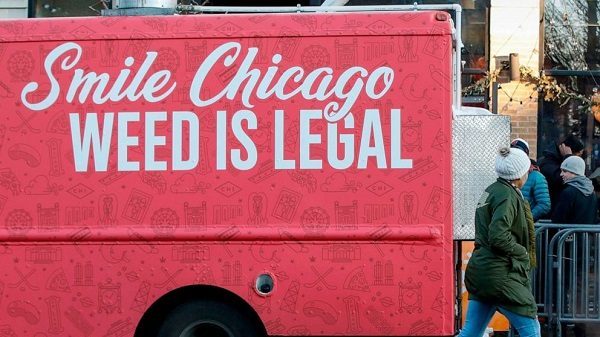
© Kamil Krzaczynski/AFP via Getty ImagesA food truck sits outside the Sunnyside Cannabis Dispensary
Under the law, Illinois residents can buy up to 30 grams of marijuana plant material, edibles with up to 500 milligrams of THC and 5 grams of cannabis concentrate items. Customers from outside the state can purchase half those amounts.
"A small number of cannabis concentrates were miscoded in the State's traceability system, resulting in single-gram concentrates being reported as concentrates that exceeded the concentrate maximum level of 5 total grams. The state's traceability system vendor, BioTrack, has already resolved the issue," a spokesperson for the Illinois Department of Financial and Professional Regulation said in a statement.
Just hours before the prohibition on recreational cannabis was lifted, Pritzker announced he was granting pardons to 11,017 people convicted of low-level marijuana crimes involving fewer than 30 grams of weed.
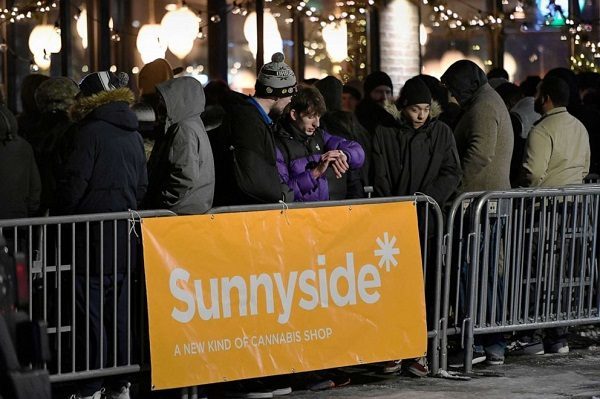
© Paul Beaty/APA long line of people brave the cold as they wait to be the first in Illinois to purchase recreational marijuana at Sunnyside dispensary.
Pritzker, who campaigned on a pledge to legalize cannabis and won election in November 2018, said the defining purpose of legalization "is to maximize equity for generations to come."
The American Civil Liberties Union of Illinois lauded the governor's decision to grant pardons.
"The Governor's pardons of Illinoisans with convictions for marijuana possession makes the new year brighter for thousands. We applaud the Governor for acting to address the history of unnecessary and discriminatory enforcement of marijuana laws in Illinois," the ACLU of Illinois said in a statement. "We know that Black Illinois residents are far more likely to be arrested and convicted for marijuana possession than whites. This is a good step forward as we begin the legal sales of recreational marijuana."
Illinois is the first state where lawmakers passed legislation legalizing recreational cannabis. Voters in the other states and the District of Columbia passed ballot measures.
Other states where cannabis can be legally purchased are Alaska, California, Colorado, Maine, Massachusetts, Michigan, Nevada, Oregon, Vermont and Washington.


Reader Comments
Now, there are others I was/am fond of, see the AB and realize that in the early 70s through 80s, Cocoa WAS THE place it all came in (check my map avatar) because Miami had gotten too hot. By the time I was 16, I'd done more different such items than people ten years older or younger than me ever have done in their lives.
The only thing I'd not tried by then - and to this day? Heroin. Surfers did NOT use needles and did NOT smoke cigarettes. Those were true ostracization offenses. No sh*t. A rare occurrence of peer pressure being a good thing. To this day, I've probably 'smoked'/tried to smoke 5-7? cigarettes. The last two times were separated by ~16 years each, the last time over 20 years ago.
In each event, I'd had like 2-3 beers, (had learned to 'inhale' somehow ) and foolishly took an offered cigarette. Before it would be halfway smoked, I'd be in the parking lot projectile vomiting a la , followed by 20 hour + hangovers. Had a great effect.
R.C.
Don't smoke and drive.
The pyramid trading example of unlawful drugs leads to massive penetration through schools.
There will always be a need for drug education.
The USA made it an international imperative to "make war" on drugs.
The decline in "American" influence is desirable even if most of it is a ploy to encourage yet another Pearl Harbor.