
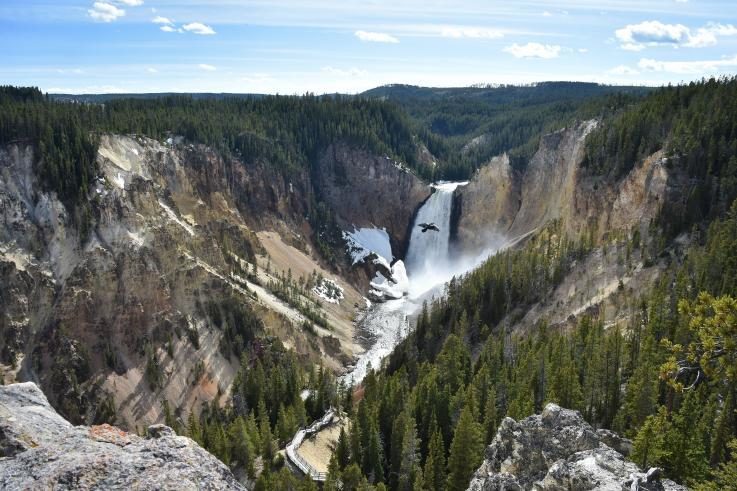
© MLADEN ANTONOV/AFP/Getty ImagesA view of the Lower Falls at the Grand Canyon of the Yellowstone National Park on May 11, 2016. Yellowstone, the first National Park in the US and widely held to be the first national park in the world, is known for its wildlife and its many geothermal features.
Experts at the Yellowstone Volcano Observatory found what appeared to be a previously unknown pocket of warmth nestled between West Tern Lake and the Tern Lake thermal area after studying the latest thermal infrared images of the National Park taken in April 2017, according to the U.S. National Geodetic Survey.
The team then checked high resolution aerial photos of the same spot captured in 2017 by the The National Agriculture Imagery Program, and noticed dead trees and bright soil. These were the signs of a thermal area they were expecting to find. In contrast, a 1994 picture showed a crop of healthy trees which started to fade in a 2006 image.
Researchers therefore believe the thermal area near the northeast border of the Sour Creek resurgent dome first emerged in the late 1990s or early 2000s.
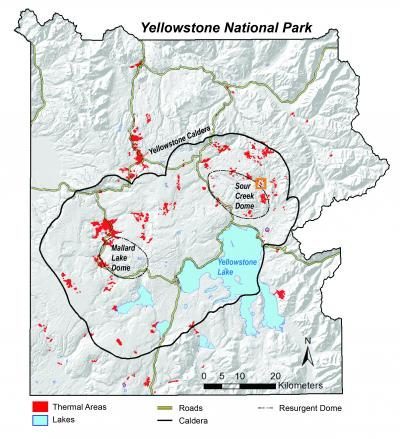
© USGSMap of thermal areas in Yellowstone National Park. Most of Yellowstone's more than 10,000 thermal features are clustered together into about 120 distinct thermal areas (shown in red). Lakes are blue. The Yellowstone Caldera is solid black and the resurgent domes are dotted black. Roads are yellow. The orange box shows the location of the Tern Lake thermal area.
"Yellowstone's thermal areas are the surface expression of the deeper magmatic system, and they are always changing. They heat up, they cool down, and they can move around," the U.S. National Geodetic Survey said of the National Park famed for its long-dormant supervolcano.
More than 10,000 thermal features can be found across around 120 thermal areas in Yellowstone, most of which sit in remote and hard to reach areas.
Thermal areas are made up of a sequence of geologic units with at least one thermal feature, like a geyser, sitting inside an area of "hydrothermally altered ground, hydrothermal mineral deposits, geothermal gas emissions, heated ground, and or a lack of vegetation," according to the U.S. National Geodetic Survey.
The finding "highlights that changes are always taking place, sometimes in remote and generally inaccessible areas of the park," the U.S. National Geodetic Survey said.
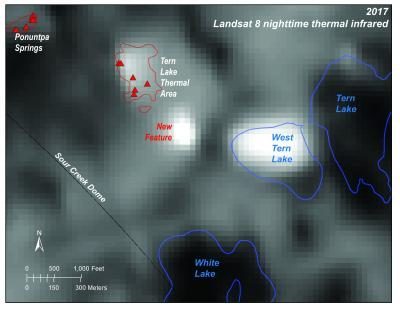
© USGSLandsat-8 nighttime thermal infrared image from April 2017 showing the Tern Lake area. In Yellowstone, temperatures are extremely cold at night in the winter, and most lakes are frozen (dark pixels). West Tern Lake seems to be thawing here - perhaps it receives some thermal waters from nearby hot springs. The patch of bright (warm) pixels between West Tern Lake and the Tern Lake thermal area has emerged over the last 20 years. Lakes are outlined in blue; the boundary of the Sour Creek resurgent dome is in black; known thermal areas are outlined in red; and the red triangles are individual thermal features that have been mapped.
Earlier this year, the Yellowstone Volcano Observatory revealed that 2018 was a record-breaking year for the tallest active geyser in the world, which is located at the park. The Steamboat geyser erupted 32 times, topping the 29 eruptions in 1964.




(Note: small screen & a low resolution picture above; and the original article at [Link] has a slightly better image)
My best guess is a Red Tailed Hawk. (It seems too looongg to be a Golden Eagle.) The white areas look like glare/reflection off of the wings' sheen, rather than 'reflecting'* a color. Other options: Immature Bald Eagle, Harrier? Too thick to be an Osprey, though the wings as caught in the picture lean that way when little else does.
Birders' thoughts?
R.C.
* Pun intended.
RC