Storms
S


Windsock

Two powerful storms to lash Central U.S.

Image
With the autumn season now here, the strength and number of powerful storm systems will be on the increase.

This week will feature two powerful autumn storm systems, one through the middle of the week and another towards the end of the week.

As the jet stream strengthens and dips farther south, the clashes between warm and cold air become more frequent. As a result, the potency of low pressure systems increase.

Tens of millions will be impacted by these storm systems this week, with the risks ranging a wide spectrum.

First Storm System Targets Central U.S.

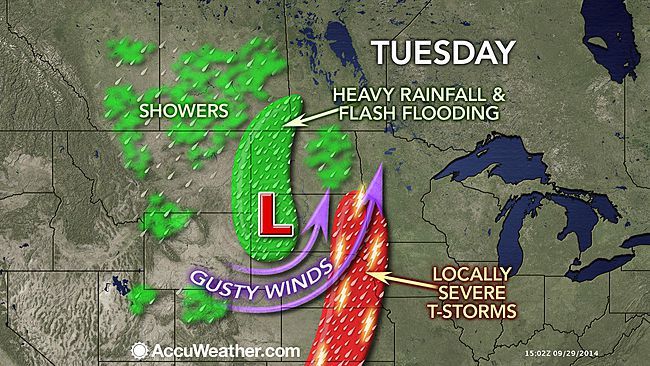
The first storm will take shape across the High Plains and into the central portion of the United States as the energy that brought flooding downpours and severe weather to the Southwest shifts to the northeast.

Folks from eastern Montana to Wisconsin and south to Oklahoma will be impacted by this storm as it passes through the Plains.

Cloud Precipitation

Heavy rain, flooding to target Deep South to Carolinas

Image
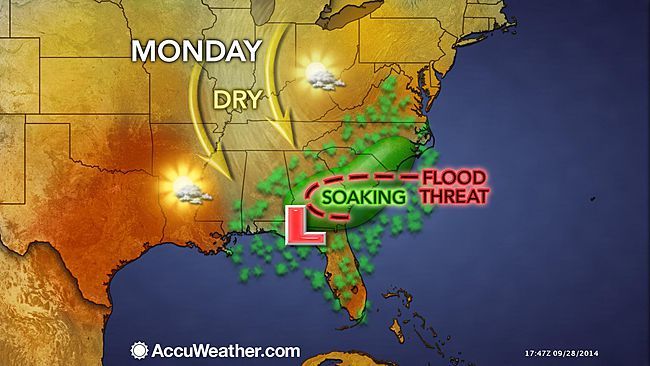
Umbrellas and rain jackets will be put to good use over the next couple of days in the Deep South to the Carolinas.

An upper-level disturbance, aided by abundant gulf moisture, will slowly pass over the region through Tuesday.

According to AccuWeather.com Meteorologist Bob Smerbeck, the weather set-up will feature a rather wet couple of days.

"Deep tropical moisture will fuel a developing low pressure system over the Deep South, resulting in heavy rain across the region," said Smerbeck.

Rain and thunderstorms will spread along the Gulf Coast from Louisiana to Florida and eventually to the Carolinas Monday into Tuesday.

Some of the rain could turn rather heavy at times, with rainfall rates approaching an inch per hour in some spots.

"The rain will be heavy enough to cause flash flooding in some locations," added Smerbeck.

Attention

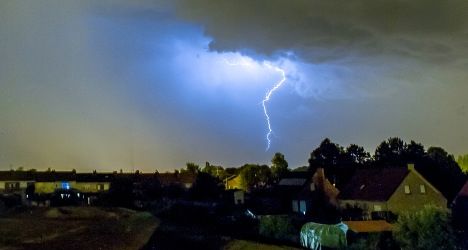
Southern France put on maximum storm alert, risk of flash-flooding

south france storms
© Agence France-Presse/Philippe HuguenNasty storms in southern France have prompted the country's top weather warning
Residents in the Hérault department on the Mediterranean coast were under a red alert on Monday because of storms heavy rain just two weeks after four people were killed by raging flood waters in the area.

Downpours since midday on Monday left local authorities concerned enough about the risk of flash flooding that they put out the red alert, which warns people they are facing an exceptional danger.

They are concerned the river Lez, the main waterway in the Hérault department will burst its banks.

According to reports 95mm of rain fell between midday and 4pm in parts of Hérault on Monday.

The rains have forced officials to shut down trams in Montpellier and certain sections of roads and motorways are blocked due to flooding.

Comment: Montpellier today:
Image
© iambigmax.com


Windsock

Tropical Storm Kammuri to batter Japan with rain, rough surf, wind

Image
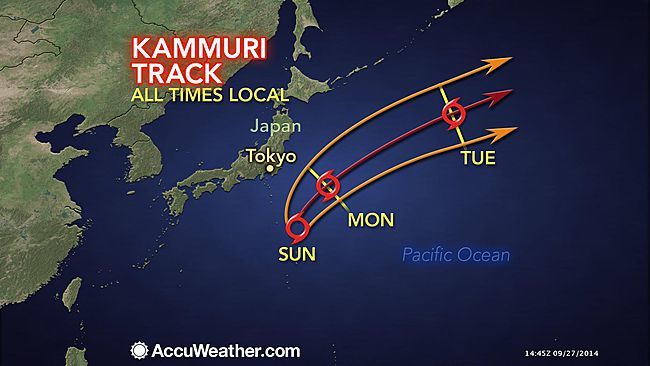
Tropical Storm Kammuri has gradually become more organized during the past several days. The system began early this past week as a weak area of low pressure that produced showers and thunderstorms near the Mariana Islands.

Kammuri is now located to the southeast of Japan and is generally moving to the north. A turn to the northeast is expected Sunday into Monday which will cause the storm to miss Japan. However, Kammuri will still pass close enough to bring a few impacts to the country.

The key factor in the movement of the tropical storm is a fast-moving trough of low pressure that AccuWeather.com meteorologists have been tracking since it was located over 1,000 miles away across Siberia.

Now that this trough is located across eastern Asia, Tropical Storm Kammuri is feeling the effects as the storm is being pulled to the north and eventually the northeast.

As the trough of low pressure continues to interact with Kammuri, effects will become even greater which will cause Kammuri to accelerate to the northeast across the northern Pacific early this coming week.

Cloud Lightning

Wild weather: Rare lightning, hail strike Napa Valley in California

Napa Valley hail 1
One month after an earthquake struck the Napa area, the region was pounded by an incredibly rare hailstorm Friday afternoon. Heavy rainfall and lightning were also reported throughout the North Bay.

A viewer in the Napa County community of Browns Valley took video of hail covering the ground like snow.

KPIX 5 meteorologist Paul Deanno reported six inches of hail in the Napa area. Children were seen making snow angels and had snow fights with the hail.

"It was nothing but rain, then all of a sudden it comes down. It was complete hail for a good to 20 to 25 minutes," said Paul Frommelt of Napa. "In the 49 years I've lived here, I've never seen anything like this ever."

Cloud Lightning

Ups and downs: 2013's natural disasters in review

earth changes
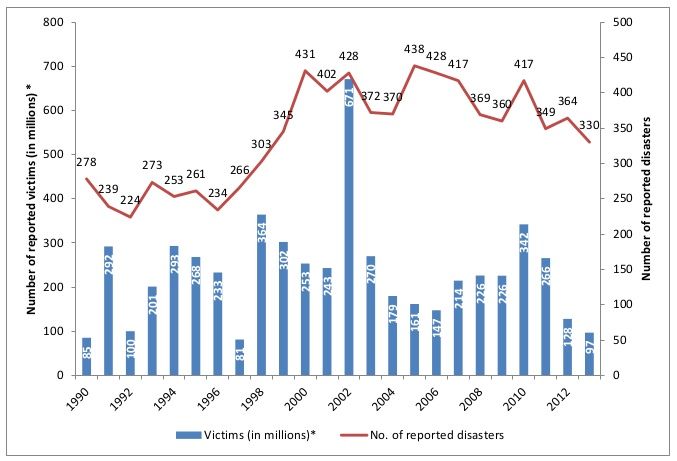
According to the "Annual Disaster Statistical Review 2013" published this month by the Centre for Research on the Epidemiology of Disasters (CRED), 2013 is a year with 330 registered natural disasters. This is less than the average annual disaster frequency observed from 2003 to 2012 which is 388, and represents a decrease in associated human impacts of disasters which were, in 2013, at their lowest level in last 16 years.

The death toll of natural disasters still killed a significant number of people totaling to 21,610 but this is largely below the annual average between 2003-2012 which is 106,654.

96.5 million people became victims worldwide, which was also below the 2003-2012 annual average of 216 million. On the side of the economy, economic damages from natural disasters shows, in 2013, a decrease to average levels, 2013 US$ 156.7billion, with estimates placing the costs at US$ 118.6 billion.
Image
Trends in occurrence and victims (deaths and affected)
For the last decade, China, the United States, Indonesia, the Philippines and India constitute together the top 5 countries that are most frequently hit by natural disasters.

In 2013, China experienced its highest number of natural disasters of the last decade. The country was affected by a variety of disaster types, including 17 floods and landslides, 15 storms, 7 earthquakes and one mass movement of geological origin, one drought and one period of extreme temperature.

Comment: In sum, 2013 saw fewer disasters, deaths, victims and economic damages on the whole. However, it saw isolated instances of record-breaking disasters, while floods and storms were responsible for the worst damage in terms of people affected. China and the U.S. continue to be hit the hardest, with China enduring its highest number of disasters in the last decade.

As Pierre Lescaudron describes in his book, Earth Changes and the Human-Cosmic Connection, this apparent decrease in disasters is probably due to an overall decrease in the Earth's electric field (due to a solar-companion-induced drop in the Sun's activity) and an increase in the conductivity of that field (due to the increase in comet dust entering our atmosphere). The result: more frequent, smaller storms (hurricanes, tornadoes, lightning, etc.). This will show up in the statistics as a drop in major natural disasters, but as we can see around us, it doesn't say much about the continued crazy weather the planet has been experiencing the last couple years.

It's the time for floods and storms to do their damage, while cosmically-induced processes perhaps build up for some future, major disasters. Think Chelyabinsk. Think Ebola.


Cloud Precipitation

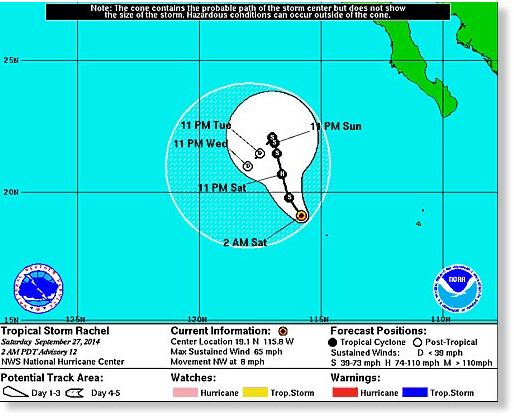
Tropical Storm Rachel upgraded to Hurricane Rachel

Image
© NOAA
NHC has upgraded Tropical Storm Rachel to a hurricane - the twelfth hurricane of this active 2014 eastern North Pacific hurricane season. Maximum sustained winds are 75 mph - a Category 1 hurricane on the Saffir-Simpson Hurricane Wind Scale. Little change in strength is expected tonight, with weakening forecast to begin on Sunday.

Rachel is centered about 460 miles west-southwest of the southern tip of the Baja California peninsula, moving toward the north-northwest. There are no coastal watches or warnings in effect.

Get the latest on this tropical cyclone tonight by visiting the NHC website.
Image
© NOAA

Cloud Precipitation

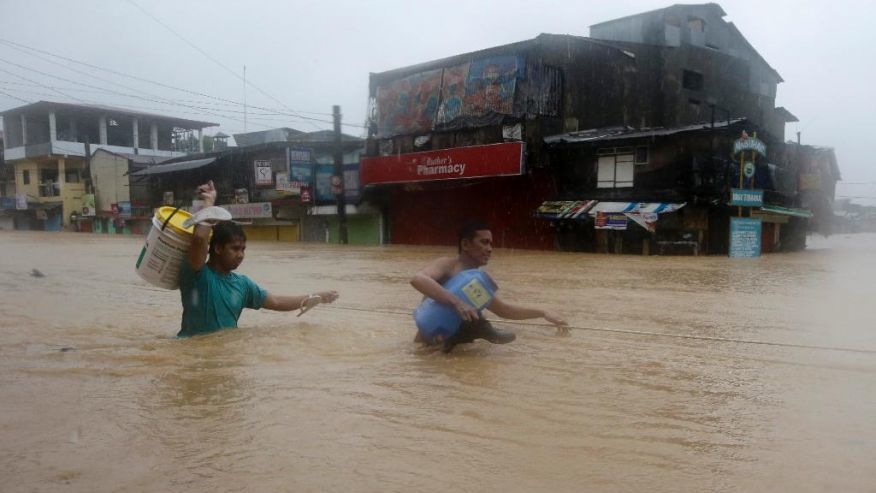
Tropical storm Fung-wong hits the Philippines, Taiwan with torrential rainfall, flooding - 13 dead

Image
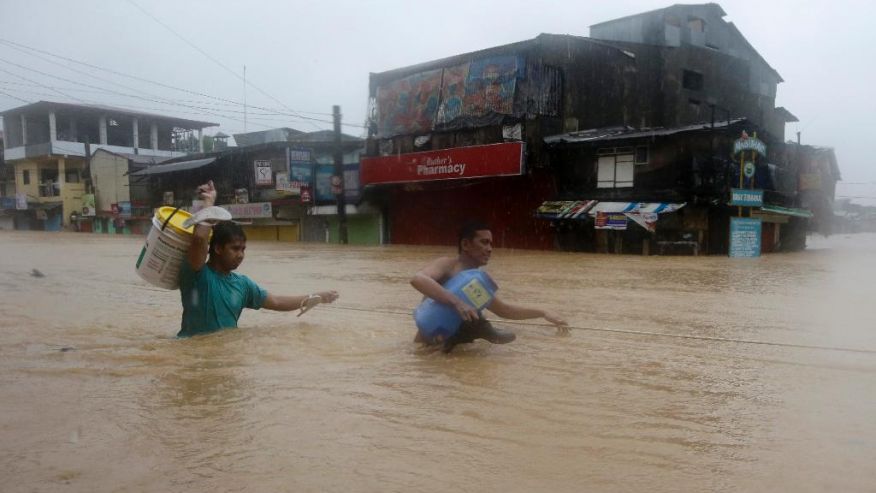
© AP/Bullit MarquezA rescuer helps a resident to go to a safer area after heavy rains spawned by Tropical Storm Fung-Wong flooded Marikina city, east of Manila, Philippines and most parts of the metropolis Friday, Sept. 19, 2014
Thirteen people are now dead and 18 injured in two countries as tens of thousands have been forced from their homes due to Tropical Storm Fung-wong, which lashed the Philippines and then Taiwan with extremely heavy rainfall.

The Philippine government's National Disaster Risk Reduction and Management Council says 425 houses have been destroyed and another 1,710 damaged due to the storm, which was called "Mario" in the Philippines.

The storm's torrential rains, which flooded much of the Philippine capital, battered the country's northern provinces Saturday. The provinces of Ilocos Norte and Ilocos Sur, north of Manila on the far northwestern coast of the main island of Luzon, account for more than half of the damaged and destroyed houses.

More than 800,000 residents of metropolitan Manila and nearby provinces were affected as their communities were inundated by floodwaters, according to local officials. In the capital city, at least 86,000 people were displaced in one of the worst floods in years to hit this sprawling metropolis of some 12 million people. About 205,000 residents were displaced by the storm countrywide.
Image
© AP/Bullit Marquez
The NDRRMC report says nine people have died due to drownings, two by electrocution and one due to a head injury, for a total of 12 fatalities. The deaths were concentrated around Metro Manila and areas to the south and southeast in southern Luzon -- ironically, areas that received less rainfall than farther north. Fourteen people were injured in the Philippines.

Cloud Lightning

Extreme hail storm inundates Florence, Italy with ice

Florence hail storm
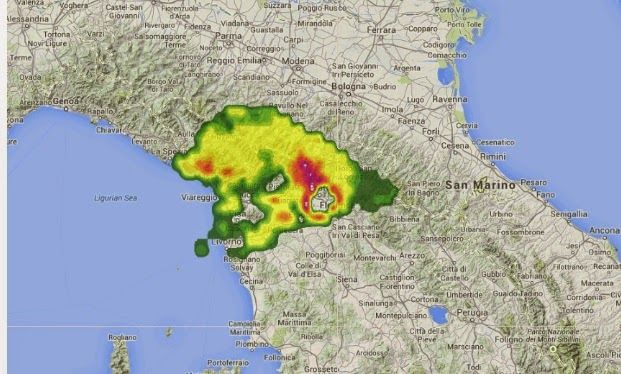
A violent hail storm has ravaged parts of Tuscany, Italy on Friday, with significant impacts on the region's capital of Florence.

Videos of the storm show torrential rain and hail coming down, and while the hail stones themselves are not large, the sheer quantity is enough to cause chaos on the city streets. Local media report that the hail storm lasted about ten minutes in the city of Florence. This was plenty of time for hail stones to coat the roads like snow.
Florence hail
Radar shows the storm beginning off the west coast of Tuscany early Friday morning. As the storm crosses into Tuscany, it grows in size and intensity. By 1:30 p.m. local time, the storm is over Florence. Gaping holes in the storm suggest it was so intense that it maxed out on Weather Underground's radar reflectivity scale.


Cloud Lightning

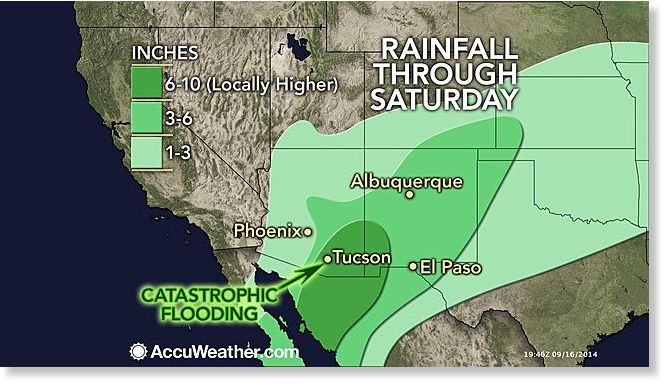
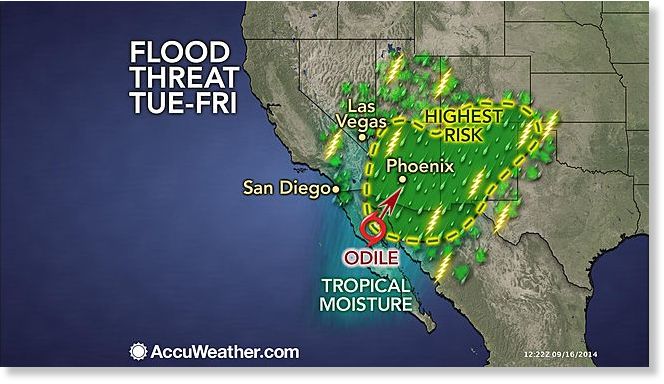
Hurricane Odile could bring catastrophic flooding from Tucson to Albuquerque NM in U.S. Southwest

Image
Odile will unload tremendous rainfall over a large part of the Southwest United States that will run off the mountains and into the desert valleys and plains through the end of the week.

According to Western Weather Expert Ken Clark, "There is the potential for devastating, catastrophic and historic flooding in this scenario."

The heaviest rainfall will hit the Southwestern states of Arizona and New Mexico where a general 3 to 6 inches will fall, but local amounts of 10 inches or more are possible on the slopes of the mountains. Rainfall of 1 to 2 inches per hour can occur.

There is a significant risk to lives and property in the region.

"Not only will flash and urban flooding occur in this case, but there is the potential for major river flooding," Clark said.
Image