Floods
S


Cloud Precipitation

Rivers rising after record rainfall in Argentina, Brazil and Uruguay - almost 20 inches in 3 days with 7 inches in 80 minutes

flood
At least 3 people have died in flooding and storms that have affected several provinces of Argentina over the last few days.

Heavy rain and flooding was reported in Corrientes, Tucumán, Santa Fe and Chaco, while strong winds caused damage in Santiago del Estero. Record rainfall was recorded in Resistencia, Chaco.

Meanwhile authorities have warned that the Uruguay River could reach danger levels in Concordia, Entre Rios, Argentina.

The Uruguay River has already broken its banks upstream, causing flooding in the Brazilian state of Rio Grande do Sul, where some areas have recorded almost 500mm of rain in the last 3 days. Stormy weather has also caused at least one fatality in the state.

Heavy rain has also affected parts of Uruguay, including in the cities of Durazno and Sarandí del Yí, where the overflowing Yí river has prompted evacuations.


Snowflake

Storm packing snow and rain paralyzes parts of Lebanon

flood
Among those affected are tens of thousands of Syrian refugees

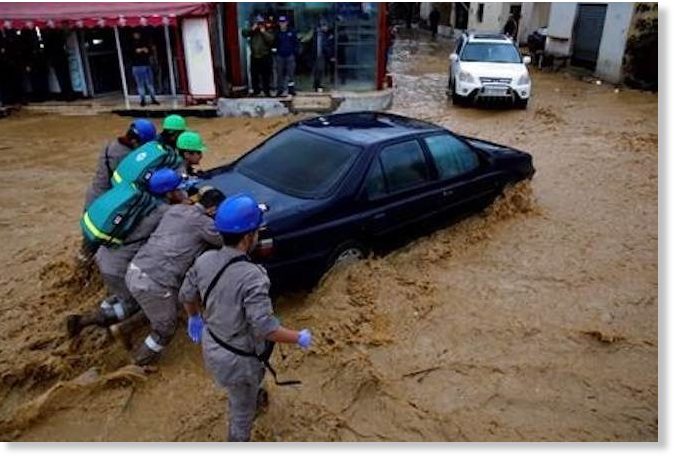
A winter storm packing heavy rain and snow has turned streets in Lebanon into rivers of water and mud and paralyzed parts of the country.

Among those affected Tuesday are tens of thousands of Syrian refugees many of whom live in tent settlements.

In the eastern Bekaa Valley, Syrian refugees stayed indoors next to diesel or wood heaters as snow covered their flimsy tents.

Authorities closed the highway linking Beirut with the Syrian capital Damascus after parts of it that cut through high mountains became covered with snow.


Snowflake

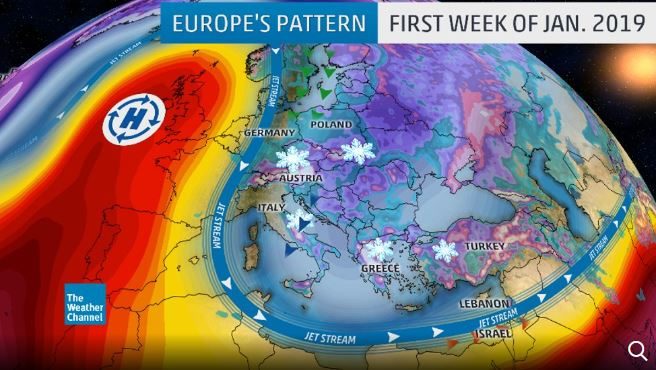
Europe weather pattern generates feet of snow, coastal flooding and even Middle East dust

Europe weather pattern
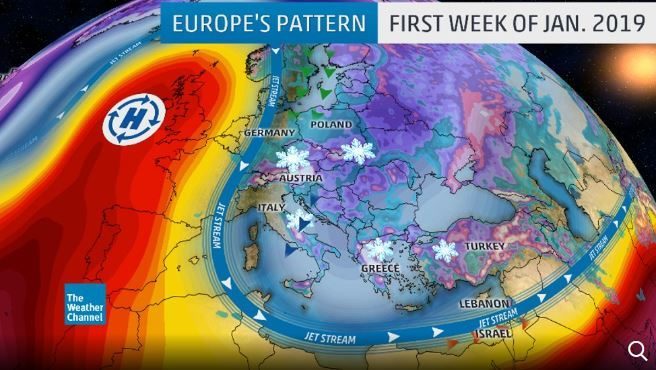
© The Weather Channel (screen capture)The jet-stream pattern in place during the first days of 2019 featured a sharp, southward plunge of the jet stream guiding cold air into eastern Europe and the Mediterranean Sea. A nose of high pressure over the U.K., Ireland and the Iberian Peninsula kept the weather there mostly tranquil.
Europe has arguably had the most interesting weather pattern anywhere in the Northern Hemisphere in the first days of 2019, wringing out feet of snow, coastal flooding, high winds and even blowing dust in parts of Europe and the Middle East.

It started with a powerhouse storm sweeping in from the North Atlantic into Scandinavia and northern Europe as the new year arrived.

The so-called Storm Zeetje brought the first storm surge of the year on the Baltic coast of Germany and southern Denmark.

Strong onshore winds drove water levels up to 6 feet above normal in Wismar, Germany, on Jan. 2, flooding parts of the city center. Flooding was also reported in the coastal towns of Flensburg, Kiel and Travemunde, and storm surge drove water up the Trave River into the town of Lubeck.

Water levels in some parts of Denmark were the highest in two decades, the CPH Post reported. A 5- to 6-foot surge was measured at Bagenkop, on Langeland Island about 100 miles southwest of Copenhagen, a level only reached one other time in 42 years.

The pounding waves washed out sections of trails along the coast and partially sank boats along parts of the Baltic coast.
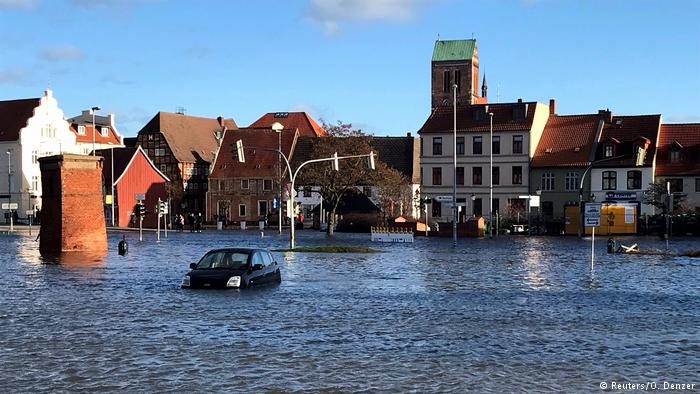
Wismar flooding
© Reuters/O. DenzerThe city of Wismar in the northern Mecklenburg-Western Pomerania state was one of the worst hit. The water level in the morning rose as much as 1.70 to 1.80 meters (up to 6 feet) above normal, flooding Wismar's historic city center.

Comment: Adapt 2030 Ice Age Report: Jet streams pinched - desert snows USA, beach snows Mediterranean


Arrow Down

Rain sets off Indonesia landslide, death toll reaches 32 (UPDATE)

The landslide occurred during New Year's Eve celebrations less than two weeks after a deadly volcano and tsunami disaster.
Soldiers, police and residents fanned out across a damaged Indonesian village on Tuesday, searching in the mud for possible victims of a landslide caused by torrential rain that killed at least nine people and left 34 others missing.

Tons of mud that rolled from the surrounding hills late Monday buried 30 houses in Sirnaresmi village of West Java's Sukabumi district. Sixty people who were displaced have fled to a temporary shelter, said Sutopo Purwo Nugroho, the National Disaster Mitigation Agency spokesman.

He said more than 500 rescuers have retrieved eight bodies from mounds of mud and pulled out four injured people, including an infant who died in the hospital. They are still searching for 34 villagers said to still be missing.

Authorities struggled to get tractors and other heavy equipment over washed-out roads as heavy rain was hampering search efforts, Nugroho said. Television footage showed hundreds of police, soldiers and residents digging through debris with their hands, shovels and hoes.


Comment: Update: Xinhua on January 4th reports:
The death toll from a landslide triggered by heavy rain in Indonesia's West Java province earlier has risen to at least 18, while 15 others remain missing, disaster agency official said on Friday.

The natural disaster devastated Sinaresmi village of Sukabumi district on Monday leaving three villagers seriously injured, spokesman of national disaster management agency Sutopo Purwo Nugroho said.

As many as 29 houses were buried by soils sliding from a hill when heavy downpours hit the village. A total of 63 villagers survived the landslides and were taking shelters in safer places, said Sutopo.

More than 1,000 soldiers, police personnel, the personnel from search and rescue office, disaster management agency and volunteers were scrambling to find the missing villagers, said Sutopo.

The major obstacle of the search operation is the rain. When the weather is clear, the operation can be undertaken until night but the efforts would be terminated earlier when it is raining, he told Xinhua in a text message.

Update: Rappler on January 7 reports:
Rescuers who have been pulling bodies from mountains of mud call off the search with one person still unaccounted for

At least 32 people were killed by a landslide in Indonesia on New Year's Eve, authorities said Monday, January 7, as they ended a week-long search for missing victims.

Rescuers who have been pulling bodies from mountains of mud called off the search with one person still unaccounted for after heavy rains triggered the deadly slides in West Java province.

Several others were injured in the December 31 disaster.

"The search has wrapped up," said West Java police chief Agung Budi Maryoto.

"Just one victim has not yet been found and the family has accepted it."

Landslides are common in Indonesia, a vast tropical archipelago prone to natural disasters and torrential downpours.

More than 20 people died in October when flash floods and landslides hit several provinces on Sumatra island, western Indonesia.

In June 2016, nearly 50 people died when floods and landslides struck Central Java province.

rescue workers search for survivors at the site
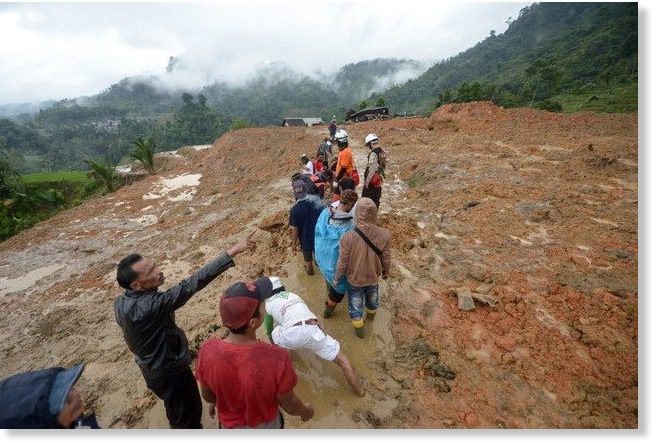
© AFPIn this file photo taken on January 1, 2019, rescue workers search for survivors at the site of a landslide triggered by heavy rain in Sukabumi, West Java province.
Source: Agence France-Presse
Elsewhere in south-east Asia recently: Death toll in Philippines floods, landslides rises to at least 122


Cloud Precipitation

Afghanistan flash flood kills at least 30 villagers

Badakhshan province, far northeastern Afghanistan. MASSOUD HOSSAINI
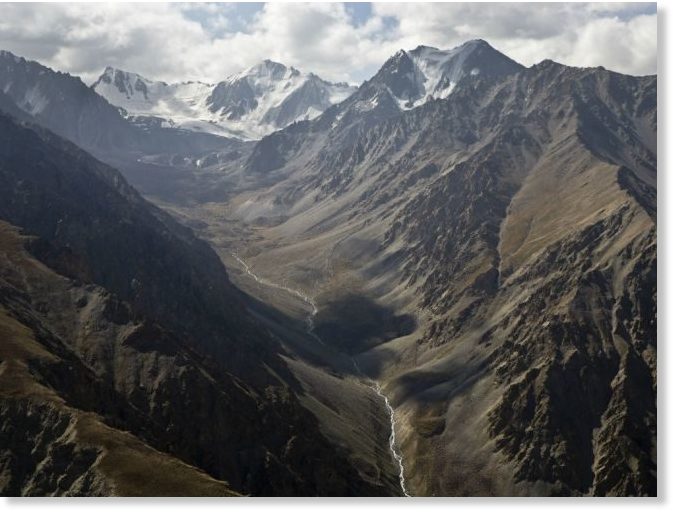
© MASSOUD HOSSAINIThis Aug. 15, 2016 photo, shows an ariel view of the snow-capped Pamir mountains in the Wakhan district of Badakhshan province, far northeastern Afghanistan.
At least 30 Afghan villagers searching for gold in a riverbed perished on Sunday in a flash flood in northeastern Badakhshan province, provincial officials said.

Along with those killed, dozens were also injured as a landslide and flash flood engulfed the river in the morning in Kohistan district, an area about 68 miles, from Fayzabad, the capital of Badakhshan.

Nek Mohammad Nazari, the spokesman for the provincial governor, said the villagers had dug deep in the river, which had in the past been mined for gold, when they were caught in the flash flood. The casualty numbers could rise, he said.

Snowflake

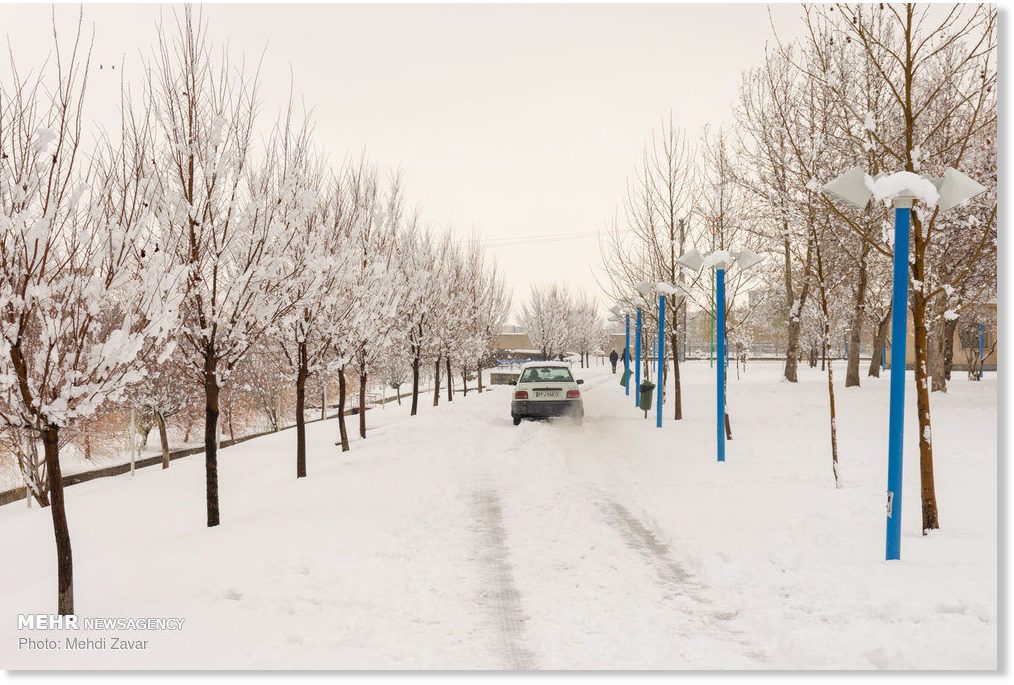
Snow storm hits 17 Iranian provinces

Seventeen provinces of Iran have been stricken by heavy snow storm over the past 24 hours, Rescue and Relief Organization head Morteza Salimi has said.
Snow swept across 17 provinces namely West Azarbaijan, Ardebil, Isfahan, Alborz, Tehran, Chaharmahal and Bakhtiari, North Khorasan, Fars, Semnan, Zanjan, Qazvin, Qom, Kordestan, Gilan, Lorestan, Mazandaran, and Markazi, Tasnim news agency quoted Salimi as saying on Friday.

Some 90 rescue teams comprising 320 rescue workers offered relief and rescue service, Salimi highlighted.

Meanwhile, some 4,100 who were stranded in the snow storm received relief services and 656 cars stuck in snow were released, he added.


Snowflake

British Columbia storm pounds province with snow, rain, smashing records - up to 74 cms (29 inches) of snowfall in 24 hours

Athlete Mark Abma, captured on Whistler, after the early January snowfall.
© Eric Berger/Whistler BlackcombAthlete Mark Abma, captured on Whistler, after the early January snowfall.
The storm that moved across B.C. over the past 72 hours has left many areas of the province cleaning up on Friday.

No weather alerts remain in place for the province but parts of Vancouver Island remain under high streamflow advisories.

The Englishman River and Little Qualicum River on Vancouver Island were under a flood watch following the downpour but Friday afternoon it was downgraded to a high streamflow advisory.

High stream advisories remain in place for part of Vancouver Island, the North Shore, Fraser Valley, Howe Sound and Sunshine Coast.

From 8 a.m., Wednesday, Jan. 2, to 9 a.m., Friday, Jan. 4, many areas of B.C. saw a huge dumping of snow.


Info

Greenland Crater - The 12,000 year old comet that erased ancient civilization

Ancient Impact
© ScreenCapture/YouTube
NASA recently discovered of a massive, 19-mile (31km) wide crater, found hidden underneath Greenland's Hiawatha Glacier. This crater is the result of an asteroid impact, from a nearly 1 mile-wide mountain of iron, weighing somewhere around, get this, 11-12 BILLION tons, and was traveling at approximately 12 MILES per second - which is equivalent to more than 43,000 miles per hour - when it slammed into the earth some 12,000 years ago - And...with the mind-boggling force of essentially a 700-megaton bomb. And without a doubt, THIS is the reason why there is so much mystery and why we know so little about lost Ancient human civilization

Cloud Precipitation

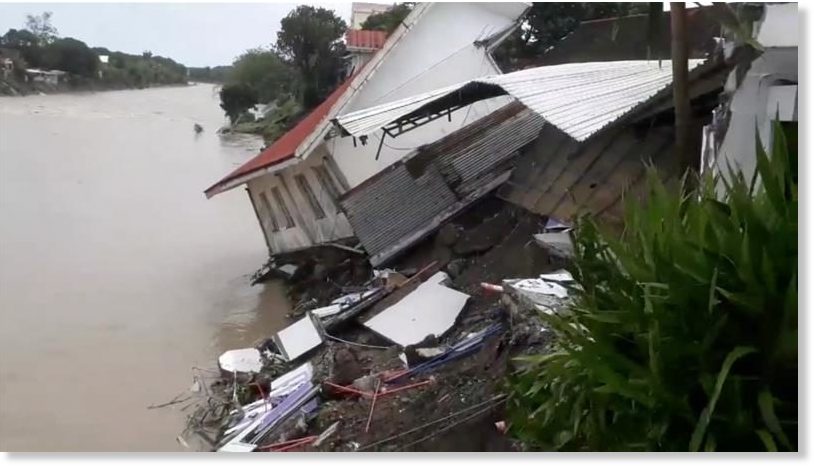
Death toll in Philippines floods, landslides rises to at least 122 (UPDATE)

A destroyed house after a tropical depression
© Robert BalidoyA destroyed house after a tropical depression hit Daet, in Camarines Norte
Authorities warn number of victims to increase as thousands are forced from their homes by the bad weather.

The death toll from flash floods and landslides caused by torrential rains due to a tropical depression in the eastern Philippines has jumped to at least 68, officials have said, warning that the number of fatalities will climb even higher.

Fifty-seven of the victims were reported in the eastern region of Bicol, located south of the main island of Luzon, civil defence officials said on Monday. Eleven others died in the nearby region of Eastern Visayas.

Twelve people were also injured in various accidents in the two regions most affected by the rains even days before the tropical depression - known locally as Usman - made landfall in Eastern Samar province on Saturday.


Comment: Update:The Philippine Star on January 3 reports:
The death toll from Tropical Depression Usman in Bicol, the Visayas and Southern Tagalog has reached 87, with 20 others missing, the National Disaster Risk Reduction and Management Council (NDRRMC) reported yesterday.

NDRRMC spokesman Edgar Posadas said the figures are still subject to validation by the Department of the Interior and Local Government (DILG)'s Management of the Dead and the Missing (MDM).

Posadas said Usman also directly affected 45,348 families or 191,597 people from 457 barangays in Bicol, Eastern Samar and the Cavite-Laguna-Batangas-Rizal-Quezon (Calabarzon) region, as well as in Mindoro-Marinduque-Romblon-Palawan (Mimaropa).

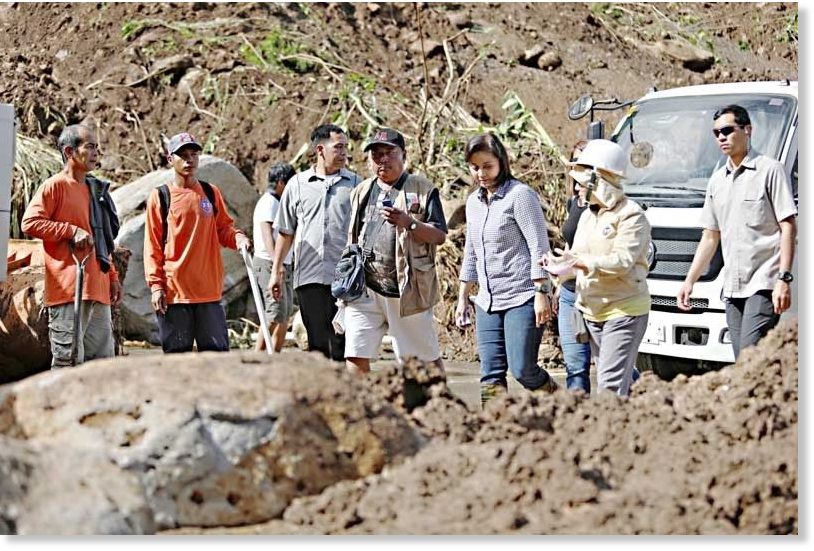
Vice President Leni Robredo visits Barangay
Vice President Leni Robredo visits Barangay Patitinan in Sagñay, Camarines Sur yesterday to check the extent of damage in the area following a landslide.

Update: The Gulf Today on January 3
reports
:
The death toll from landslides and floods in the eastern Philippines has climbed to 122 as emergency teams reach isolated areas and recover more bodies, officials said Thursday.

According to the Deutsche Presse-Agentur, DPA, quoted civil defence and disaster risk reduction officials as saying that nearly 30 people were still reported missing in the affected areas in the eastern regions of Bicol and Eastern Visayas.

The tropical depression was the last and deadliest cyclone to hit the Philippines in 2018. Previously, Typhoon Mangkhut was considered the deadliest, killing more than 80 people in September.

Nearly 25,000 people were displaced by the landslides and floods
, the national disaster risk reduction office said.

flood


Cloud Precipitation

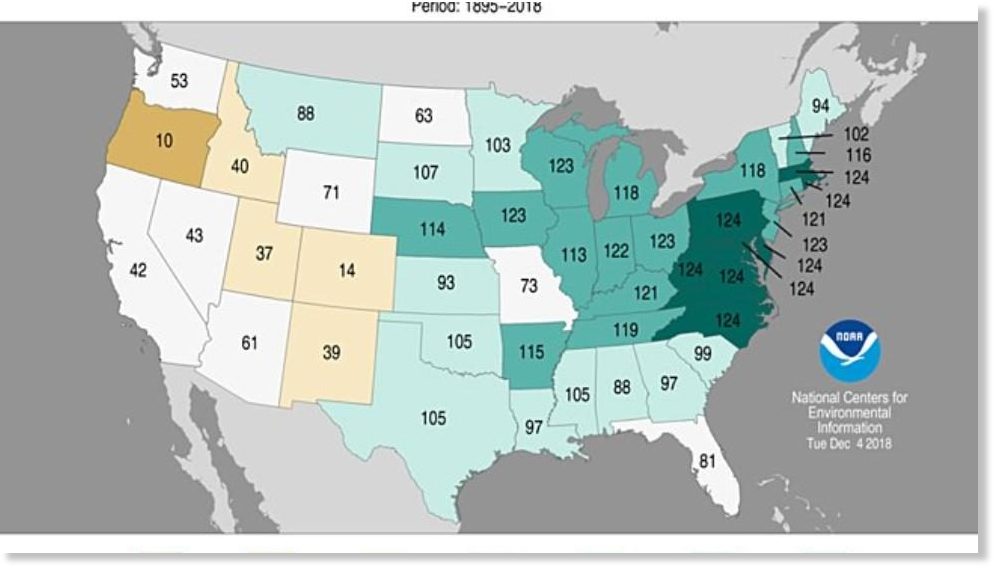
2018 was wettest year on record in over 2 dozen cities in the East, Midwest, including Washington D.C. and Pittsburgh

Statewide ranks of January-through-November precipitation in 2018. States shaded in dark green had the wettest first 11 months of any year in records dating to 1895.
© NOAA/NCEStatewide ranks of January-through-November precipitation in 2018. States shaded in dark green had the wettest first 11 months of any year in records dating to 1895.
Over two dozen cities in the East and Midwest had their wettest year on record in 2018, stretching from North Carolina to South Dakota.

On Dec. 15, Reagan National Airport's year-to-date precipitation total eclipsed the previous record-wet year in the nation's capital, which had stood for 129 years, since Benjamin Harrison took office as president.

After topping the record, they would tack on almost 5 inches of additional rain in the latter half of December.

Washington D.C. set a record-wet November, fifth-wettest September, fourth-wettest July and sixth-wettest May, according to National Weather Service records dating to 1871. Only January, March and October were drier than average in 2018 in the nation's capital.

Comment: See also: Record rainfall was the story of 2018 weather in West Virginia