Animals
S


Attention

Girl 'plays dead' to survive brutal black bear attack in Florida

Image
She was out walking her dog at 6pm when the bear suddenly appeared and tackled her. Pictured: Investigators at the scene of the attack
A 15-year-old girl who suffered horrific injuries after being attacked by a bear only survived because she remembered to 'play dead.'

Leah Reeder, 15, sustained deep bites and gouges to her legs, back, neck and face, after the attack on Sunday in Eastpoint, Franklin County, on Florida's panhandle.

She was out walking her dog at 6pm when the bear suddenly appeared and tackled her.

'I was listening to music and I heard my dog start barking. It was like a black blur,' she told Apalach Times from her hospital bed.


Question

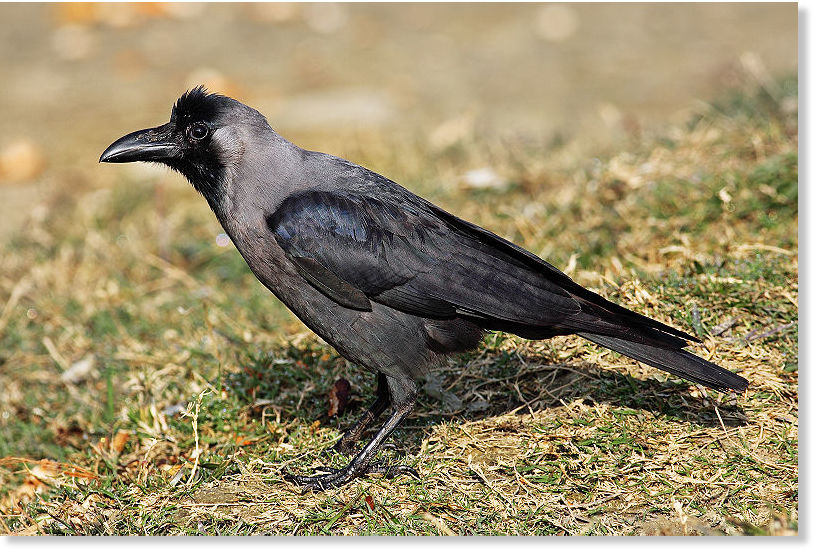
500 crows found dead in Indian village

Image
Nearly 500 crows have been found dead in the past four days at Baghiari village near Tarn Taran, which is close to a bird sanctuary at Sarai Amanat Khan. With bird flu causing deaths of geese at Sukhna Lake in Chandigarh, senior officials of the Animal Husbandry Department have responded quickly to take preventive measures in the area. The district administration is also on alert.

"The reasons for the birds' deaths could be the use of pesticide in fields, contaminated water or the cold wave. However, we have sent the carcasses of birds to Regional Diagnostic Laboratory in Jalandhar to know the exact cause of the deaths," said Dr Raminder Monga, Deputy Director, Animal Husbandry Department. He added that it would take six days to know the reason for such a high bird mortality," said Dr Monga. Deputy Commissioner Balwinder Singh Dhaliwal met officials of various departments and constituted response teams. Amarinder Singh Tiwana, a PCS officer, has been made the point person to coordinate with all teams. Dhaliwal urged people in the area to stay alert and do not panic.

Info

Seals may use 'natural GPS'

Image
© Wikimedia Commons/changehaliWeddell seals underwater
While hunting, Weddell seals have biological adaptations that allow them to dive deep, as much as of hundreds of meters, but also an uncanny ability to find the breathing holes they need on the surface of the ice. Now, researchers supported by the U.S. National Science Foundation (NSF) believe they have figured out they do it: by using the Earth's magnetic field as a natural GPS.

"This animal, we think, may be highly evolved with an ability to navigate using magnetic sense in order to find ice holes some distance apart and get back to them safely," explained Randall Davis of the Department of Marine Biology at Texas A&M University.

If the hypothesis turns out to be true, it would represent the first evidence of such a trait in a marine mammal.

Highlights of the research have been captured on video in underwater images and in interviews by myself and Ralph Maestas, of the "Antarctic Sun" newspaper, which is published by the U.S. Antarctic Program (USAP). (NSF manages the USAP, which coordinates all U.S. research on the southernmost continent.)


Comment: See also:

Animal Magnetism: How the magnetic field influences animal navigation

Seal found 20 miles inland near St Helens, UK


Binoculars

Wrong place, wrong time: European robin turns up thousands of miles away in China

Image
© GettyPhotographers were awestruck by the sighting of a European robin in the Temple of Heaven
Appearances on greetings cards, wrapping paper and festive tree baubles are one thing but the notion of a cheery redbreast preening in front of hundreds of assembled cameras does sound a little incongruous.

Take a peek at this week's photo and while the robin looks very much like your common-orgarden favourite, the way it was pictured in all its flame-toned glory has become the talk of the birdwatching world.

However this delightful individual has been holding court in Beijing's Temple of Heaven Park, creating the kind of scenes reminiscent of a rarity arrival on the Isles of Scilly or the north Norfolk coast.

How this robin arrived in the Chinese capital thousands of miles from its European home is open to conjecture. There is increasing evidence that small populations of migratory birds often take a "left-hand turn" and fly in the reverse direction in autumn as a survival technique against a possible disaster on their normal wintering ranges.

Comment: See also: Rare bird from Mongolia turns up in Wakefield, UK

Wrong time, wrong place: Rare bird found in Barrie, Canada

As well as these articles (which could have some relevance as to possible explanations for these odd migrations): Animal Magnetism: How the magnetic field influences animal navigation

Earth's magnetic field is weakening 10 times faster now


Question

Seal found 20 miles inland near St Helens, UK

Image
© Liverpool Echo
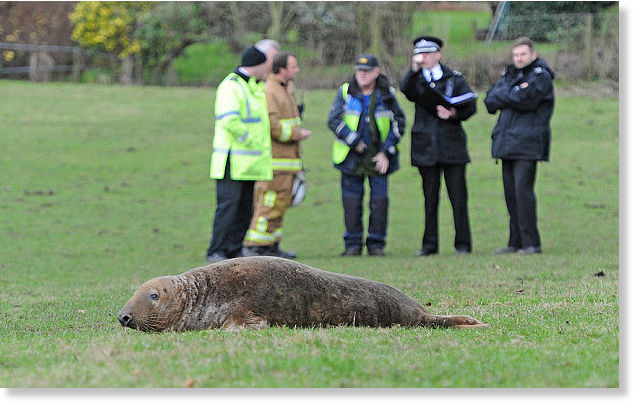
Seal washed up in a field in Newton-le-Willows near Warrington, Cheshire
A seal had to be rescued from a field more than 20 miles inland - after apparently getting "very, very lost".

The seal, which was discovered in Newton-le-Willows, near St Helens in Merseyside on Monday morning, was likely to have swum up to 50 miles away from its home before clambering into the fenced-off field from a nearby brook, experts said.

It was found in a "distressed" state by a dog-walker at about 9.45am, sparking a rescue operation involving the emergency services and the RSPCA as police warned locals to stay away from the "potentially dangerous" animal.

The creature, believed to be a juvenile male grey seal, was eventually coaxed into a trailer using mackerel as bait and taken to a wildlife centre for checks.

Farm owner Gary Watkinson, who owns the field where the seal was found, said: "We woke up this morning and found a seal in our field, which is quite unusual to say the least.

Eye 2

Over 100 live snakes released on Vietnam highway

Image
Over 100 snakes of different kinds crawled along a national highway in southern Dong Nai Province, throwing locals into panic on Saturday afternoon.

Around 4.40pm, locals who travelled and live in a neighborhood in the province's Thong Nhat District along the National Highway No. 1 were petrified at the ghastly sight of over 100 snakes crawling across the highway.

Witnesses said they earlier saw three men, who resembled Buddhist monks with shaved heads in yellow outfits, getting down from a seven-seat car with three green sacks.

The men unpacked the sacks as if they were pouring out the contents.

Info

Two otters found dead in Sundarbans oil spill, Bangladesh

Image
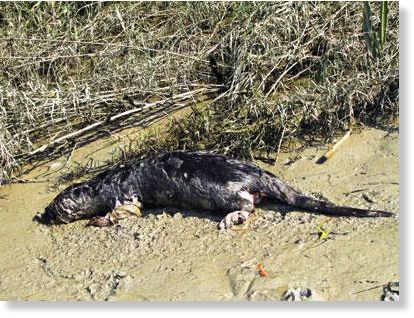
Autopsy on the two otters, recovered by forests department workers from the river Shela in the Sundarbans on Thursday, have confirmed that they had died from ingestion of oil.

The veterinarians of the forests department on Saturday found furnace oil in the mouths and lungs of the two animals. Previously innumerable otters could be seen in the rivers of the southwest regions, but now they are only found in the Sundarbans. These are enlisted as endangered species by the International Union for Conservation of Nature (IUCN). Fishermen of Narail and the Sundarbans use otters to catch fish, and National Geographic as well as other wildlife agencies have done researches on this.

After 350 thousand litres of oil was spilled in the river Shela of the Sundarbans in the 9 December tanker capsize, the shipping ministry has stated that this will cause no harm to the forest. The ministry for environment and forest took samples of water from the rivers Shela and Pashur and observed that the water has an adequate level of dissolved oxygen for plants and animals to survive. In other words, the animals and plant life was free of risk.

Wolf

Animals and insects can predict natural disasters and diseases

golden wing warbler predict disaster
Anecdotal evidence has long suggested that certain animals can predict natural disasters, detect disease and more, and now science is proving many of these stories to be correct.

Close observation of such animals could even help people to plan well in advance of coming problems, suggests a new paper in the latest issue of the journal Current Biology.

Henry Streby of the University of California, Berkeley, and his colleagues discovered that golden-winged warblers take off from their expected locations more than 24 hours before storms hit. In this case, the storm in question produced tornadoes that killed at least 35 people.

"The most curious finding is that the birds left long before the storm arrived," said Streby. "At the same time that meteorologists on The Weather Channel were telling us this storm was headed in our direction, the birds were apparently already packing their bags and evacuating the area."

Comment: The idea that animals can predict earthquakes has ancient origins. In 373BC, the Greek historian Thucydides recorded that rats, dogs, snakes and weasels deserted the city of Helice in droves a few days before a catastrophic earthquake.

On the morning of December 26, 2004, Thai villagers noticed that buffalo grazing on the beach lifted their heads, pricked their ears and looked out to sea, then stampeded to the top of a nearby hill. For the villagers who chose to follow them, it was a live-saving move as the tsunami struck only minutes later. There have been hundreds of reports of animals seemingly foretelling catastrophe, sometimes hours and even days before it occurred. These include tales of bizarre behavior by wild beasts including elephants, antelopes, bats, rats and flamingos, plus stories of dogs refusing to go for their usual morning walk.


Eye 2

Local people terrorized by unusual explosion of venomous snakes in central Vietnam

Image
© Tuoi TreA Quang Ngai resident is shown holding a green snake he has killed.
The green pit viper, a species of venomous snake, has appeared in urban residential areas in Vietnam's central region at an alarming rate, slithering into kitchens, bedrooms, gardens, and schools.

Dozens of people in Da Nang City, as well as Quang Nam and Quang Ngai Provinces, have been hospitalized recently after being bitten by the poisonous reptile 'rắn lục' (green snake), with the scientific name of Trimeresurus albolabris.

The snake perfectly disguises itself around trees thanks to its green body. It is yellow or pale green below the eyes, while its belly is green, yellowish or white, and the end of the tail is brown or red.

The situation has reached such a dangerous level that the Department of Forest Management of Quang Ngai has asked local authorities to urgently begin a campaign to drive the animals out of local neighborhoods.

Question

Mystery as 5,000 pigeons die in Nepal

Image
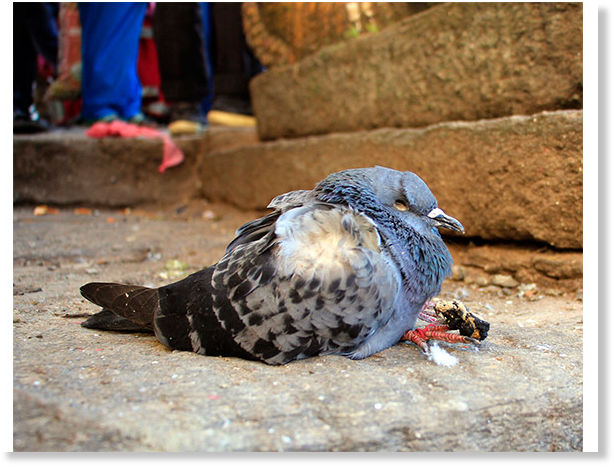
Mystery surrounds the death of thousands of pigeons on the Bhimeshwor temple premises in the past week.

According to the people in Dolakha Bazaar, dead pigeons are lying on the streets, rooftops, gardens and paddy fields. The stench from dead birds pollutes the atmosphere.

"Approximately 5,000 pigeons have died in a week," said Bharat Shrestha, treasurer of the Bhimeshwor temple prayer and trust management committee.

Authorities are yet to respond to the situation. Vets said an unidentified virus may be responsible for the menace while the locals have got into a panic fearing a disease outbreak in humans.

"Such cases happened in the past but the damage this time is terrible," said temple caretaker Kashi Narayan Shrestha. He added that rooftops and areas surrounding the temple had yet to be cleared of dead pigeons.

Comment: Similar reports: Bird deaths in Moscow spark 'zombie pigeon' scare

Over 500 pigeons drop dead in Bihar village, India