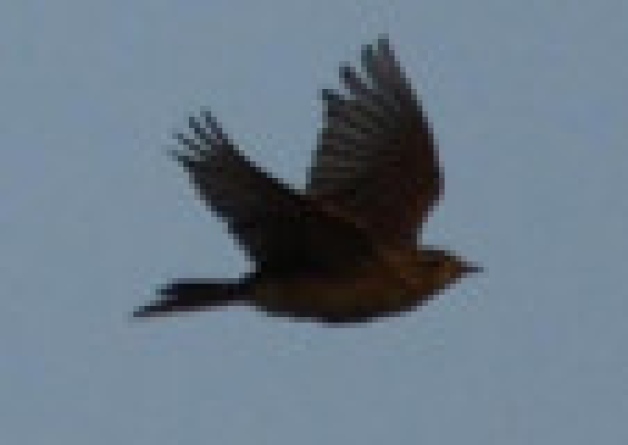
© Mick HemingwayBlyth's Pipit
A Blyth's Pipit was spotted late morning by birder Jonathan Holliday close to the Calder Wetlands site, which is across from Pugneys Country Park.
The bird, which breeds in Mongolia, is believed to be the first county record for Yorkshire.
Birders from across the region rushed to Denby Dale Road to see the "archetypal little brown job" after the news broke on social media and pagers. More twitchers are expected tomorrow.
Fellow birder Mick Hemingway, 50, managed to get pictures of the bird before it flew off towards the M1 at Durkar at about 3pm.
He said: "It's a rare vagrant, a first for Yorkshire. It's huge for an inland patch, you expect this sort of thing on the coast.
"I've been birding for nearly 30 years and it's my first one."
He believed the bird may still be in the reedy area and expects more birders to turn up at first light on Tuesday to try and relocate it.
Comment: Maybe some change in the planet's environment is interfering with this bird's ability to correctly utilise the Earth's magnetic field to navigate by? See also this:
Animal Magnetism: How the magnetic field influences animal navigationExtract -
Human impacts on the Earth's magnetic field
Humans have an impact on so many aspects of the earth's ecology. While wrangling with the magnetic field might seem like an activity that is out of our reach, human-induced electromagnetic noise could be a concern for migrating animals.
In a 2014 study published in the journal Nature, laboratory studies on robins showed birds that were exposed to background electromagnetic noise had trouble discerning which way was south.
While other studies have not seen the same impact from everyday background noise, it's prudent to be aware that human-induced electromagnetic disturbances could have an impact on some animals' highly-tuned sensory systems.
Then again, perhaps any magnetic changes of a natural kind may also play a role?
Earth's magnetic field is weakening 10 times faster now




Phylloscopus inornatus, a bird that breeds in the region extending from the Ural mountains to Eastern Siberia and which spends the winter months in Southeast Asia has been spotted in Hatay, a district of Turkey close to the Syrian border.