Animals
S


Attention

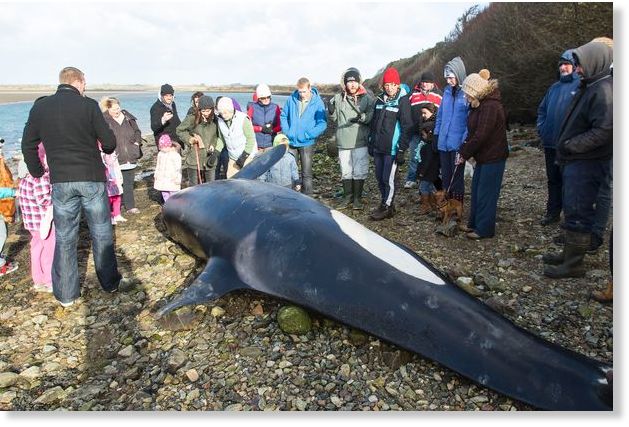
Female killer whale found dead on beach in County Waterford, Ireland

Image
© Patrick BrowneA Killer Whale washed ashore at Saleens Beach, Tramore, Co Waterford
Marine biologists are working to remove the body of a killer whale which washed up on a beach near Tramore in Waterford on Friday morning.

The five metre whale was spotted by a passerby who alerted members of the Irish Whale and Dolphin Group (IWDG).

It is believed the predatory mammal may have died of malnutrition and was dead before it washed up on shore.

"It's probably a youngish female, but its teeth are worn down which is kind of surprising. Looking at the teeth you'd think it's a very old animal," said Andrew Malcolm of the IWDG.

"When you see the teeth as worn down as that you would speculate that it could be malnourished, and that it wasn't getting enough to eat.

Attention

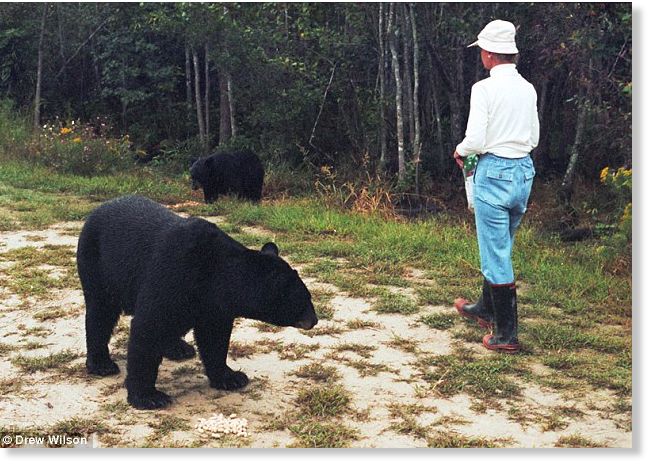
'Bear Lady' of North Carolina likely killed by bear

Image
© Drew WilsonGrayson lived without a phone, running water or electricity for two decades at the home she dubbed 'Bearsong' and used to feed the animals with peanuts and dog food
A woman known as North Carolina's 'Bear Lady' may have been killed by a bear.

The remains of Kay Grayson, 67, were found in a well-known bear path just 100 yards from her isolated home in Tyrrell County on Monday.

Authorities could only find bones, hair and ripped clothing, which had likely been there for two weeks after she was reported missing.

Binoculars

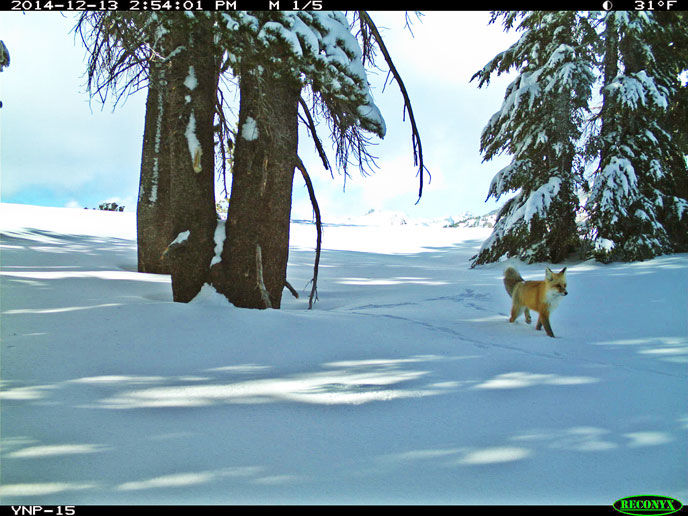
Rare Sierra Nevada red fox spotted for the first time since 1916

red fox
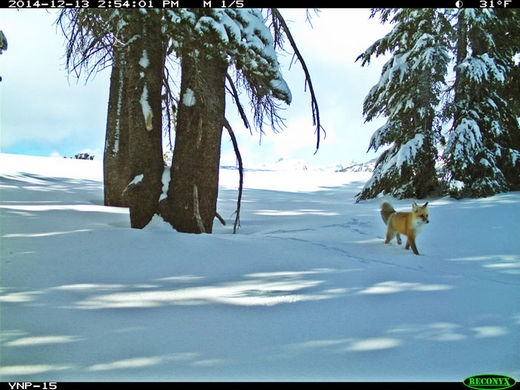
© National Park ServiceA rare photo of a Sierra Nevada red fox, snapped by a remote camera trap in Yosemite National Park.
The elusive and rare Sierra Nevada red fox has been spotted in Yosemite National Park for the first time in nearly a century, park officials said yesterday (Jan. 28).

Camera traps caught the sleek animal in a remote northern corner of the park on Dec. 13, 2014, and again on Jan. 4 of this year. The cameras were set up by wildlife biologists hoping to spot the red fox and the Pacific fisher, Yosemite National Park's rarest mammals. The ongoing study is funded by the Yosemite Conservancy.

There hasn't been a verified sighting of the Sierra Nevada red fox inside Yosemite National Park since 1916, said Ben Sacks, director of the University of California, Davis Veterinary School's Mammalian Ecology and Conservation Unit. That year, two animals were killed in Yosemite's Big Meadows, northeast of El Portal, for the University of California, Berkeley's Museum of Vertebrate Zoology.

"It's likely that the Sierra Nevada red fox has been in the backcountry of Yosemite in the last century, but they are rare enough and secretive enough that they haven't been encountered by anyone who has been able to document them," Sacks told Live Science.

Attention

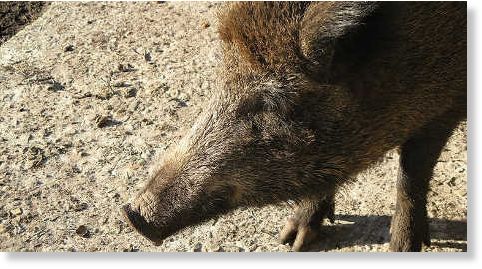
Wild boar attacks man outside nursery in Umbria, Italy

Image
© Prinke
A man is recovering in hospital after being attacked by a wild boar outside a nursery in Umbria.

The 54-year-old was attacked after dropping his grandson off at the nursery in Arrone, a town near Terni, Il Messaggero reported.

Forestry workers are now hunting for the boar, which fled the scene. The nursery is close to a green area along the Nera river.

The wild boar population in Italy has grown in recent years alongside a rise in demand for their luxury meat, which can be found in many butcher's shops.

Comment: A run down of the global reports featuring wild boar attacks on people for the past year:


Attention

Tusker kills man in Nayagram, India

Image
At Nayagram's Chunapara area, one person was killed by a wild elephant. The person, according to the locals, went into the nearby forest for some work. It is then a wild tusker came out of the woods and attacked him. Although he tried his best to rescue himself from the elephant, the tusker got the better of him at the end and killed him. The forest officers have already reached the spot of the mishap.

Binoculars

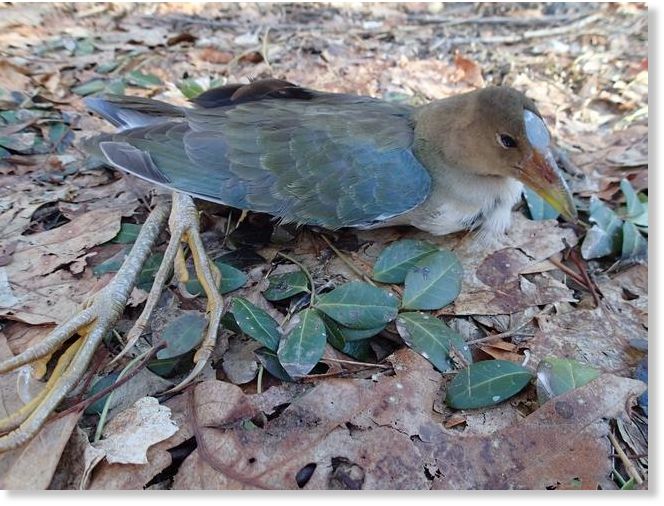
Wrong time, wrong place: Purple gallinule bird found in Weston, Massachusetts

Image
A purple gallinule was found near the 80-Acre Conservation Area near Hobbs Pond
A purple gallinule, a common marsh bird of Florida, made a wrong landing in Weston last week. Unable to withstand the cold temperatures and find food, its final resting place turned out to be 80-Acre Conservation Area near Hobbs Pond.

On Jan. 19, dog walker Susie Duff discovered the bird when her two dogs stopped to examine something about 20 feet off a trail. When she approached, she observed an "odd bird" sitting motionless, but alive on the ground.

Conservation Agent Michele Grzenda received the email on Monday night.

"Being an avid bird watcher, I'm always intrigued when I receive a mystery bird inquiry," Grzenda said. "Fortunately Susie was able to take a couple of pictures and attach them to the email she sent me. I took one look at the photo and quickly emailed back, 'Wow! Susie, you have to take me to that bird first thing tomorrow.' I suspected the bird would not last the night, since it was so approachable and far away from its normal habitat."

Binoculars

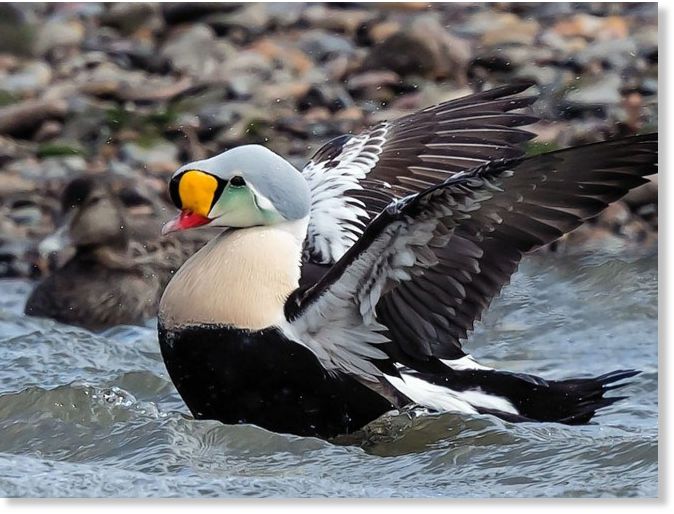
Stunning rare duck from the Arctic seen in Aberdeen, UK

Image
A stunning rare bird, hailing from the Arctic, has been spotted in Aberdeenshire.

The beautiful drake King Eider was found off St Combs in Aberdeenshire, on Wednesday.

Described as one of North America's most spectacular species, the King Eider forms large flocks during spring migration, sometimes exceeding 10,000 individuals, however, this duck appears to have been split from the flock.

Elsewhere a Ridgway's Cackling Goose was spotted at Castle Kennedy near Stranraer in Dumfries and Galloway.

The rare goose is native to North America. It breeds in northern Canada and Alaska in a variety of tundra habitats.

Source: The Press and Journal

Attention

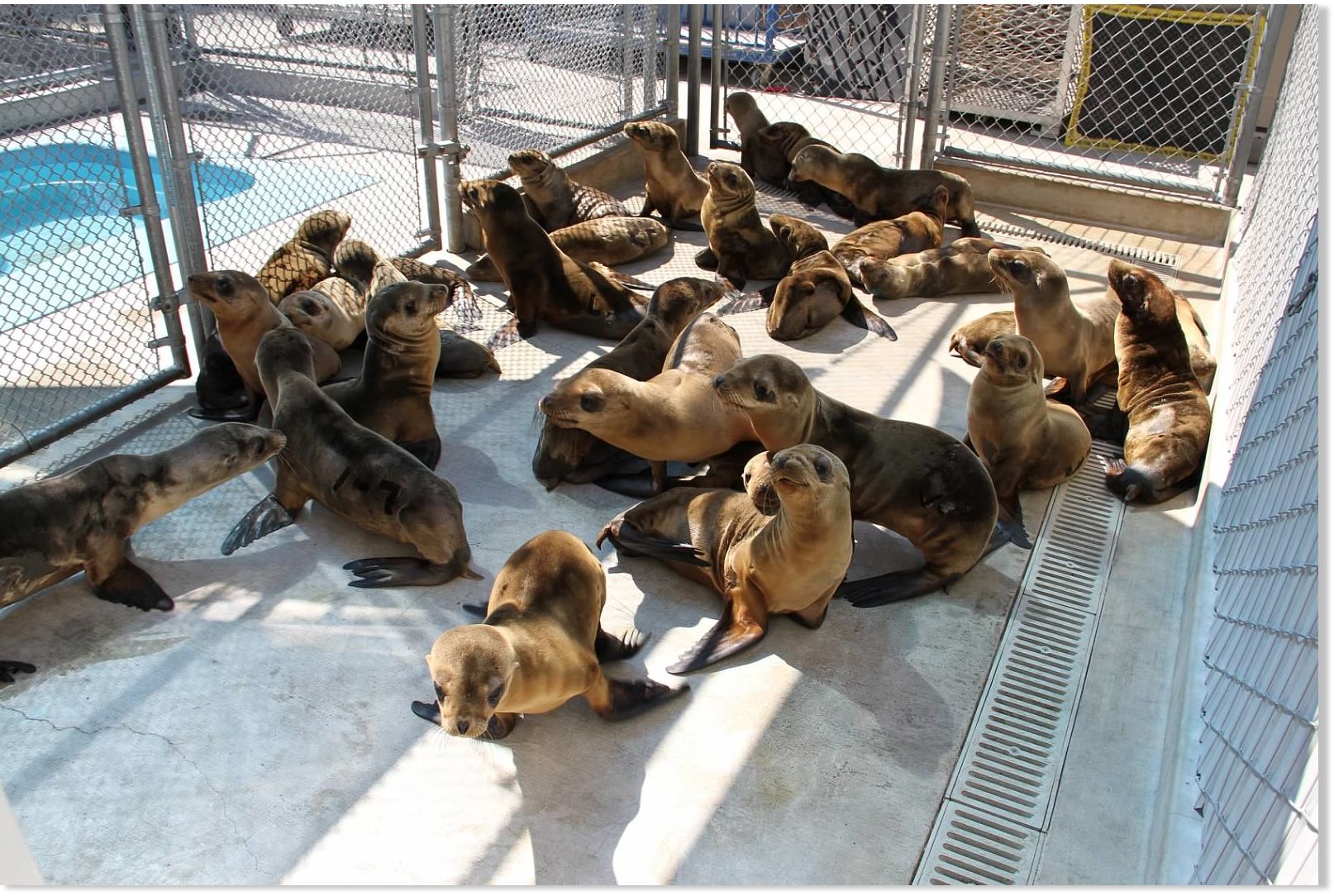
Sick sea lions wash ashore at alarming rate, California

Image
The Pacific Marine Mammal Center will release a recently nursed-back-to-health sea lion back into the ocean at Crescent Bay in Laguna Beach Tuesday.

The center usually doesn't see any ill sea lions washing ashore this time of the year, but already more than two dozen have needed treatment by the only licensed agency in the county.

At most, two or three might end up on the beach and need a rescue, but the center has taken in 28 this month while 13 sea lion pups washed ashore in December, Executive Director Keith Matassa said.

Further alarming the center's experts is an influx of varying species, Matassa added.

"The difference this year is we're also seeing different species we don't normally see down here," Matassa said.

Comment: See also: 650 emaciated sea lion pups wash up on the California coast over last 2 months

2013 California sea lion unusual mortality event in California

Sea lion strandings pass 1,500 mark


Cloud Precipitation

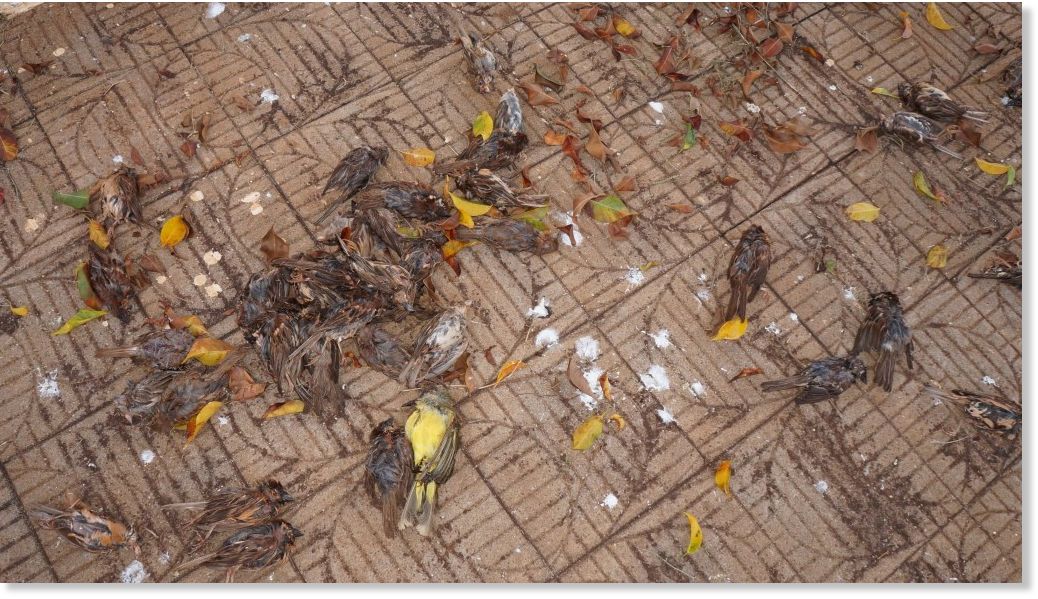
Hailstorm kills 300 birds in Ivaiporã, Brazil

Image
© Ivan Maldonado
A hailstorm that hit mainly south central Ivaiporã on Sunday night killed about 300 birds, including sparrows and doves.

According to information from the Environmental Secretariat, the hailstorm was located between the Plaza Henry Portelinha, near the Bank Brazil,on Bible Square, close to the bus station and Rio Grande Street South, near the State Barboza Ferraz College.

At first there was a suspicion of environmental crime, which was dismissed by Secretary of Environment Jayme Ayres, moreover, the birds were badly hurt. "We talked with the population living here in this region and they confirmed the hailstorm yesterday (Sunday) at about 23 hours. The dead birds were found only where the hail occurred. "

According to Ayres, just before the hail there was a strong wind that frightened the birds. "Frightened by the wind, they went looking for another shelter. It was when there was a hailstorm which ended up killing the birds, "said Ayres.

Bizarro Earth

Rare megamouth shark washes up in the Philippines

Bulbous head, 50 (yes, 50!) rows of tiny teeth, flabby body ... yep, it's a megamouth shark!
Megamouth Shark
© Manay Ning & Rosalina Sariola/Facebook
The 66th megamouth shark ever seen washed ashore this morning in Marigondon, a port in the Albay province of the Philippines. Initial reports suggest the shark (Megachasma pelagios) was approximately five metres (16 ft.) in length, but until a necropsy can be performed, the finer details about the animal (including the cause of death) will remain a mystery. Sightings like this are rare ... so rare, in fact, that when the first megamouth was spotted in 1976, a new shark family, genus and species had to be created!

These bizarre deep-diving animals are characterised by their bulbous snouts, loose skin, poorly calcified skeletons and (of course) their mega-mouths, which extend upward beyond the eyes. Only two living specimens have ever been studied by researchers, so every find is a big deal for science.