Volcanoes
Tungurahua, has been persistently active since 1999 so wear and tear was inevitable, especially given that the 'Throat of fire,' or 'Black giant' as the Quechua indigenous people named it, has already collapsed twice before thousands of years ago.
"Using satellite data we have observed very rapid deformation of Tungurahua's west flank, which our research suggests is caused by imbalances between magma being supplied and magma being erupted," says geophysical volcanologist James Hickey from the University of Exeter in the UK, whose worrying research was recently published.
Tungurahua previously collapsed at the end of the Late Pleistocene, after which it then rebuilt itself for thousands of years, before collapsing again about 3,000 years ago.
Zealandia is a chunk of continental crust next door to Australia. It's almost entirely beneath the ocean, with the exception of a few protrusions, like New Zealand and New Caledonia. But despite its undersea status, Zealandia is not made of magnesium- and iron-rich oceanic crust. Instead, it is composed of less-dense continental crust. The existence of this odd geology has been known since the 1970s, but only more recently has Zealandia been more closely explored. In 2017, geoscientists reported in the journal GSA Today that Zealandia qualifies as a continent in its own right, thanks to its structure and its clear separation from the Australian continent.
Now, a new analysis of chunks of Zealandia drilled from beneath the ocean floor in 2017 reveals that this continent underwent a paroxysm of change between 35 million and 50 million years ago. As the continental collision process known as subduction started in the western Pacific, parts of northern Zealandia rose by as much as 1.8 miles (3 kilometers), and other sections dropped in elevation by a similar amount. (Subduction occurs when one tectonic plate collides with another and sinks underneath it.)
"These dramatic changes in northern Zealandia, an area about the size of India, coincided with buckling of rock layers (known as strata) and the formation of underwater volcanoes throughout the western Pacific," study co-authors Rupert Sutherland, a geophysicist at Te Herenga Waka-Victoria University of Wellington, and Gerald Dickens of Rice University in Texas, wrote in The Conversation.
It was, in a nutshell, the birth of the Ring of Fire, the arc of subduction zones that circles the Pacific. The Ring of Fire's tectonic activity is accompanied by relatively frequent earthquakes and regions of volcanic activity.
"One of the amazing things about our observations is that they reveal the early signs of the Ring of Fire were almost simultaneous throughout the western Pacific," Sutherland said in a statement.
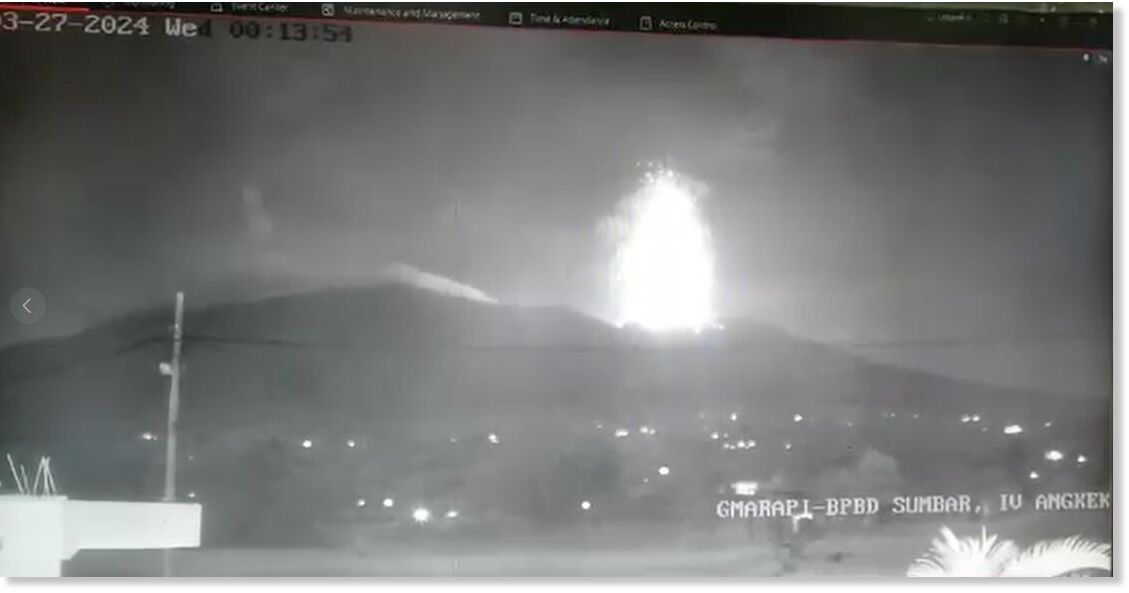
According to reports, the explosion occurred at 00:55 local time (06:55 GMT).
Popocatepetl is 5,426 meters (17,802 feet) tall and is the second-highest mountain in Mexico and the fifth-highest in North America.
El Popo, as it is affectionately known locally, is one of Mexico's most active volcanoes.
The volcano which rises to 9,550 feet above sea level, is located at the border between Yogyakarta and Central Java (home to Indonesia's capital Jakarta). It erupted at 5:16 a.m. local time, which lasted for around 150 seconds, according to a statement by Indonesia's National Disaster Management Agency (BNPB).
Volcanic material was reported to have spewed over a 0.62-mile radius, pouring ash rain over various villages around 6.2 miles south of the volcano, according to a statement by Hanik Humaida, the head of the Geological Disaster Technology Research and Development Center (BPPTKG).
Dramatic footage filmed from a helicopter has captured the molten rock pouring out of the Piton de la Fournaise volcano and stretching across the striking landscape as smoke fills the air.
The squat volcano is one of the most active in the world, periodically erupting for long stretches of time. The current eruption began all the way back in October 2019 and is still going strong.
Another layer of ash later covered the slope, sealing away at least 81 tracks until the early 1800s, when erosion revealed them to the local humans. The tracks record where at least five climbers, all with different foot sizes, walked down the steep, ash-covered hillside. One trail zigzags back and forth downhill, and you can easily picture climbers carefully working their way diagonally across the slope. Along another, more curving path, there are still handprints where the climbers reached out to steady themselves, and a slide mark reveals where one climber slipped.
The ash must have been cool enough to walk on but still soft enough to preserve tracks — very detailed ones, in a few cases. According to ichnologist Adolfo Panarello (of University of Cassino and Southern Latium) and his colleagues, that must have happened within a few days of the pyroclastic flow; Roccamonfina may even still have been erupting. In the 1800s, people living around the now-extinct volcano were sure that only the devil could have left those tracks.

Cars were left stacked upon one another in Campanillas, Malaga, Spain after freak hail storm and flash floods.

Mount Shindake, on Kuchinoerabu Island in Kagoshima Prefecture, erupted early Monday morning.
Pyroclastic flows — observed there for the first time since Jan. 29 last year — reached around 900 meters southwest of the crater, while ash and smoke rose to an altitude of some 7,000 meters after the 5:30 a.m. eruption of Mount Shindake on Kuchinoerabu Island, according to the agency.
Rocks were thrown around 600 meters from the crater. The agency maintained the current alert level of 3 on its scale of 5, which advises climbers not to scale the mountain. The alert was raised from level 2 in October following a major earthquake.
The agency warned of the potential for big rocks being hurled into the air and of pyroclastic flows within about a 2-kilometer radius of the crater, adding that volcanic ash and small rocks can travel far downwind.


Comment: What are lost continents and why are we discovering so many?