Earthquakes
S


Road Cone

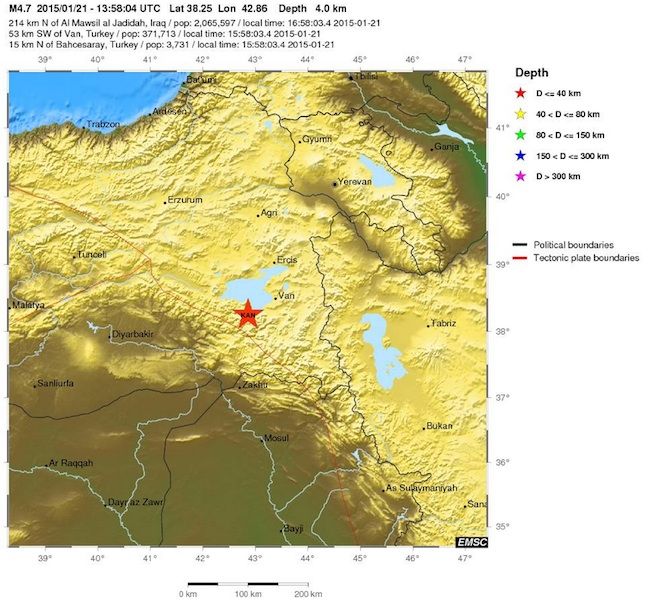
4.7 magnitude earthquake strikes Eastern Turkey

Magnitude
ML 4.7

Region
Eastern Turkey

Date time
2015-01-21 13:58:03.4 UTC

Location
38.25 N ; 42.86 E

Depth
4 km

Distances
214 km N of Al Mawşil al Jadīdah, Iraq / pop: 2,065,597 / local time: 16:58:03.4 2015-01-21
53 km SW of Van, Turkey / pop: 371,713 / local time: 15:58:03.4 2015-01-21
15 km N of Bahçesaray, Turkey / pop: 3,731 / local time: 15:58:03.4 2015-01-21

Source parameters provided by:
Kandilli Observatory and Earthquake Research Institute -- Istanbul, Turkey (KAN)
Image
© emsc-csem.org

Comment: According to the Hungarian National Association of Radio Distress-Signalling and Infocommunications there have been several earthquakes in Turkey since January 17, 2015:

Image


Map

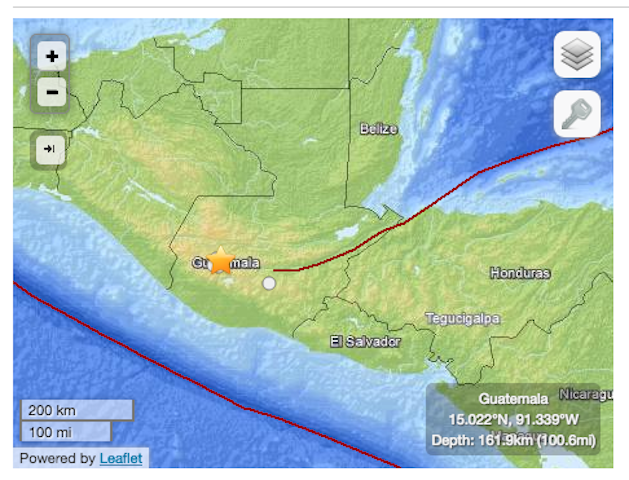
5.6 magnitude earthquake hits Santa Maria Chiquimula, Guatemala

Image
© USGS
Event Time
  1. 2015-01-20 06:59:52 UTC
  2. 2015-01-20 00:59:52 UTC-06:00 at epicenter
  3. 2015-01-20 01:59:52 UTC-05:00 system time
Location

15.022°N 91.339°W depth=161.9km (100.6mi)

Nearby Cities
  1. 1km (1mi) SW of Santa Maria Chiquimula, Guatemala
  2. 7km (4mi) ESE of Momostenango, Guatemala
  3. 12km (7mi) NNE of Totonicapan, Guatemala
  4. 14km (9mi) NE of San Francisco El Alto, Guatemala
  5. 98km (61mi) WNW of Guatemala City, Guatemala
Tectonic Summary

Seismotectonics of the Caribbean Region and Vicinity


Extensive diversity and complexity of tectonic regimes characterizes the perimeter of the Caribbean plate, involving no fewer than four major plates (North America, South America, Nazca, and Cocos). Inclined zones of deep earthquakes (Wadati-Benioff zones), ocean trenches, and arcs of volcanoes clearly indicate subduction of oceanic lithosphere along the Central American and Atlantic Ocean margins of the Caribbean plate, while crustal seismicity in Guatemala, northern Venezuela, and the Cayman Ridge and Cayman Trench indicate transform fault and pull-apart basin tectonics.

Comment: Earthquakes worldwide for the past week:


Attention

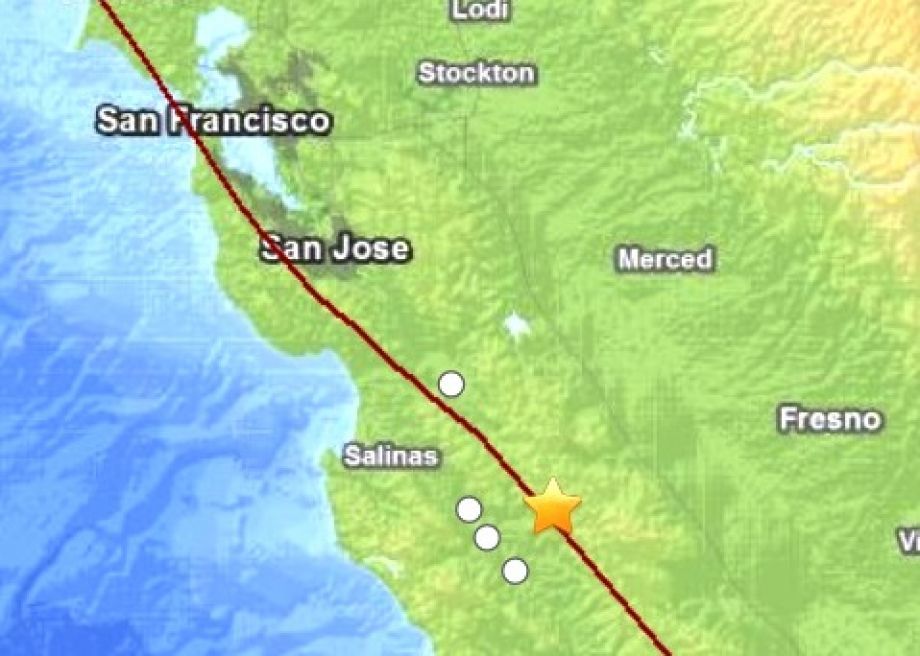
4.4 magnitude earthquake near King City, California

Image
© USGS
A light earthquake has shaken a Central California region southeast of Monterey Bay.The U.S. Geological Survey says the magnitude-4.4 tremor struck at 5:21 a.m. Tuesday.

The epicenter was 17 miles northeast of King City. The USGS says the quake occurred at a depth of 6 miles.

The immediate area is largely rural and lightly populated. The USGS public reporting pages show it was felt lightly or weakly around Monterey Bay and to the east in some San Joaquin Valley cities.

Bizarro Earth

Vancouver Island will 'rip open like a zipper' when overdue megathrust earthquake strikes, experts say

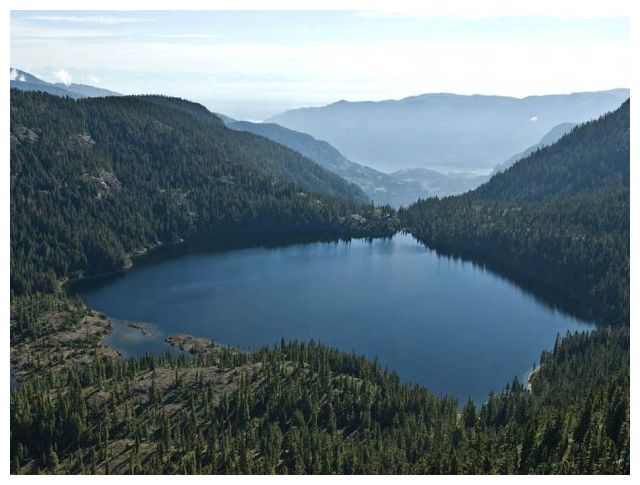
Capes Lake, Vancouver Island
© National Post, CanadaCapes Lake, Vancouver Island. The odds of another megathrust earthquake and tsunami on Vancouver Island happening within the next 50 years are about one-in-10, experts say.
Pachena Bay , B.C. - The low tide, bright sunshine and constant roar of endlessly approaching waves display the full power of the wide-open Vancouver Island shoreline at the remote beach handed down to Stella Peters and her family as a wedding dowry.

For generations, Peters and her relatives have been the keepers of Pachena Bay, the picturesque beach that scientists forecast as an epicentre for the next massive earthquake and tsunami.

The bay is also the home to the Huu-ay-aht First Nations village of Anacla, about 300 kilometres northwest of Victoria, which aboriginal oral history says was devastated when an ancient earthquake convulsed the West Coast of North America.

First Nations from Vancouver Island to northern California describe the earthquake and tsunami in similar legends and artwork involving a life-and-death struggle between a thunderbird and a whale that caused the earth to shake violently and the seas to wash away their people and homes.

When the next megathrust quake hits, residents on the west side of Vancouver Island will barely have 20 minutes to get to higher ground.

Attention

Unprecedented earthquake in Playa del Carmen and Tulum, Mexico - areas not known for seismic acivity

Yucatan Earthquake Seismograph
An earthquake was registered on the evening of Sunday January 10th, with an epicenter near Playa del Carmen, Quintana Roo, an area traditionally considered non seismic. According to Margarita Vidal Amaro of the National Seismological Service, an earthquake of magnitude 4.2 on the Richter scale occurred at 9:49 pm on Sunday January 10th 2015. The epicenter was located exactly 67 kilometers (41 miles) southwest of Playa del Carmen, in Quintana Roo.

Several Twitter users such as @FerDelor, @arnulfo_26, @CarlosQuikeYam and @linachapa among others, posted comments regarding this unusual event in this part of the country.

The government of Quintana Roo requested support from national institutions on Monday January 12th, to help determine the causes of this earthquake that occurred off the coast of Tulum. But the National Seismological Service in Mexico City officially confirmed the event since Sunday January 11th. Vidal Amaro explained that the quake occurred on the mainland and so there was no danger of a tsunami in the area. She added that even though earthquakes are unprecedented in the area, there are tectonic plates all over Mexico, which can lead to earthquakes. The quake was felt with greater magnitude in the town of Tulum, according to reports on social networks.

Source

Comment: And if it's not tectonic plates, then WHAT is causing the increase in earthquakes or ones deemed "unprecedented"?

Also see:


Bizarro Earth

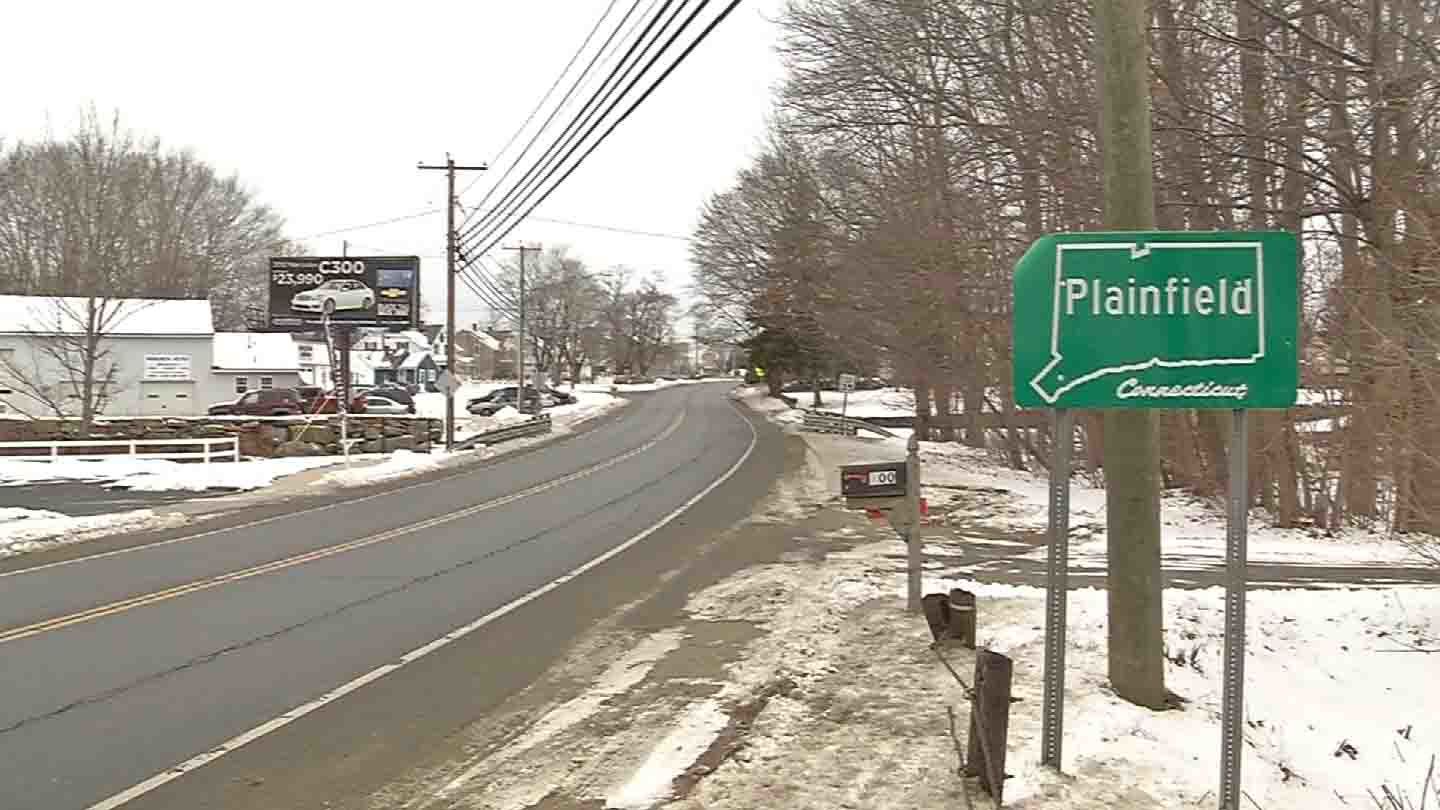
Earthquake in eastern Connecticut is 4th straight day of quakes in area

Image
A 2.2-magnitude earthquake has rattled eastern Connecticut again.

In what's becoming a daily seismic event, the Weston Observatory of Boston College said the earthquake occurred at about 4:40 a.m. Thursday near Plainfield, where previous earthquakes were recorded.

It says two minor earthquakes were recorded on Wednesday and another on Tuesday.

Several were recorded on Monday and last week, too.

The observatory says that while the greatest earthquake activity in the United States is in the west, earthquakes are "quite common" in many areas of the eastern United States, including New England.

Plainfield officials have invited Alan Kafka, director of the observatory, to an informational meeting at 6:30 p.m. Friday at the town's high school.

Comment: While this earthquake activity is being described as "quite common", it certainly seems as though something strange is going on in Connecticut for all this earthquake activity to be happening.


Bizarro Earth

Loud explosion precedes series of earthquakes in New England

Image
© WFSBThe Weston Observatory recorded four small earthquakes in the Plainfield area on Monday morning.
Five small earthquakes rattled New England on Monday.

It was the third day in less than a week that rumbles shook the Plainfield region.

Plainfield police said they received dozens of calls about homes shaking in the Plainfield, Killingly, Brooklyn and Sterling areas. They received even more around the noon hour.

"They just started pouring in regarding a loud explosion," said Capt. Mario Arriaga, with the Plainfield Police Department. "However, this time, people were reporting earthquakes since last time we had one on the 12th."

Authorities released a few of the 911 calls they received. Police said they received well over 100 calls.

"We just had a massive earthquake again," one caller reported.

"It sounded like a bomb and everything was shaking," another caller said.

Comment: Loud booms and explosion-like sounds are more and more frequently associated with earthquakes these days. There is also the possibility that some earthquakes could have been caused by meteorites breaking up in the atmosphere in New England. However, you are unlikely to hear this from the mainstream media.

Breaking: Meteor outburst over 6 Northeastern U.S. states - Connecticut, New York, New Hampshire, New Jersey, Massachusetts and Maine (so far...)


Bizarro Earth

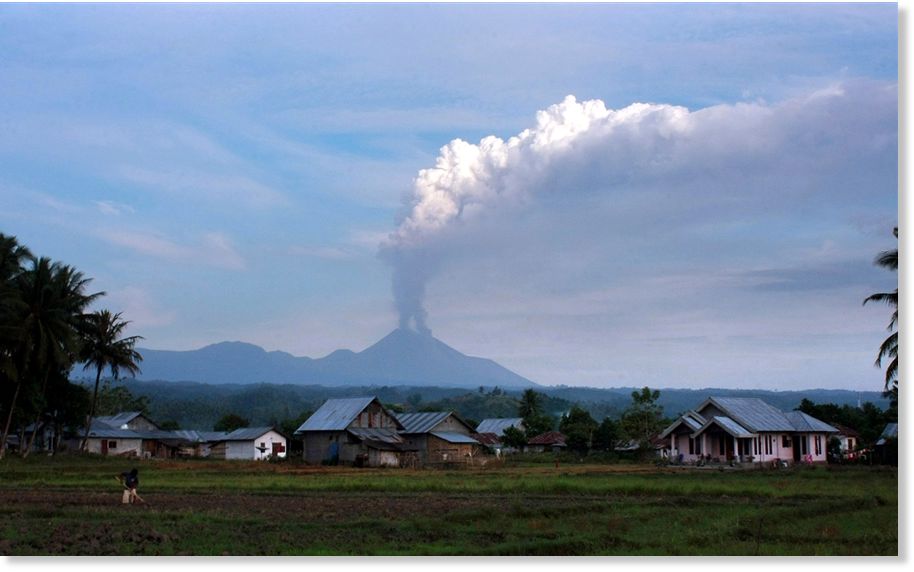
Indonesia's Soputan volcano blows its top in strong, explosive eruption

Image
The volcano erupted this morning at 02:45 local time with a strong explosion from the summit lava dome. It sent an 6 km tall ash column to approx. 26,000 ft (8,5 km) altitude. The eruption followed an increase in seismic activity in December, when so-called "drumbeat" earthquakes appeared - a type of volcanic tremor typically associated with movements of viscous magma at shallow depths,- in this case new lava rising beneath the existing lava dome (in place since 1991). As a consequence, the alert status of the volcano had been raised to the second highest level "Siaga" (3 on a scale of 1-4, alert).

Today's explosion caused parts of the summit dome that occupies the crater, open to the western flank, to collapse and produce a glowing avalanche that traveled approx. 2000 m, remaining within the volcano's caldera. It seems that no pyroclastic flow (which could sweep over the caldera walls and into inhabited areas below) occurred. No damage to people or infrastructure was reported. Continued glow from the summit dome after the explosion suggests that magma has and continues to arrive now there. - Volcano Discovery

Comment: Time-bomb? Iceland's Bardarbunga volcano eruption mystery - ground sinking below lava build-up by a foot a day


Bizarro Earth

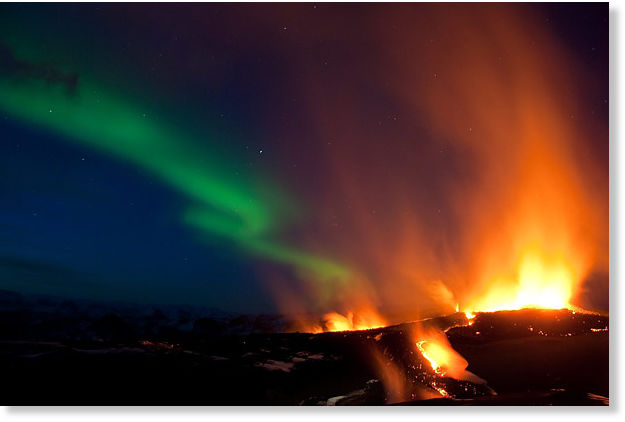
Time-bomb? Iceland's Bardarbunga volcano eruption mystery - ground sinking below lava build-up by a foot a day

Image
Skaftafell - Just north of here, on the far side of the impenetrable Vatnajokull ice sheet, lava is spewing from a crack in the earth on the flanks of Bardarbunga, one of Iceland's largest volcanoes. By volcanologists' standards, it is a peaceful eruption, the lava merely spreading across the landscape as gases bubble out of it. For now, those gases - especially sulfur dioxide, which can cause respiratory and other problems - are the main concern, prompting health advisories in the capital, Reykjavik, 150 miles to the west, and elsewhere around the country.

But sometime soon, the top of Bardarbunga, which lies under as much as half a mile of ice, may erupt explosively. That could send plumes of gritty ash into the sky that could shut down air travel across Europe because of the damage the ash can do to jet engines. And it could unleash a torrent of glacial meltwater that could wipe out the only road connecting southern Iceland to the capital. All of that could happen. Then again, it may not.

Such are the mysteries of volcanoes that more than four months after Bardarbunga began erupting, scientists here are still debating what will happen next. The truth is, no one really knows. Volcanic eruptions are among the Earth's most cataclysmic events, and understanding how and when they happen can be crucial to saving lives and reducing damage to infrastructure and other property.

Comment: Indonesia's Soputan volcano blows its top in strong, explosive eruption


Bizarro Earth

Texas trembling! Swarm of nine earthquakes rattle the State in one day

Image
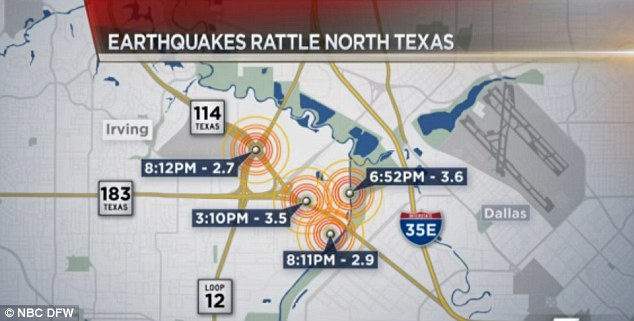
© NBC DFWMap: The U.S. Geological Service plotted the epicenters of the first four quakes to northeast Irving, a Dallas suburb in North Texas
Nine small earthquakes rattled North Texas just hours apart on Tuesday, though no damage has so far been reported from the temblors.

The magnitudes of the earthquakes, which began around 7.30am, ranged from 1.6 to 3.6, according to the USGS. Earthquakes of magnitude 2.5 to 3.0 are generally the smallest people can feel.

The U.S. Geological Service plotted the epicenters of the first four quakes to northeast Irving, a Dallas suburb. At least two of those could be felt throughout the Dallas-Fort Worth area.

Seismologists also installed a new earthquake-monitoring device in Irving this week, after minor temblors rocked an area which is near the site of the former Dallas Cowboys football stadium.

The first quake at 3:10 p.m. measured 3.5 in magnitude. Another at about 7 p.m. measured 3.6, while tremors at 8:11 p.m. and 8:12 p.m. measured less than 3.0.

The first four happened within an area near the Trinity River that's seen a swarm of mild temblors in recent months.

USGS geophysicist Jana Pursley says Tuesday's quakes were the 'largest since the earthquakes started happening there in the last year.'

According to NBC DFW, a 1.7 earthquake took place close to a Dallas intersection at 9:54pm, and a 2.4 earthquake hit Irving's University of Dallas campus at 10:05pm.

A 1.6 earthquake struck at 11:02pm - and like many of the other quakes, was also in the vicinity of the Trinity River, the affiliate station reported.

Comment: These earthquake swarms are intensifying! As well as the increasing evidence linking fracking to increased seismic activity, the Earth is 'opening up' as seismologists confirm a global surge of great earthquakes from 2004-2014 and the earthquake frequency increasing rate of strong quakes doubles in 2014

To understand why this is happening, read Earth Changes and the Human-Cosmic Connection. Here's a relevant excerpt:
From 1973 to 1996, earthquake and eruption frequencies were almost stable, increasing only slightly year after year, but from 1996 onwards, an acceleration is noticeable. Volcanic eruptions show an increase from about 59 eruptions per year at the end of the 1990s to roughly 75 eruptions per year in the period 2007 - 2010 (+30%).

Today, the increase in volcanic activity has reached such a level that, by late November 2013, 35 volcanoes were actively erupting , including volcanoes that had been dormant for decades.

It could be argued that the increase in both the frequency and intensity of earthquakes and volcanic eruptions is, at least partly, a result of the slowdown and 'opening up' processes:

1) The Earth's minute slowdown exerts mechanical stress on the crust (compression at low latitudes and extension at high latitude). This stress deforms the crust. This deformation is more pronounced and can even lead to partial ruptures around the weakest spots of the crust, i.e. the fault lines (boundaries between tectonic plates) which are the typical location of seismic and volcanic activity.

2) The mantle has a higher density than the crust and therefore has a higher momentum and won't slow down as fast as the crust. The difference in rotation between the crust and the mantle is equal to the crustal slippage. The fluidity of the mantle enables slippage induced by the different momentum carried by the crust, the upper mantle and the core.

This speed difference can cause friction at the interface between the crust and the mantle. This friction can locally deform the crust and cause earthquakes and eruptions.

3) The decrease in the surface - core E-field reduces the binding force and loosens the tectonic plates relative to each other. The plates are then free to move relative to each other. It is this very relative movement (divergence, convergence or sliding) which is one of the main causes for earthquakes and volcanic eruptions:
[Change] in Earth's speed of rotation would induce changes in the magma tide as it adjusted to the new equator or altered rotational speed. Such changes, however, might not be uniform throughout, owing to a 'drag' factor deep in the magma itself, although, overall, they would certainly impose terrible strains on the lithosphere generally.
4) A final factor involved in earthquakes and volcanic eruptions is electromagnetism:
Some scientists have become aware of a correlation between sunspots and earthquakes and want to use sunspot data to help predict earthquakes. The theory is that an intensification of the magnetic field can cause changes in the geosphere [i.e. crust]. NASA and the European Geosciences Union have already put their stamp of approval on the sunspot hypothesis, which suggests that certain changes in the Sun-Earth environment affect the magnetic field of the Earth, which can then trigger earthquakes in areas prone to them. It is not clear how such a trigger might work.