Earthquakes
S


Bizarro Earth

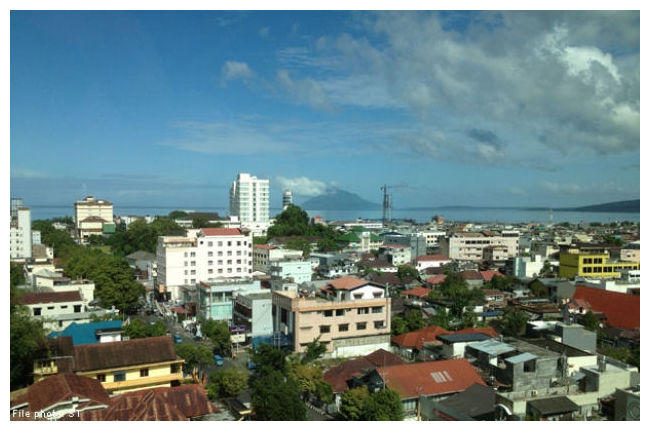
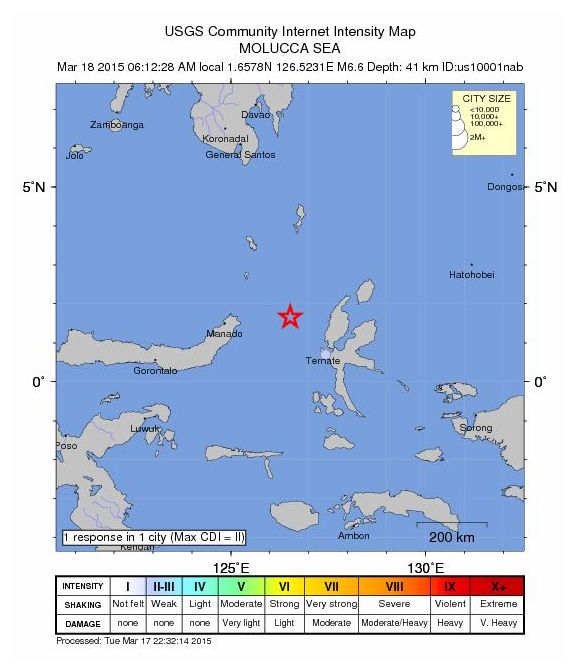
USGS: Earthquake Magnitude 6.2 - 134km NW of Kota Ternate, Indonesia

Ternate Quake_180315
© USGS
Event Time
  1. 2015-03-17 22:12:28 (UTC)
  2. Times in other timezones
Nearby Cities
  1. 134km (83mi) NW of Kota Ternate, Indonesia
  2. 136km (85mi) NW of Ternate, Indonesia
  3. 151km (94mi) E of Bitung, Indonesia
  4. 165km (103mi) W of Tobelo, Indonesia
  5. 1083km (673mi) SW of Koror Town, Palau
Scientific Data

Bizarro Earth

Magnitude 6.3 earthquake strikes Papua New Guinea

papua new guinea earthquake
A magnitude 6.3 earthquake struck off the Papua New Guinea island of New Britain on Monday, the U.S. Geological Survey (USGS) said.

The quake struck 6 miles (9 km), northwest of the town of Rabaul, on the northeast tip of New Britain island, it said. There were no immediate reports of any damage or casualties.

Bizarro Earth

U.S. Geological Survey reports earthquake in western North Carolina

Image
The U.S. Geological Survey has reported an earthquake that shook part of Swain County late Friday night.

The U.S.G.S. tracked the earthquake to Cherokee and said it happened at 11:51 p.m.

According to the U.S.G.S. website, this was a 2.8 magnitude earthquake.

Bizarro Earth

More big earthquakes coming to California, forecast says

Earthquake
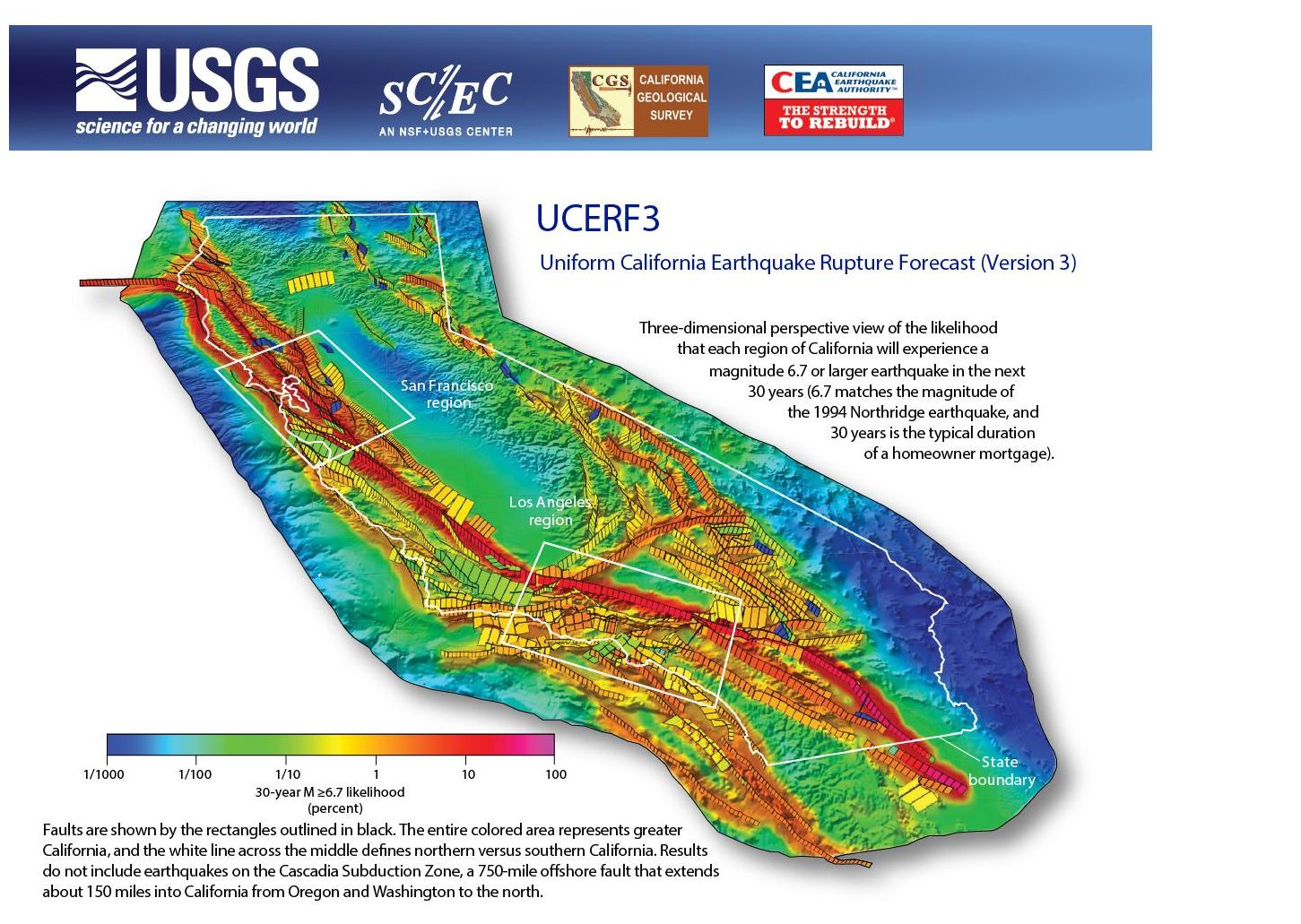
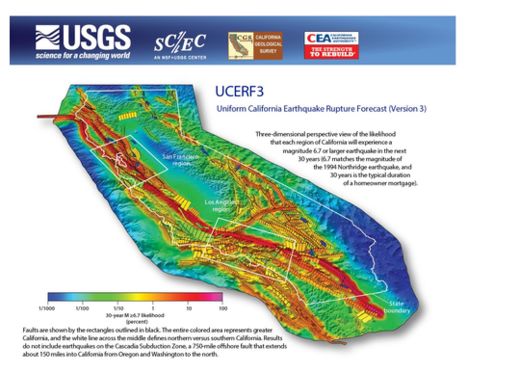
© USGSA 3D view of the likelihood that a magnitude-6.7 earthquake will hit in the next 30 years. Larger image here.
A new view of California's earthquake risk slightly raises the likelihood of big earthquakes in the Golden State, but lowers the chance that people in some regions will feel shaking from smaller, magnitude-6.7 quakes.

The new report does not predict when or where earthquakes will strike, nor how big the next quake will be; instead, it provides a better sense of how often earthquakes will occur and how likely faults are to break in the next three decades. This information helps set earthquake insurance rates and building codes in California.

Under the new forecast, the likelihood of a magnitude-8 earthquake in the next 30 years has increased from about 4.7 percent to 7 percent. A magnitude-8 quake would be twice as strong as the devastating 1906 San Francisco earthquake, a magnitude 7.8.

Meanwhile, the analysis said that Californians should expect a magnitude-6.7 quake to occur every 6.3 years somewhere in the state, which is less than the estimate of every 4.8 years from the previous forecast, released in 2007.

According to the new model, magnitude-8 earthquakes are still exceedingly rare in California. An earthquake of that size would require an extraordinarily long break along the San Andreas Fault, something that may happen only every 500 years.

"The model is probably good news for a homeowner, because they are more threatened by a small, local earthquake than a big, rare, distant earthquake," said Ned Field, lead author of the report and a U.S. Geological Survey research scientist in Golden, Colorado.

But earthquake insurance rates and building codes may change to reflect the uptick in great earthquakes, Field said. A magnitude-8 earthquake triggers long and fast shaking that is highly damaging to buildings and structures such as bridges.

Bizarro Earth

Evacuations as 6.6 earthquake shakes Colombia capital

Colombia Quake
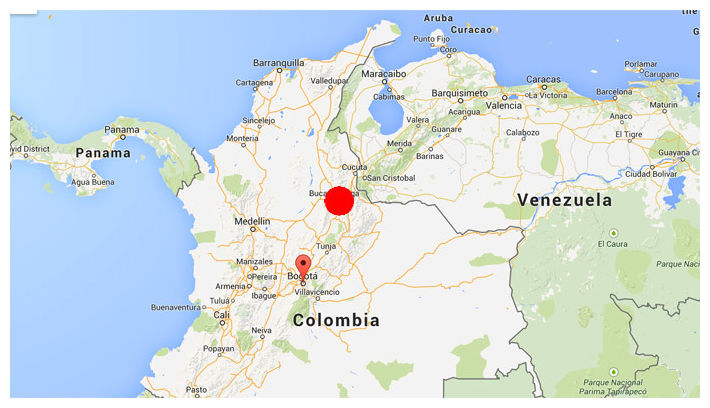
© Google mapsA screenshot from Google maps.
A magnitude 6.6 earthquake has hit the Colombian capital of Bogota, prompting mass evacuations from the city's buildings. Strong and prolonged tremors sparked panic and a social media storm.

The Colombian Geological Survey reported that the tremors originated from the Santander Department area and were 158 kilometers deep. The earthquake was an estimated magnitude of 6.6.
BOGOTA, Colombia - A Widely Felt Earthquake Has Shaken Colombia's Capital, Swaying Buildings. No Immediate Reports of Damages -AP

— Breaking News (@Breaking911) March 10, 2015
"@monterocnn: Evacúan varios edificios del centro de #Bogotá tras el fuerte sismo http://t.co/tiwRihrVIu pic.twitter.com/cRT7FqJ7m5"

— AdrianaCarolina! (@Cinnamon_Skin22) March 10, 2015
According to the US Geological Survey (USGS), the earthquake was centered about nine miles (14 kilometers) north of Aratoca, which is about 175 miles (280 kilometers) north of Bogota. The epicenter was reportedly 91 miles (147 kilometers) deep. The USGS revised the earthquake's magnitude to 6.2.

No damage or casualties were immediately reported.

Hardhat

A new level of understanding earthquakes on a microscopic scale

Image
© Berkeley Labs
As everyone who lives in the San Francisco Bay Area knows, the Earth moves under our feet. But what about the stresses that cause earthquakes? How much is known about them? Until now, our understanding of these stresses has been based on macroscopic approximations.

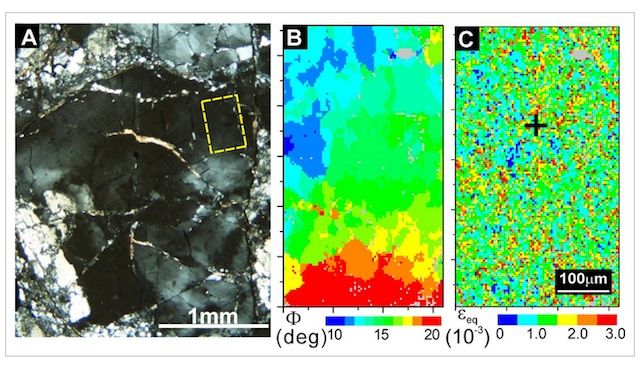
Now, the U.S. Department of Energy (DOE)'s Lawrence Berkeley National Laboratory (Berkeley Lab) is reporting the successful study of stress fields along the San Andreas fault at the microscopic scale, the scale at which earthquake-triggering stresses originate.

Working with a powerful microfocused X-ray beam at Berkeley Lab's Advanced Light Source (ALS), a DOE Office of Science User Facility, researchers applied Laue X-ray microdiffraction, a technique commonly used to map stresses in electronic chips and other microscopic materials, to study a rock sample extracted from the San Andreas Fault Observatory at Depth (SAFOD). The results could one day lead to a better understanding of earthquake events.

"Stresses released during an earthquake are related to the strength of rocks and thus in turn to the rupture mechanism," says Martin Kunz, a beamline scientist with the ALS's Experimental Systems Group.

"We found that the distribution of stresses in our sample were very heterogeneous at the micron scale and much higher than what has been reported with macroscopic approximations. This suggests there are different processes at work at the microscopic and macroscopic scales."

Kunz is one of the co-authors of a paper describing this research in the journal Geology. The paper is titled "Residual stress preserved in quartz from the San Andreas Fault Observatory at Depth." Co-authors are Kai Chen, Nobumichi Tamura and Hans-Rudolf Wenk.

Most earthquakes occur when stress that builds up in rocks along active faults, such as the San Andreas, is suddenly released, sending out seismic waves that make the ground shake. The pent- up stress results from the friction caused by tectonic forces that push two plates of rock against one another.

Comment: It is possible that some some earthquakes could be caused by meteorites breaking up in the atmosphere. Read Earth Changes and the Human-Cosmic Connection by Pierre Lescaudron and Laura Knight-Jadczyk for more details.

See also:
Earthquake frequency increasing: Rate of strong quakes doubles in 2014


Bizarro Earth

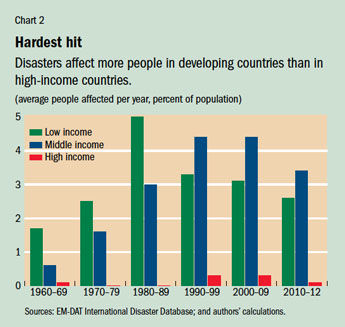
Economic losses from global disasters hit low-income countries the hardest

disaster chart natons
Deaths, economic losses and other negative impacts from disasters have caused losses equivalent to 42 million years annually since 1980, a measure that is comparable to the burden of tuberculosis worldwide, the United Nations said.

More than 90 percent of the total "years" lost in disasters between 1980 and 2012 were in low and middle-income countries, representing a serious setback to their development, the U.N. Office for Disaster Risk Reduction (UNISDR) said.

"If these figures show that disaster loss is as much a critical global challenge to economic development and social progress as is disease, they also show that it is a challenge unequally shared," the UNISDR said in a report on Wednesday.

Comment: Low income nations are least likely to have the resources to build infrastructure to withstand the increasingly devastating affects of earth changes. While wealthier nations invest in developing countries, often the focus is on resource-grabbing rather than building to sustain a nation and its inhabitants. And in some cases, even so-called wealthy nations like the US are unrealistically ignoring a crumbling infrastructure in order to fund war and plunder in other nations. The way things are looking on the BBM, it will become increasingly obvious that such policies have been disastrous in themselves.


Bizarro Earth

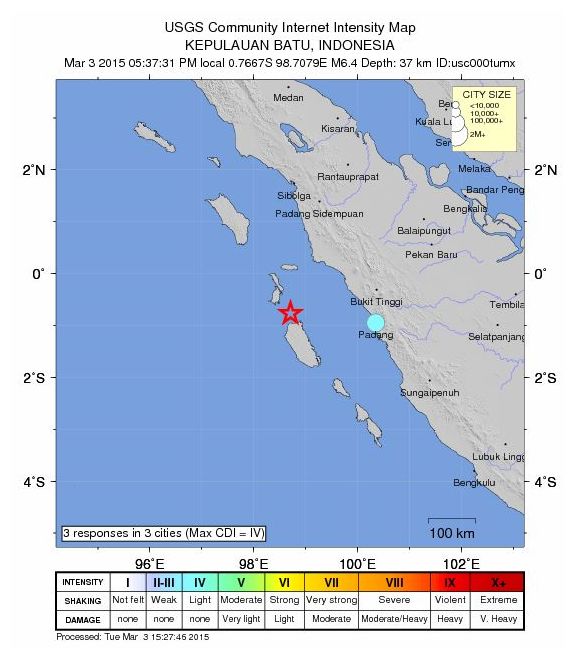
USGS: Earthquake Magnitude 6.4 - 50km NW of Sikabaluan, Indonesia

Sikabaluan Quake_030315
© USGS
Event Time
  1. 2015-03-03 10:37:31 (UTC)
  2. Times in other timezones
Nearby Cities
  1. 50km (31mi) NW of Sikabaluan, Indonesia
  2. 158km (98mi) W of Pariaman, Indonesia
  3. 184km (114mi) W of Padang, Indonesia
  4. 191km (119mi) WSW of Bukittinggi, Indonesia
  5. 544km (338mi) SW of Kuala Lumpur, Malaysia
Scientific Data

Bizarro Earth

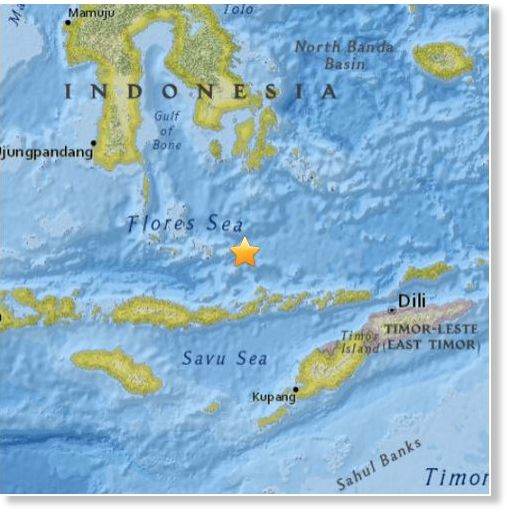
USGS: Earthquake Magnitude 7.0 - 132km N of Nebe, Indonesia

Nebe Quake_270215
© USGS
Event Time
  1. 2015-02-27 13:45:05 (UTC)
  2. Times in other timezones
Nearby Cities
  1. 132km (82mi) N of Nebe, Indonesia
  2. 152km (94mi) NNE of Maumere, Indonesia
  3. 198km (123mi) NNE of Ende, Indonesia
  4. 200km (124mi) S of Baubau, Indonesia
  5. 363km (226mi) WNW of Dili, East Timor
Scientific Data

Bizarro Earth

Rare earthquake shakes Kalimantan, Indonesia

Rare Earthquake
© News Asia One
Kalimantan is among the regions in the archipelago known to be free of earthquakes, but a recent series of light to strong quakes recorded in North Kalimantan have shaken that belief.

The latest quake was one recorded measuring 5.7 on the Richter scale that hit Tarakan on Tarakan Island in North Kalimantan at 9.31 a.m. local time on Wednesday.

Meteorology, Climatology and Geophysical Agency (BMKG) Balikpapan station head Mudjianto said the earthquake's epicenter was located in the Sulu Sea, which was closer to cities in the Malaysian state of Sabah, such as Sandakan, Kota Kinabalu, Lahat Datu, Tawau and Beaufort.

Cities in Indonesia that were close to the quake's epicenter were Tarakan on Tarakan Island and Tideng Pale in the Tana Tidung regency, located 432 kilometers away, and Nunukan in the Nunukan regency, located at the border with Sabah and across from Tawau, located 416 km from the epicenter.

"We did not calculate the quake's duration given the distance," said Mudjianto. He added that the duration could only have been recorded had the tremor reached human settlements or human structures. The magnitude of this quake was recorded by sensors owned by BMKG and was not felt on the sea, or on land in Kalimantan, or on the surrounding islands.