Earthquakes
S


Attention

A disaster waiting to happen in Oklahoma? The link between fracking and earthquakes is causing alarm in a town where oil storage is 'booming'

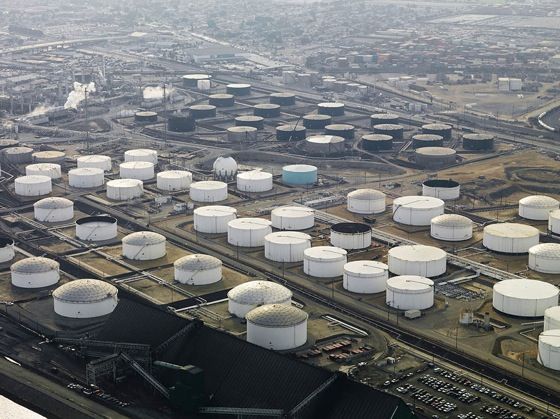
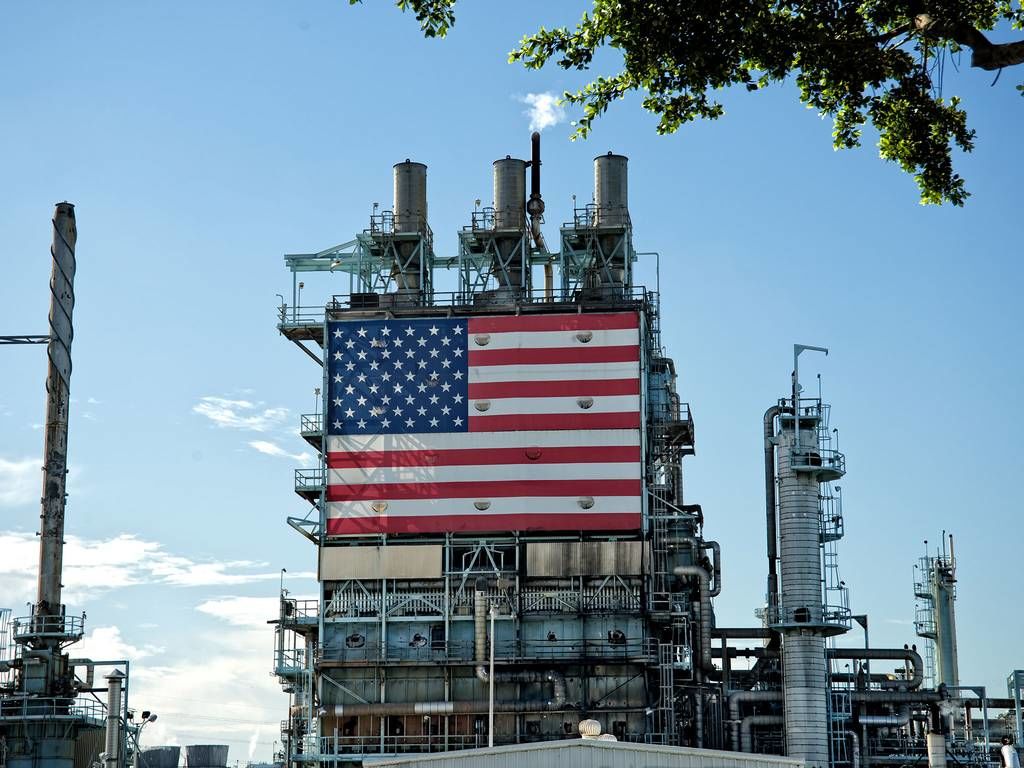
Oil storage tanks in Cushing, Oklahoma
Oil storage tanks in Cushing, Oklahoma, located at the convergence of several pipelines; the number of earthquakes above 3.0 on the Richter scale has risen from a few dozen in 2012 to more than 720 so far this year.
At first glance the small town of less than 8,000 inhabitants looks like typical country America, the kind of place that John Updike might once have written about. Except Cushing, in north-east Oklahoma, is very different.

On top of its human residents, it is also home to about 87 million barrels of oil storage. The biggest ocean-going supertankers carry about two million barrels. The Exxon Valdez spilled less than half that amount when it hit Bligh Reef in Prince William Sound, Alaska, in 1989.

Now, more tanks are being built in Cushing as storage companies seek to increase stocks at lower oil prices.

Dr Riki Ott has seen most oil-related disasters at first hand. A campaigner for energy transportation reform since the Exxon Valdez, she sees the same convergence of risk and lack of preparedness in Cushing that she once saw in Prince William Sound: "It has all of the ingredients for a major disaster. Government and industry officials are misleading the public and hardly anyone knows about it."

The oil is in Cushing because the town sits at the convergence of several of the largest pipelines in the country and has been a hub for oil transportation and storage since the early 20th century.
US oil industry
One of those pipelines is essentially the southern leg of what has come to be known as the Keystone XL, perhaps the most controversial energy development of the last 20 years. In total, there are about 14,000 miles of pipeline in Oklahoma.

Oil is stored in vast quantities at Cushing in above-ground storage containers that litter the fields surrounding the town. This is a place where "oilfield" has nothing to do with drilling, in a state where the oil and gas industry has become as powerful as it is anywhere in the United States.

Now, thanks to fracking, it's also one of the most active seismic areas in the entire United States.


Ironically it is the fracking industry that created this very real and little-discussed threat to Cushing which, according to Oklahoma Sierra Club's director Johnson Bridgwater, has "the potential for producing one of the worst environmental catastrophes in American history".

Until very recently earthquakes were a rare occurrence in Oklahoma. Not any more. In 2008 the US Geological Survey recorded just two earthquakes above 3.0 on the Richter Scale in Oklahoma.

In 2014 it recorded 585, including 15 that measured over 4.0. The state is on target to break through 800 in 2015, taking California's crown as the most active seismic state in the country.

The epicentre of an earthquake on 10 October that measured 4.3 on the Richter Scale just happened to be Cushing.
Comment: The potential disasters resulting from the same "lack of understanding of risk" and "official denial of reality" and the probable causes are getting more 'fracking obvious'!


Attention

Larger, more destructive earthquakes possible given new link between two California faults

Image
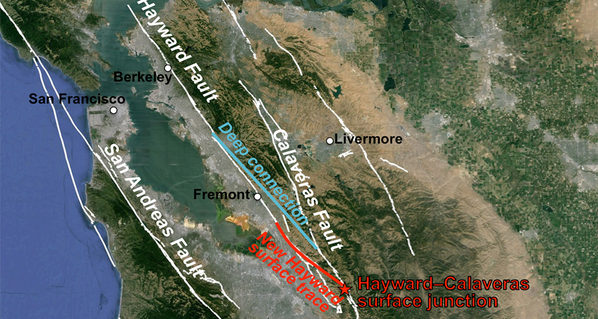
© Estelle Chaussard/UC BerkeleyThe red line indicates the newly discovered link between the southern end of the Hayward Fault and the Calaveras Fault, once thought to be independent systems.
Two California fault lines — the Calaveras Fault and the Hayward Fault — are actually connected, new research shows, meaning an earthquake resulting from the pair could be much more destructive than originally thought, with a potential for a magnitude 7 quake or greater.

Seismologists from the University of California Berkeley used two decades of satellite data to look at "ground deformation" and "fault creep," a news release explained. Creep describes the constant, slow movement of a fault line as opposed to a fault line that's still between quakes, like San Andreas, according to the U.S. Geological Survey. "The Hayward Fault is actively moving, year-by-year," the USGS noted.

However, as Estelle Chaussard, lead researcher from UC Berkeley, explained to weather.com, though the ground is continuously moving, this movement is not producing any earthquakes. Until, that is, there's a rupture.

Comment: The potential for California to have its predicted 'big one' just got a little a bigger!


Attention

Another small earthquake hits southern Los Angeles area

Image
© Lalate
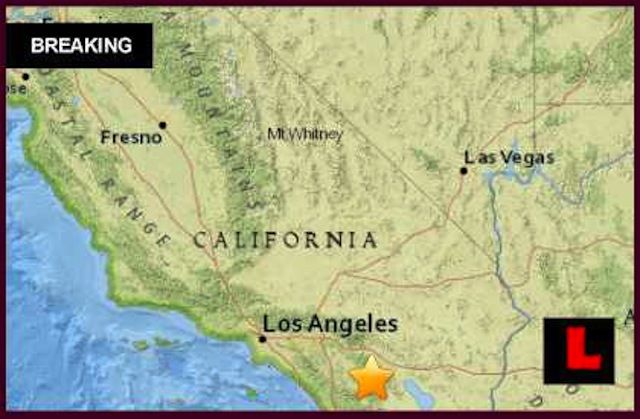
Another Los Angeles area earthquake today 2015 has struck Southern California. This time the quake was centered further south, closer to Anza and La Quinta. Damage assessment is pending. The quake follows another temblor that struck Granada Hills on Saturday.

USGS indicates to news that a Los Angeles area earthquake today April 5, 2015 struck just after 5:56 am PST. The quake was shallow. Reps tell news that the quake started just 8.9 km below ground level. As a result the quake could be felt across the vicinity. The quake registered a 2.6 magnitude. It was seven miles east of Anza, twenty miles south of La Quinta, it was twenty-one miles southwest of Palm Dester and 21 miles south of Rancho Mirage.

Several quakes have been hitting the region since 2012. In April that year one quake was centered near Indio. It was twelve miles north of Coachella, and thirteen miles east of Thousand Palms. It was reportedly twenty miles from Twenty-nine Palms and ninety-four miles from San Diego, news analysts note.

Then in June a 3.5 magnitude earthquake struck centered eight miles east of Coachella. The quake was ten miles outside of Indio and Mecca. The quake was less then twenty-eight miles east of Palm Springs. The quake was also ninety-one miles from San Diego, officials remind news.

Bizarro Earth

Multiple earthquakes shake Los Angeles area over a period of three hours

Image
© USGS
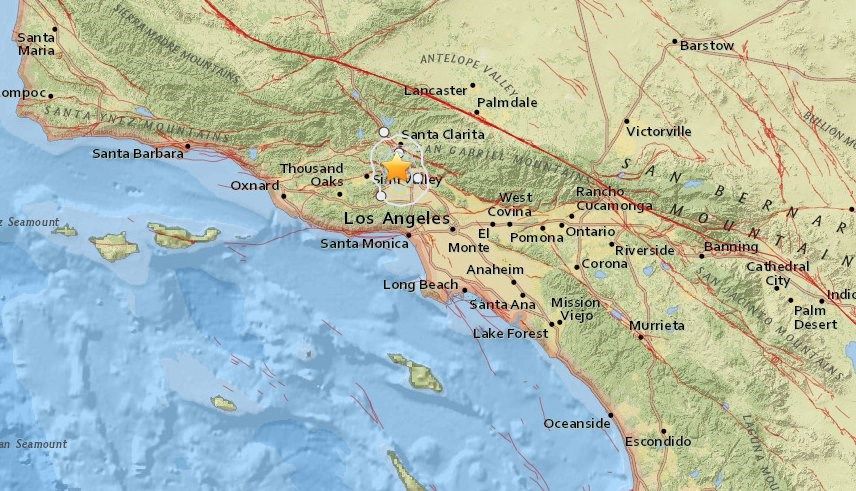
A series of earthquakes, the largest magnitude 3.1, shook the Oat Mountain area north of the San Fernando Valley Saturday.

Automated seismographs reported a series of six quakes, most in the 1-2 magnitude, starting at 7:45 a.m.

The largest quakes were magnitude 2.7 at 7:52 and magnitude 3.1 at 7:54, according to preliminary automated reports that have not been reviewed by humans.

A magnitude 2.0 temblor hit the mountain at 10:14 a.m.

As a precaution, Los Angeles city fire trucks were rolled out of station houses, where garage doors can jam or stall if a major quake occurs.

Seismologists routinely give a 10 percent chance of a major shaker following what turns out to be a foreshock.

Firefighters also scanned bridges and buildings near their station houses, which is the standard drill following a quake. No damage was found.

Persons reported to the USGS that they felt weak shaking in the northern half of the San Fernando Valley, and in across Santa Clarita, and as far away as Westlake Village, Glendale and the Antelope Valley.

Hourglass

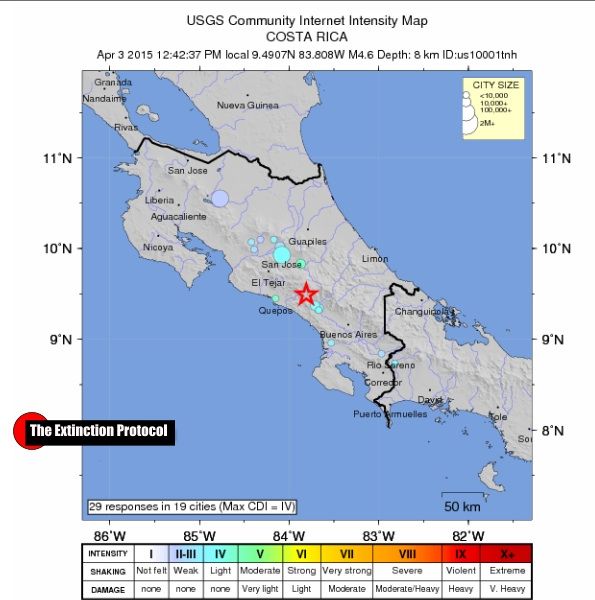
Two Good Friday earthquakes rock southern Costa Rica

A series of earthquakes rocked the southern Costa Rican city of Pérez Zeledón and could be felt in the capital, San José, starting at 12:32 p.m., reported the Volcanological and Seismological Observatory of Costa Rica, OVSICORI.

The first quake had a magnitude of 4.8 with an epicenter some 10 kilometers from Pérez Zeledón. A magnitude-5.2 aftershock at 12:42 p.m. was followed by a magnitude-2.3 temblor at 12:50 p.m., according to initial reports from OVSICORI.

The temblor was strong enough to drive some families out of their homes in Pérez Zeledón and crack the walls of homes in the beach town of Uvita, according to reports received by The Tico Times. Some beachgoers on the Caribbean even felt the quake.
Image

Comment: 4.6 magnitude Costa Rican earthquake produces more than 70 aftershocks


X

4.2 magnitude earthquake hits Alaska's Cook Inlet

Image
© Media.jrn.com
Seismologists say a light earthquake that struck Alaska's Cook Inlet region was felt in at least one town.

The Alaska Earthquake Center says the 4.2 magnitude quake occurred at 5:15 a.m. Thursday about 44 miles southeast of Newhalen.

The earthquake was felt in the Kenai Peninsula town of Homer. There are no immediate reports of damage from the earthquake.

Attention

Three earthquakes shake Irving,Texas in 24 hours

earthquakes in Texas April 2015
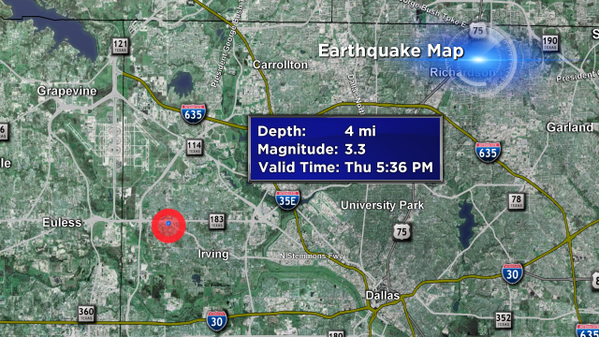
Three earthquakes shook the Irving area Thursday.

The first was a 2.7 magnitude quake recorded at 5:38 am, centered 4 miles from Irving.

The second and largest hit in the early evening. USGS reported a 3.3 magnitude earthquake at 5:36 pm. This one was centered 2 miles from Irving, but was felt in Dallas as well.


Social media lit up with people in downtown and uptown Dallas reporting they felt high rise buildings shake.

Passengers at Dallas Love Field reported feeling it, and people in Irving said on social media that the earthquake did not feel "small."

Dominoes

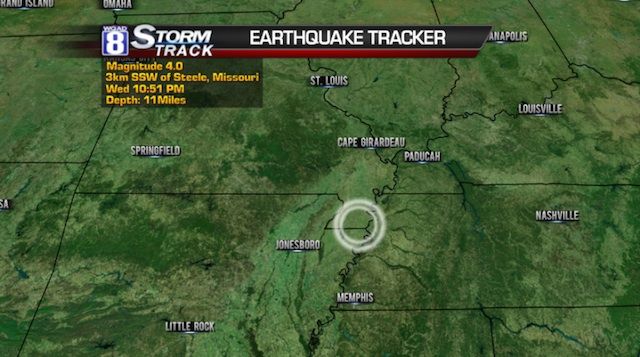
4.0 earthquake hits along New Madrid fault in Missouri; felt across the Mid-South

Image
Shortly before 11pm local time Wednesday night, an earthquake occurred along the New Madrid Fault Zone in far southeastern Missouri. The epicenter of the quake was near Steele, Missouri. Nearby cities include Blytheville, Arkansas and Hayti-Caruthersville, Missouri. The USGS reports it as a magnitude 4.0, occurring about 11 miles below the surface of the Earth.

KFVS-TV in nearby Cape Girardeau, Missouri reports it being felt as far away as Carbondale, Illinois. People on the station's Facebook page report feeling the shaking as much as 100 miles from the center. No damage or injuries have been reported with this quake. Typically, earthquakes in this part of the world with a magnitude of 4.0 don't do damage. However, earthquakes just a little stronger have been known to do minor damage within 25 miles of the epicenter.

Boat

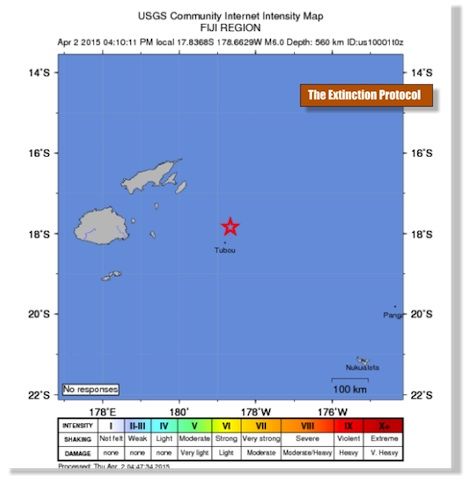
Magnitude 6.0 earthquake strikes off coast of Fiji

A strong earthquake struck off the coast of Fiji Wednesday evening but poses no tsunami threat to Hawaii.

The preliminary magnitude 6.0 temblor struck 162 miles southeast of Lambasa, Fiji at 6:10 Hawaii time at a depth of 332 miles, according to the U.S. Geological Survey.

The quake did not generate a tsunami alert from the Pacific Tsunami Warning Center and no injuries were immediately reported.

Image
© USGS

Attention

4.6 magnitude Costa Rican earthquake produces more than 70 aftershocks

Image
© Insidecostarica.com
An early morning earthquake that struck two kilometers north of Vara Blanca, Heredia, produced more than 70 aftershocks, according to the National Seismological and Volcanological Observatory (OVSICORI).

The initial quake, measuring 4.6-magnitude on the Richter scale, struck at 3:09 a.m. Aftershocks continued until 5:17 a.m., according to OVSICORI.

Significant shaking was reported in various sectors of Heredia, as well as in Naranjo, La Garita, El Coyal and Poas in Alajuela, and the western San Jose suburbs of Escazu and Santa Ana.

There were no reports of injury or damage.