Earthquakes
S


Ambulance

Death toll exceeds 7,000 with 14,000 injured; 101-year old man pulled from rubble alive in Nepal

Image
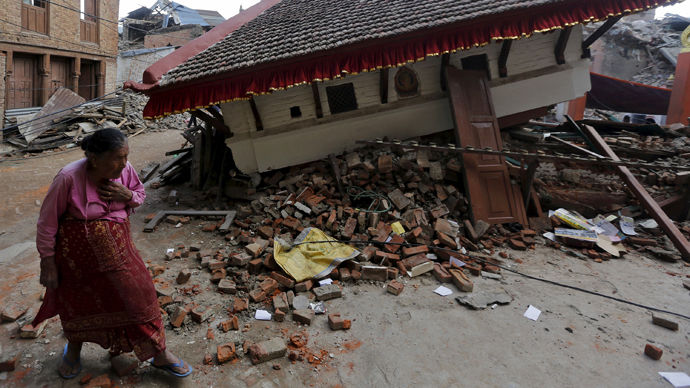
© Reuters/Adnan AbidiAn earthquake victim walks past a collapsed temple in Sankhu, on the outskirts of Kathmandu.
The death toll after the devastating earthquake that struck Nepal last week, has reached at least 7,040, officials said.

A spokesperson from the National Emergency Operations Centre confirmed the death toll on Sunday. The number of injured has climbed to 14,123, with 6,512 of theses currently being treated in hospital.

The death toll will be "much higher," warned Nepal's Finance Minister Ram Sharan Mahat.

"There are still villages where we know that all houses have been destroyed, but haven't yet been able to reach. The aftershocks have not receded and we expect the final casualty numbers to climb much higher," he said.

Earlier, Nepal police spokesman Kamal Singh Bam spoke of 7,056 dead and 14,227 injured.

"We are continuing our search and rescue operations, " Bam said on Saturday.

Nepal's Home Ministry official Laxmi Dhakal added there is little hope of finding any more survivors: "Unless they were caught in an air pocket, there is not much possibility."

About 100 people in neighboring India, China and Bangladesh were also victims of the quake.

Arrow Down

Scientists: Mount Everest shrunk about 2.8 centimeters after Nepal earthquake; Nepal region lifted about 1 meter

Image
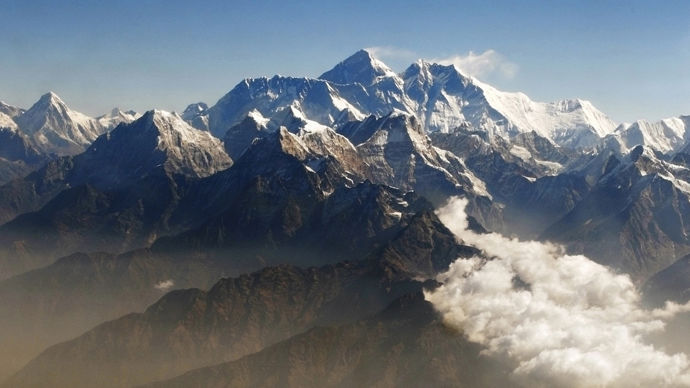
© Reuters/Tim ChongMount Everest (C), the world highest peak, and other peaks of the Himalayan range.
The deadly quake in Nepal not only devastated the country killing thousands but also changed its landscape. Mount Everest shrank a little bit after the disaster, satellite data shows.

According to Europe's Sentinel-1A radar satellite, which passed over the affected area on Wednesday, a day after the 7.8-magnitude quake, Earth's highest mountain is now 2.8 centimeters smaller than it used to be, reports LiveScience.

The lowering is explained by a relief of strain in the Earth's crust, it said citing UNAVCO, a nonprofit geoscience research consortium.

At the same time a region about 120 kilometers long and 50 kilometers wide near Nepal's capital Kathmandu lifted about 1 meter, which partially explains the extensive damage the city suffered. The uplift peaked just 17 kilometers from the city.

The satellite data is still raw and will be analyzed by teams of scientists over the next few weeks. Roger Bilham, a professor in geological sciences at the University of Colorado Boulder, told the Huffington Post that the shrinking of Mount Everest is probably just about one or two millimeters.

Info

Shallow magnitude 3.9 earthquake reported in Los Angeles area

Image
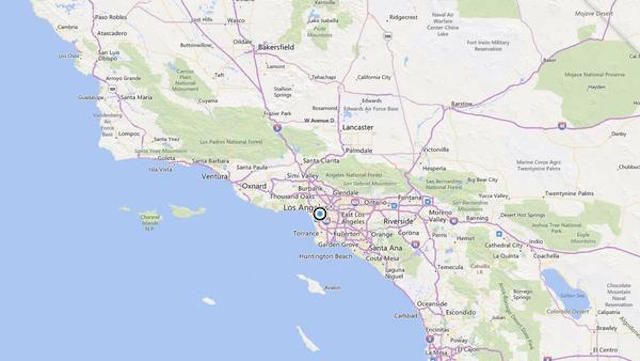
© BingA map shows approximate location of the epicenter of Sunday morning's quake near View Park-Windsor Hills.
A shallow magnitude 3.9 earthquake was reported Sunday morning one mile from View Park-Windsor Hills, according to the U.S. Geological Survey. The temblor occurred at 4:07 a.m. PDT at a depth of 5.6 miles.

The quake was classified by the USGS as "light" but was felt over a wide area of the L.A. basin. The Los Angeles Fire Department said it had received no reports of damage.

A 3.5 quake rattled the same general area on April 12. Both quakes were centered on the Baldwin Hills/Inglewood border. The Newport-Inglewood fault runs along that area.

In the aftermath of that quake, some residents asked whether oil production in the area might have been a factor. But Caltech scientist Lucy Jones wrote on Twitter that it was unlikely because the depth of the quake was so far below oil production facilities.

According to the USGS' "Did You Feel It" survey, the quake was felt over a wide area of the Los Angeles basin as well as areas to the east.

According to the USGS, the epicenter was two miles from Inglewood, two miles from Culver City and four miles from Lennox.

In the last 10 days, there has been one earthquake of magnitude 3.0 or greater centered nearby.

Road Cone

Rare earthquake strikes Michigan; 4.2 magnitude

Image
© USGS
No injuries or damages were reported today after a magnitude 4.2 earthquake rattled Michigan and surrounding states shortly after noon today.

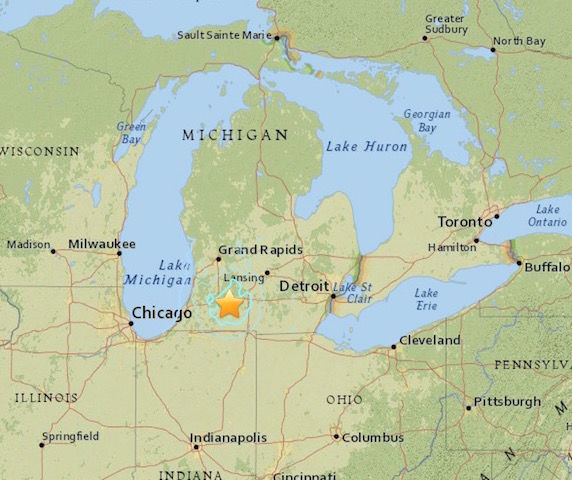
John Bellini, a geophysist at the U.S. Geological Survey's National Earthquake Information Center in Goldon, Colo., said the earthquake's epicenter was roughly five miles south of Galesburg, or nine miles southeast of Kalamazoo in central Michigan.

He said the earthquake at 12:23 p.m. could be felt widely across lower portions of the state and into northern Indiana, northwestern Ohio, eastern Illinois, southeastern Wisconsin, and western Ontario.

Gov. Rick Snyder's office said there were no immediate reports of damages or injuries.

Bellini said Michigan has had only one other earthquake of this magnitude, a 4.6 earthquake that shook the state in August 1947. Its epicenter was close to Saturday's - about 30 miles to the southeast.

He said earthquakes of this magnitude are capable of causing minor damages, such as knocking items from shelves, cracking plaster or windows, or damaging brickwork or chimneys on older buildings.

He called today's earthquake "quite uncommon. Michigan doesn't get a lot of large earthquakes."

Since 1973, the state has had only two other recorded earthquakes - one in the western reaches of the Upper Peninsula, the other in central Michigan. He said dates for those quakes were not available.

Attention

5.7 magnitude earthquake hits Japan's Hachijo-jima island

Image
© USGS
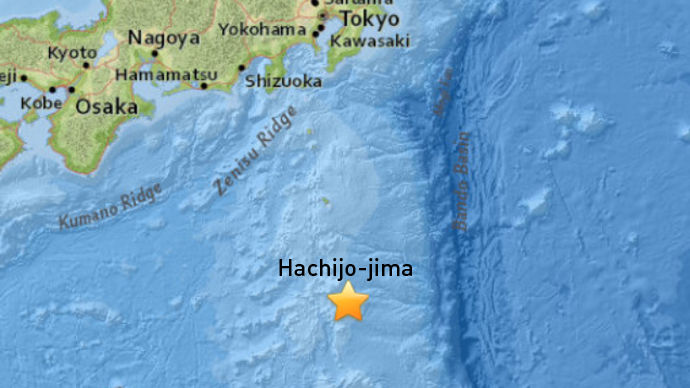
A 5.7-magnitude earthquake has struck 168 km from Japan's Hachijo-jima island, USGS said, adding that the depth of the quake stood at 10 km.

USGS initially placed the magnitude of the quake at 6.1 but later dropped it to 5.7.

Hachijo-jima, a volcanic Japanese island in the Philippine Sea, has a population of about 8,000 people.

The quake occurred 456 km from the country's capital, Tokyo, which is home to some 13 million inhabitants.It also struck 359km from the towns of Shimoda, home to 23,000 residents, and Tateyama, which has 28,000 people.

In April, southwestern Japan's Miyakojima and Yaeyama areas were placed on high alert with tsunami warnings after a 6.8-magnitude underwater earthquake struck off Taiwan's coast. Waves as high as one meter were expected to hit southwestern territories.

Question

Hundreds of methane gas flares discovered off coast of Gisborne, New Zealand

Image
© Michael Coghlan Poverty Bay.
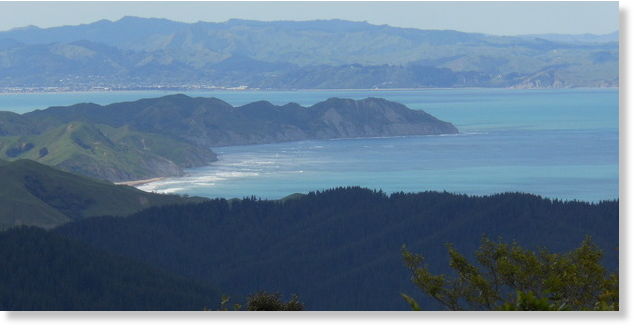
A team of scientists have found around 766 individual methane gas flares within an area of seabed off the coast of Gisborne, in what has been described as a "major advance" for science and a first for New Zealand.

The finding comes as the 11-member expedition ends tomorrow morning with the NIWA deepwater research vessel Tangaroa arriving back in Wellington.

The team, led by marine geologist Dr Joshu Mountjoy, had been investigating the area after German and Kiwi researchers last year revealed 99 seabed gas flares there using state-of-the-art 3D and 2D seismic and echosounder technology.

Following this discovery, Dr Mountjoy and his team sought to find out whether methane was getting through the water column to the ocean's surface and into the atmosphere, and determine what contribution it was making to global greenhouse gas.

The first objective of the voyage was to remap gas flares in the area in fine detail, using a range of acoustic techniques.

Comment: See also these reports for the last 12 months:

Large volumes of methane being released in Arctic Ocean

Hundreds of methane plumes erupting along U.S. Atlantic coast

Methane gas seeping out of the ground in China


Bizarro Earth

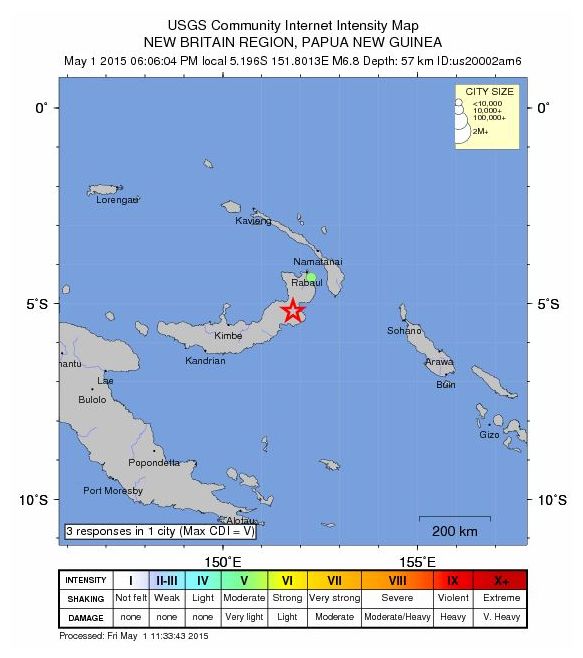
USGS: Earthquake Magnitude 6.8 - 106km SSW of Kokopo, Papua New Guinea

Kokopo Quake_010515
© USGS
Time
  1. 2015-05-01 08:06:04 (UTC)
  2. Times in other timezones
Nearby Cities
  1. 106km (66mi) SSW of Kokopo, Papua New Guinea
  2. 187km (116mi) ENE of Kimbe, Papua New Guinea
  3. 310km (193mi) SSE of Kavieng, Papua New Guinea
  4. 428km (266mi) WNW of Arawa, Papua New Guinea
  5. 693km (431mi) NE of Port Moresby, Papua New Guinea
Scientific Data

Bizarro Earth

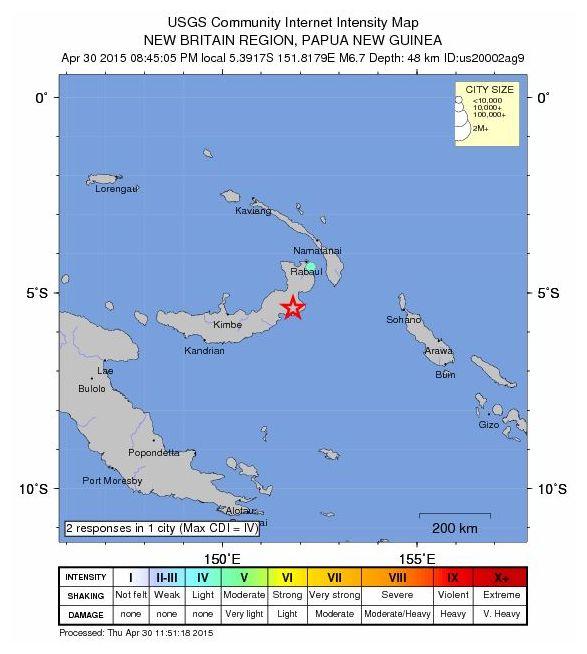
USGS: Earthquake Magnitude 6.7 - 125km SSW of Kokopo, Papua New Guinea

Kokopo Quake_300415
© USGS
Time
  1. 2015-04-30 10:45:05 (UTC)
  2. Times in other timezones
Nearby Cities
  1. 125km (78mi) SSW of Kokopo, Papua New Guinea
  2. 186km (116mi) E of Kimbe, Papua New Guinea
  3. 331km (206mi) SSE of Kavieng, Papua New Guinea
  4. 421km (262mi) WNW of Arawa, Papua New Guinea
  5. 680km (423mi) NE of Port Moresby, Papua New Guinea
Scientific Data

Bizarro Earth

USGS: Earthquake Magnitude 6.2 - 29km S of Ndoi Island, Fiji

Ndoi Quake_280415
© USGS
Time
  1. 2015-04-28 16:39:38 (UTC)
  2. Times in other timezones
Nearby Cities
  1. 29km (18mi) S of Ndoi Island, Fiji
  2. 360km (224mi) W of Nuku'alofa, Tonga
  3. 432km (268mi) SE of Suva, Fiji
  4. 537km (334mi) SE of Nadi, Fiji
  5. 539km (335mi) SSE of Lambasa, Fiji
Scientific Data

Attention

Nepal: Death toll from Saturday's earthquake rises to over 4,000 (Updated)

Image
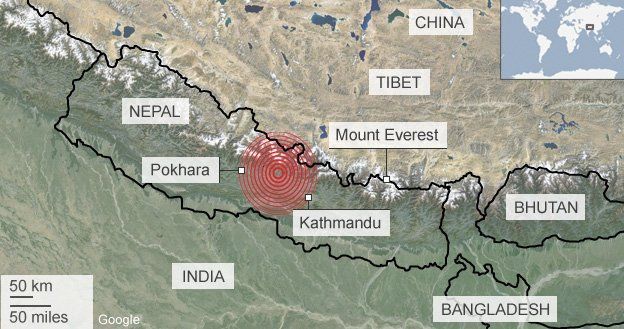
© GoogleThe earthquake, 7.8 in magnitude hit Nepal on Saturday, April 25th, 2015
At least 3,218 people are now known to have died in a massive earthquake which hit Nepal on Saturday, say officials. Rameshwor Dangal, head of Nepal's disaster management agency, said another 6,500 people had been injured. Dozens of people are also reported to have been killed in neighbouring China and India.


Comment: The death toll has expanded and is now over 4,000 people.


Thousands have spent a second night outside after the 7.8-magnitude quake, which also triggered deadly avalanches on Mount Everest. Vast tent cities have sprung up in Nepal's capital, Kathmandu, for those displaced or afraid to return to their homes as strong aftershocks continue.

"We don't have a choice, our house is shaky. The rain is seeping in but what can we do?" 34-year-old shopkeeper Rabi Shrestha, who was sleeping by the roadside with his family, told AFP news agency.

Rescue missions and aid have started arriving to help cope with the aftermath of the earthquake, the worst to hit Nepal for more than 80 years.

Comment: Billions of dollars spent on war, each year, and the US sends only $1mil... at least that makes their priorities obvious. Given the recent uptick in earthquakes and other natural disasters, we can assume only more of the same is on the way. Why's all this happening now? What's the root cause? For a good discussion on the matter the interested reader should check out Earth Changes and the Human Cosmic Connection.