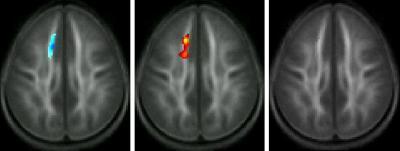
© Timothy Keller and Marcel JustThe left brain image shows the area of compromised white matter (blue area) among poor readers relative to good readers at the beginning of the study. The center brain image shows the area where the structural integrity increased (red/yellow area) among poor readers who received the instruction, and it is very similar to the initially compromised area. The right brain image shows that following the instruction, there were no differences between the good and poor readers with respect to the integrity of their white matter.
Carnegie Mellon University scientists Timothy Keller and Marcel Just have uncovered the first evidence that intensive instruction to improve reading skills in young children causes the brain to physically rewire itself, creating new white matter that improves communication within the brain.
As the researchers report today in the journal
Neuron, brain imaging of children between the ages of 8 and 10 showed that the quality of white matter -- the brain tissue that carries signals between areas of grey matter, where information is processed -- improved substantially after the children received 100 hours of remedial training. After the training, imaging indicated that the capability of the white matter to transmit signals efficiently had increased, and testing showed the children could read better.
"Showing that it's possible to rewire a brain's white matter has important implications for treating reading disabilities and other developmental disorders, including autism," said Just, the D.O. Hebb Professor of Psychology and director of Carnegie Mellon's Center for Cognitive Brain Imaging (CCBI).