
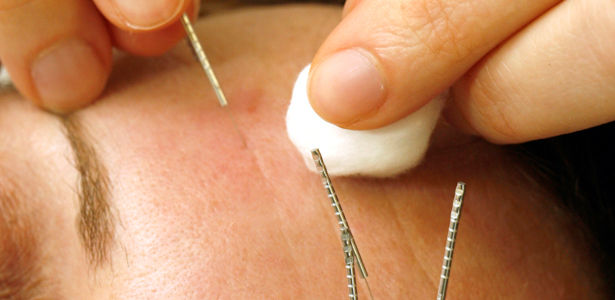
© The AtlanticAcupuncture is a "retrospective science, going on for 3,000 years. We know it works, we just don't know why."
While many practices in alternative medicine are slowly but surely making their way into the mainstream, acupuncture is one that still produces skeptical eyebrow raises. This phenomenon is partly due to linguistics. Scientists have worked to elucidate the mechanisms by which yoga, meditation, and various dietary interventions may work on the cells of the body, but there is something fundamentally more ancient-feeling about the language of acupuncture. Go to the NIH's website on complementary and alternative medicine (NCCAM), and even here you'll find a discussion that involves qi, yin, yang, and meridians.
Is it possible to discuss acupuncture in a way that makes sense to even the most Westernized brains? The short answer is yes - but with the caveat there there is no single unifying explanation for how it works. While acupuncture has been demonstrated to be useful in pain management and in treating the nausea and vomiting associated with chemotherapy, other uses have had more mixed results when studied scientifically.














Comment: Readers are encouraged to read the following articles for informed decision.
Vaccination Myths and Truths
The Vaccine Firestorm
Vaccinated Children Two and a Half Times More Likely to Have Neurological Disorders Like ADHD and Autism, New Survey in California and Oregon Finds