
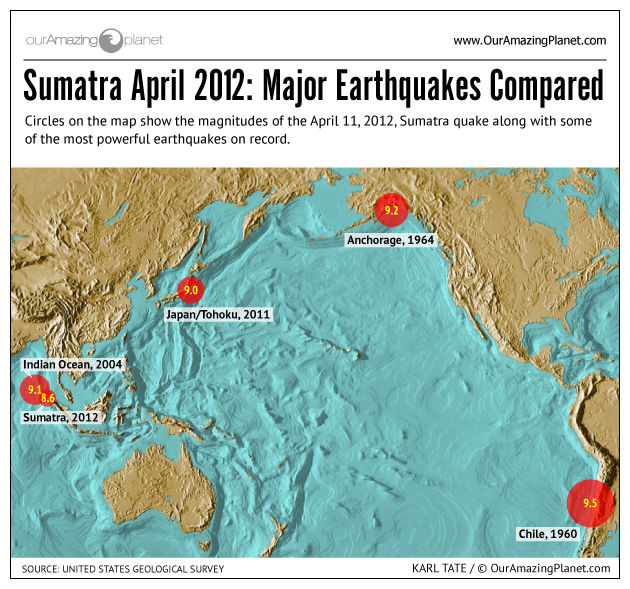
© OurAmazingPlanetThe earthquake that struck Sumatra was a big one. Here's how it compares to some record holders.
Eight years earlier, in December 2004, the third largest earthquake on record had ripped through a nearby region of the ocean floor. The magnitude-9.1 earthquake and the monstrous tsunami that soon followed killed more than 227,000 people in 14 countries,
So when a magnitude-8.7 earthquake (some put the magnitude at 8.6) shook the Indonesian island on that Wednesday afternoon earlier this year, many expected the worst. Yet, no monster wave appeared. A wave did come ashore, but it was a miniature tsunami, just 12 inches (31 centimeters) high.
All told, the earthquake did very little damage - yet only five higher earthquake magnitudes have ever been recorded. So what was the deal?
New research published today (Sept. 26) in the journal Nature delves into the intimate details of this earthquake, along with the powerful, magnitude-8.2 quake that followed two hours later. The new studies add to an existing body of research that shows this was a remarkable event - one of the most surprising earthquakes ever recorded - and one that offers an unlikely snapshot of a geological process millions of years in the making.














Comment: Note, this was seven years ago. Since then, Arctic and Green land ice sheet melt has been increasing, with the Greenland sheet melt in 2012 setting an all-time record. Recent winters in the UK and Northern Europe have made it rather clear that we are facing a much colder Northern Hemisphere, which carries the possibility of a new mini, or full scale, ice age. One year soon, winter will arrive but spring and summer may not.