Earth ChangesS


Map

Extinction-level super volcano growing in the Pacific, unfortunately

super volcano
Bad news, everyone - you have another near-certain world-ending catastrophe to look forward to.

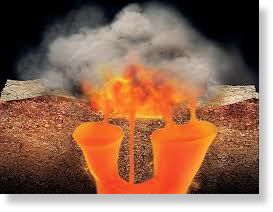
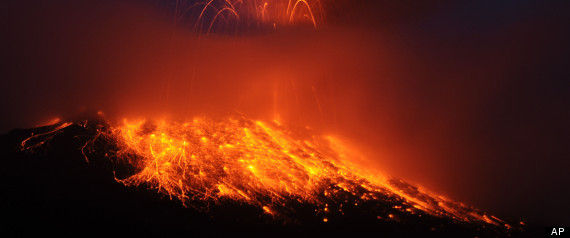
Scientists have confirmed that two continent-sized chemical blobs of partially melted rock are converging in the Pacific, and look set to create a massive new volcano which could prove cataclysmic to life on Earth. (In 100 million years.)

Geologist Michael Thorne at the University of Utah reports in Earth and Planetary Science that the collision is slowly happening 1,800 miles beneath the ocean.

He says that the collision could lead in two possible directions - both of which are bad, and would wipe out millions of species.

One is just a massive single eruption, which would kill us all, the other is a thousand-year flood basalt eruption, which would also kill us.

Bizarro Earth

Tigris and Euphrates river basin has lost Dead Sea-sized quantity of water

River Basin
© Shutterstock/Sadik Gulec
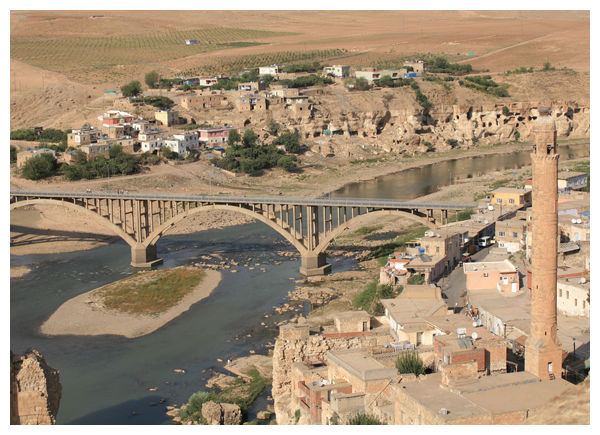
Already strained by water scarcity and political tensions, the arid Middle East along the Tigris and Euphrates rivers is losing critical water reserves at a rapid pace, from Turkey upstream to Syria, Iran and Iraq below.

Unable to conduct measurements on the ground in the politically unstable region, UC Irvine scientists and colleagues used data from space to uncover the extent of the problem. They took measurements from NASA's Gravity Recovery and Climate Experiment satellites, and found that between 2003 and 2010, the four nations lost 144 cubic kilometers (117 million acre feet) of water - nearly equivalent to all the water in the Dead Sea. The depletion was especially striking after a drought struck the area in 2007. Researchers attribute the bulk of it - about 60 percent - to pumping of water from underground reservoirs.

They concluded that the Tigris-Euphrates watershed is drying up at a pace second only to that in India. "This rate is among the largest liquid freshwater losses on the continents," the scientists report in a paper to be published online Feb. 15 in Water Resources Research, a journal of the American Geophysical Union.

Arrow Down

Major landslide at Lyme Regis, England

Coastguards were scrambled after fears that people might be trapped beneath a major landslide at Monmouth Beach, Lyme Regis, yesterday (Monday).

Rescue officers and the Portland-based helicopter were both initially despatched to establish whether members of the public on the beach at the time had been caught in the landslide.

But eye witness accounts reported to coastguards on scene and aerial surveillance quickly established that no persons were in immediate danger.


Cloud Lightning

Devastating tornado tears through southern Mississippi, seven more twisters spotted in Alabama

A swarm of tornadoes tore through several counties in southern Mississippi and Alabama on Sunday, injuring at least 10 people and ripping apart hundreds of homes and other buildings, including parts of the University of Southern Mississippi, authorities said.

The Forrest County seat of Hattiesburg, Mississippi, and the adjacent town of Petal, both about 100 miles southeast of Jackson, the state capital, bore the brunt of storms that struck less than an hour before dark.

The tornado that plowed through the Hattiesburg area was believed to have reached three-quarters of a mile in diameter at times, said Anna Weber, a National Weather Service meteorologist.


Additional images

Comment: Here's another dramatic video of this F4 tornado:


Bizarro Earth

Is the Earth cooking up another supervolcano?

Image
Every few million years or so, the Earth burps up a gargantuan volcano. These aren't like volcanoes in our lifetimes; these "super volcanoes" can erupt continuously for thousands of years. While they might be rare, you'd best look out when one hits. The ash and volcanic gases from these volcanoes can wipe out most living things over large parts of the planet. Michael Thorne, a seismologist at the University of Utah, has some clues about what causes these big eruptions. Thorne uses seismic waves to get a picture of what's going on about 1,800 miles beneath the Earth's surface, where the planet's core meets the outer mantle.

Think of the Earth as an avocado, and the pit is the core. The stuff you make guacamole with is the outer mantle. Thorne has been watching two enormous piles of rock that sit on the boundary between the core and the mantle. One pile is underneath the Pacific Ocean; the other under Africa. Scientists have known about them for 20 years, but Thorne saw something different. "I think this is the first study that might point to evidence that these piles are moving around," Thorne says.

Snowflake

Pyrenees ski resorts top world snow charts with over 7 meters (23 feet) of snowfall in one month

Image
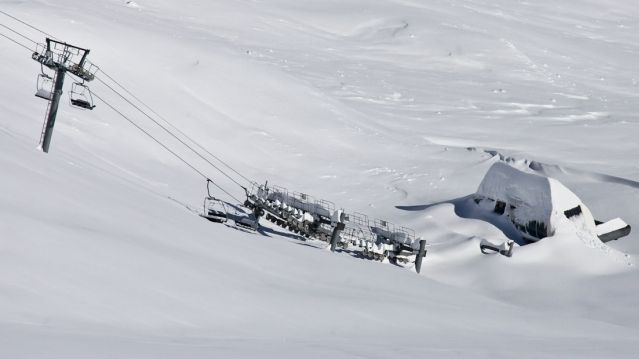
Cauterets in Hautes-Pyrenees, where ski lifts are almost buried under snow.
Road and lift closures. Evacuations and residents confined to their homes. The storms that have brought over 7 meters of snow to the Pyrenees since the New Year don't seem to be putting a smile on ski resort director's faces. Quite the opposite in fact. Some are asking if they were not better off with last season's snow drought. Yesterday at Mourtis, a resort where skiers are more familiar with grass and mud, the piste bashers were running non-stop and the upper lifts have barely opened all week. The diesel bill is eye-watering.

Noël Lacaze, director at Peyragudes, says that avalanche control work has been non-stop. "We've already used 900 kg of explosives, we've never done that before, that's between 15,000 to 20,000 euros alone". Add to that overtime plus the work clearing roofs and roads as well as additional heating costs and Lacuze thinks snowmaking might be cheaper than dealing with the effects of too much snow. Last season at Barèges there were less than 10 PIDAs organized (general avalanche control days), this season they are already approaching 20. Bernard Malus, director of le Grand Tormalet (Barèges-la Mongie-pic du Midi) says that in recent season they've invested heavily in snow making not avalanche control infrastructure. "This winter has taught us we've got to put money into remote avalanche control systems, a more performant Gazex network, it will cost around 3 million euros". Lacaze says that the investment in advanced ski lifts over recent years in the Pyrenees has had an effect "chair lifts are not more fragile but the depart and arrival areas are more complex to clear and secure, with drag lifts things were easier".

Bizarro Earth

Large tornado hits Hattiesburg, Mississippi

Map of Storm
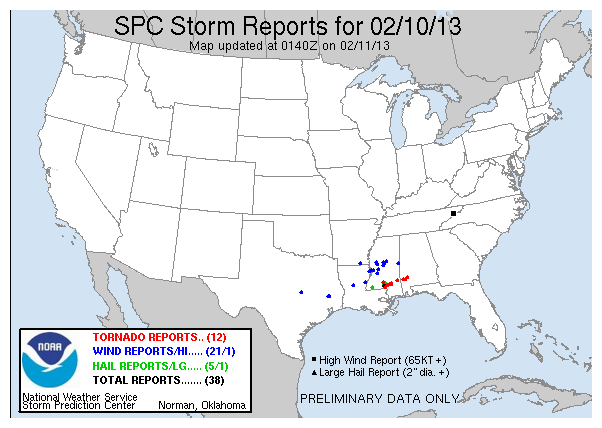
© Storm Prediction CenterStorm reports on Sunday, February 10, 2013. Red dots show tornado reports.
A strong cold front triggering blizzard conditions across northern Nebraska, South Dakota, North Dakota, and Minnesota is also triggering severe weather across the deep south today (Sunday, February 10, 2013). The Storm Prediction Center issued a slight risk for severe weather across Louisiana, southern Mississippi, and southern Alabama for a threat to see a few strong tornadoes, large hail, and strong winds.

During the evening hours, supercells developed across southern Mississippi and produced very distinct signatures on radar that would indicate strong rotation and possible tornadoes. One confirmed tornado struck the city of Hattiesburg, Mississippi around 5 p.m CST (22:00 UTC). There have been numerous reports of severe damage to buildings, structures, and what appears to be a direct hit through the University of Southern Mississippi.

In this post, we have included some images and videos that were posted via social media. It is still too early to know if any injuries or deaths occurred with this particular storm. Once we get more details, we will let you know.

Attention

Peru, Chile and Bolivia hit by floods after heavy rain

Image
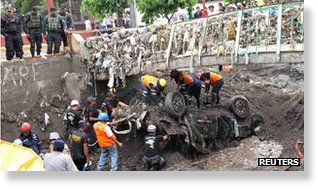
© ReutersIn Peru, thousands of people have been left without electricity and drinking water
Torrential rain has been causing havoc along the Pacific coast side of South America, with flooding causing the deaths of at least six people in Peru.

In the southern city of Arequipa, thousands of people were left without electricity and drinking water.

In Chile, some four million people were hit by cuts to water supply blamed on landslides in San Jose de Maipo, 30 miles (48 km) south east of Santiago.

The landslides contaminated two rivers supplying the capital's water plants.

Blue Planet

Jane Goodall on climate change: 'We've just been stealing, stealing, stealing from our children, and it's shocking'

Image
© AFP Photo
Jane Goodall greets the audience by imitating a chimpanzee, then launches into an hour-long talk on her relationship with apes and how, from being a primatologist, she became an activist to protect them.

At 78, Goodall, who has 53 years of studying chimps behind her, is still criss-crossing the planet to raise the awareness of populations and their leaders on the fate of the apes and the need to protect the environment.

"I haven't been more than two or three weeks in one place at one time," for the past 25 years, she says.

It all started with a conference on chimpanzees that she attended in the US in the 1980s.

There were sessions on the ethics of chimps being used in medical research, habitat destruction and chimps caught in snares and the beginning of the bush meat trade.

"I went in as a scientist happily learning about chimpanzee behaviour... but I left that conference as an activist," she recounts.

Snowflake

Time lapse video of the 2013 Snowpocalypse in the Northeast

This is fun to watch. It is a time lapse video of the Snowpocalypse in Hartford, CT. Clearly, you can see the posited global warming influences having an effect. /sarcasm