Earth ChangesS


Bizarro Earth

Sinkhole swallows Newcastle, California pond overnight

Overnight, a sinkhole swallowed a pond on Mark Korb's property in Newcastle, Calif. When he went to bed Saturday night, the pond was there. On Sunday, March 17 it was gone. How does that happen? While northern California is nowhere near as prone to sinkholes as Florida (see USGS sinkhole map), one clue might be the fact that the pond was man-made. While sinkholes don't need a human trigger; changes in drainage due to construction or agricultural irrigation have been known to activate mass outbreaks of sinkholes in Florida, and other parts of the country.


As The Christian Science Monitor reported earlier this month after a Florida man was swallowed in his bed by a sinkhole, "Drought followed by heavy rains can also instigate sinkholes as heavy, water-logged earth presses down on limestone caves suddenly devoid of buoyant water. The two previous deaths attributed to sinkholes both involved professional well drillers whose activities cracked the top of limestone caverns, causing collapse. Humans can [destabilize karst landscapes] by drawing down water tables or irrigate too much, increasing the weight of the mass of materials that sits on top of the void," says Jonathan Martin, a geologist at the University of Florida, in Gainesville. "Humans can modify the environment" enough to cause sinkholes.


Comment: Or, these more and more frequently sighted sinkholes could be caused by something more sinister than being man-made or 'agricultural irrigation'. See Sinkholes - A Sign of the Times? and do a cursory search here on SOTT for more recently discovered 'sinkholes'.

Cloud Precipitation

Global warming? Natural climate swings contribute more to increased monsoon rainfall than global warming

Natural swings in the climate have significantly intensified Northern Hemisphere monsoon rainfall, showing that these swings must be taken into account for climate predictions in the coming decades. The findings are published in the March 18 online publication of the Proceedings of the National Academy of Sciences.

monsoon changes
© Owen Shieh, University of HawaiiNew evidence suggests that high-energy particles from space known as galactic cosmic rays affect the Earth's climate by increasing cloud cover, causing an "umbrella effect."
Monsoon rainfall in the Northern Hemisphere impacts about 60% of the World population in Southeast Asia, West Africa and North America. Given the possible impacts of global warming, solid predictions of monsoon rainfall for the next decades are important for infrastructure planning and sustainable economic development. Such predictions, however, are very complex because they require not only pinning down how manmade greenhouse gas emissions will impact the monsoons and monsoon rainfall, but also a knowledge of natural long-term climate swings, about which little is known so far.

To tackle this problem an international team of scientists around Meteorology Professor Bin Wang at the International Pacific Research Center, University of Hawaii at Manoa, examined climate data to see what happened in the Northern Hemisphere during the last three decades, a time during which the global-mean surface-air temperature rose by about 0.4°C. Current theory predicts that the Northern Hemisphere summer monsoon circulation should weaken under anthropogenic global warming.

Bizarro Earth

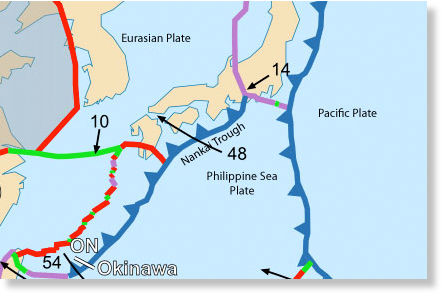
Study warns a Nankai trough earthquake would displace 10 million people in Japan, and kill 323,000

Image
A Japanese government panel is estimating that a 9.0 magnitude earthquake in the Nankai Trough region will do damage worth $2.2 billion, a figure that is much higher than the $177 million from the Great East Japan Earthquake of 2011. Scientists are predicting that the earthquake is due "in the not-too-distant future", based on historical rough calculations. These figures do not include the possible nuclear fallout from an earthquake of that magnitude. The panel also predicts the number of evacuees to reach 9.5 million a week after it hits and that 40 out of the country's 47 prefectures will suffer damage to their infrastructure. 27.1 million will suffer power outages, while 34.4 million will be without water.

In an earlier report released in August, the panel said around 323,000 could die from an earthquake with its epicenter in the Nankai Trough, also a big number compared to the 19,000 who died or were reported missing in the 2011 disasters. But if all houses and key buildings are already quake-resistant by the time the earthquake will occur, the damage can be cut to almost half at $836 million. That is why the government's priority would be to come up with basic policy measures by the end of the month against future earthquakes. The Nankai trough runs from the gulf of Suruga, Shizuoka Prefecture, central Japan, to the sea of Hyuga, off Miyazaki Prefecture in the southwestern Japan region of Kyushu. Historically, this area experiences 8.0 magnitude earthquakes once every 100 to 150 years, with the last one occurring last 1946, where around 1,330 people perished. - JDP

Bizarro Earth

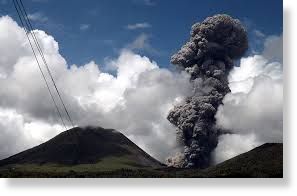
Indonesia's Mount Lokon volcano unleashes 2,000 meter ash cloud

Image
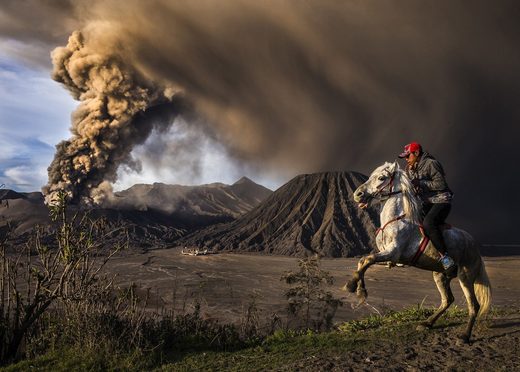
Mount Lokon in Tomohon City, North Sulawesi, erupted again at around 7:57 a.m., local time, on Wednesday, sending a plume of ash 2,000 meters into the sky from its Tompaluan crater. "There was an increase in volcanic tremors which culminated in an eruption," said Farid Ruskanda Bina, head of Mount Lokon and Mount Mahawu observation post at the Bandung Geology Agency's volcanology and geological disaster mitigation center (PVMBG), in Kakaskasen, Tomohon, on Wednesday, as quoted by Antara news agency.

Warno, an official at the observation post, added that the increases in Mount Lokon's volcanic tremors was actually not too significant. Currently, the agency's PVMBG is still maintaining Mount Lokon's volcanic activity status at "alert" (level 3) although the frequency of the volcano's eruptions has continued to decline. Previously, Mount Lokon erupted two to three times a week. The eruption on Wednesday morning shocked local residents living around Mount Lokon, as it was accompanied by loud bangs. People left their homes and crowded the Tomohon-Manado main road as well as roads in Kinilow sub-district in Kinilow Satu, Kakaskasen, to witness the eruption. Mount Lokon has been active since July 2011. Its volcanic activity status was once raised to "awas" or level 4, until it was lowered to its current level, said Farid. He said Mount Lokon's most recent eruption before it erupted again this morning was on March 10. - Jakarta Post

Bizarro Earth

19 miners rescued in Poland, after 4.7 magnitude earthquake causes mine collapse

Emergency services in western Poland have rescued 19 miners who were trapped underground when a minor earthquake caused a tunnel to collapse. The workers at Rudna copper mine in Lower Silesia were trapped for about eight hours while rescuers dug through earth and rock to reach them. The mine is owned by Poland's largest copper miner, KGHM, and has operated since 1969. A KGHM spokesman said the accident happened 600m (2,000ft) below ground. He said the rescue operation was "difficult because huge amounts of rocks have to be removed."

The tremor that caused the tunnel to collapse, lasted about 10 seconds, the BBC's Adam Easton reports from the capital, Warsaw. One miner had a gash on his head, but all those who were rescued were fit enough to go home. The mine is some 400km (250 miles) south-west of Warsaw. Accidents there are relatively uncommon. Poland has a large number of mines, many of which are located in the industrialized Silesia region, which is rich in mineral and natural resources. - BBC


Attention

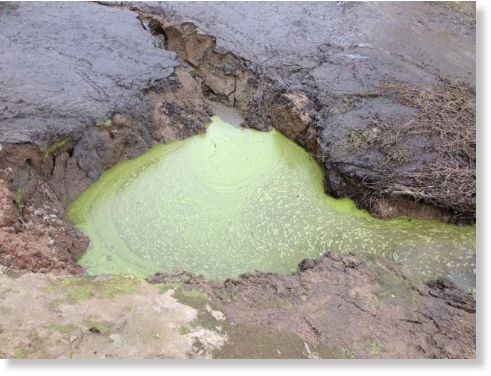
California couple wakes to find sinkhole in yard

Image
© Michael "Domi" Domalaog/KCRA"This looks like the moon," said Korb, pointing at a sinkhole that caused a pond to drain onto his property
Sinkhole caused pond to drain onto couple's property

When Mark Korb woke up Sunday morning, he noticed the man-made pond on his property didn't look the way it did when he went to bed.

"This looks like the moon," said Korb, pointing at a sinkhole that caused a pond to drain onto his property.

A few years ago, Korb drained the pond with a pump, he said. The project took him seven days to complete.

The sinkhole emptied the pond much faster: "I would guess probably four to five hours for this whole area to drain," Korb said.

Bizarro Earth

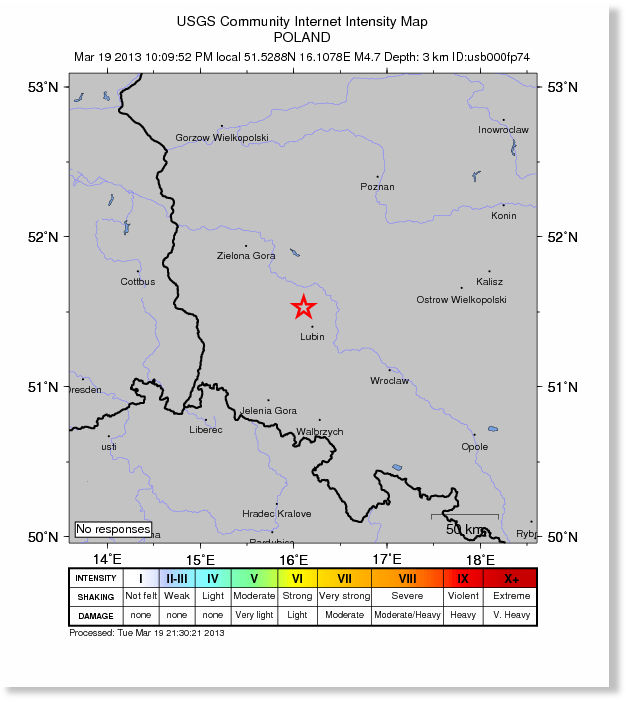
USGS: Earthquake Magnitude 4.7 - 3km NE of Polkowice, Poland

Image
© USGS
Event Time
2013-03-19 21:09:52 UTC
2013-03-19 22:09:52 UTC+01:00 at epicenter

Location
51.529°N 16.108°E depth=3.7km (2.3mi)

Nearby Cities
3km (2mi) NE of Polkowice, Poland
15km (9mi) NNW of Lubin, Poland
15km (9mi) S of Glogow, Poland
30km (19mi) NNE of Chojnow, Poland
199km (124mi) NE of Prague, Czech Republic

Technical Data

Bizarro Earth

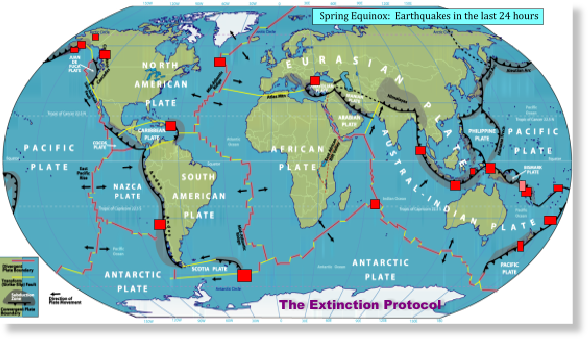
Earth reeling from spasm of quakes: seismic stress could be building towards an event?

The planet is currently reeling from a dense spectrum of moderate to light tremors, which have struck along major tectonic plate boundaries over the last 18 hours. As a precursor to this seismic dynamism; we have seen elevated activity at many of the world's volcanoes, including hotspots in Hawaii, Etna, and the Canary Islands. The latest spat of seismic activity across the globe has every indication of being a precursor to a major seismic stress release, which I have forecasted since last week. This event could be hours, or even days away. The window of elevated hazard risk, at present, extends through March 23, and is annunciated by the spring equinox. - TEP

Image

Bizarro Earth

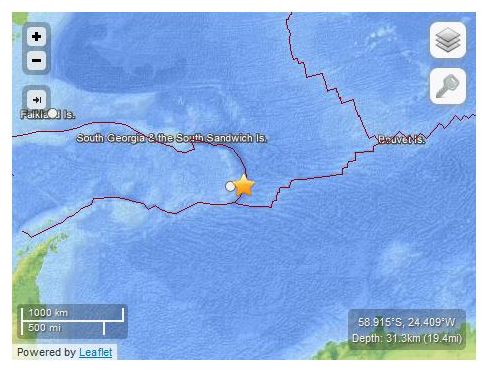
USGS: Earthquake Magnitude 6.1 - E of Bristol Island, South Sandwich Islands

Sandwich Island Quake_190313
© USGS
Event Time
2013-03-19 03:29:00 UTC
2013-03-19 01:29:00 UTC-02:00 at epicenter

Location
58.915°S 24.410°W depth=31.3km (19.4mi)

Nearby Cities
121km (75mi) E of Bristol Island, South Sandwich Islands
2666km (1657mi) ESE of Ushuaia, Argentina
2900km (1802mi) SE of Rio Gallegos, Argentina
2906km (1806mi) ESE of Punta Arenas, Chile
2241km (1392mi) SE of Stanley, Falkland IslandsTechnical Details

Extinguisher

Wildfire burns outside Great Smoky Mountains

Image
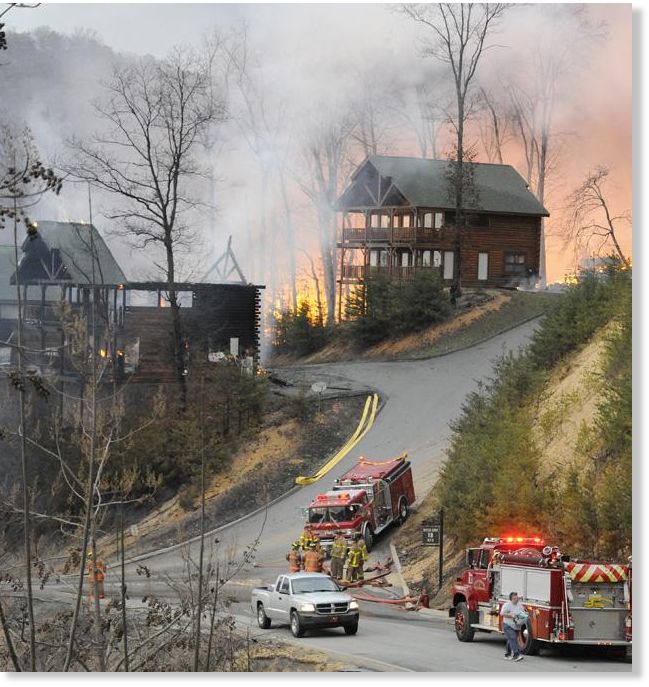
© CURT HABRAKEN/APFirefighters set a boundary as cabins burn on Black Bear Cub Way in Sevier County, Tenn., on Sunday. As of 8 p.m., there were 32 cabins reported burned with 40 more in danger.
A wildfire burning in a resort area outside the Great Smoky Mountains National Park in eastern Tennessee has destroyed more than 30 large rental cabins.

The 145-acre fire was first reported around 5 p.m. EDT Sunday in Sevier County, said Ben Bryson, a fire resources coordinator with the Tennessee Division of Forestry. Smoke was reported to be visible from 25 miles away.

Bryson said early Monday that the fire was contained and not expected to spread.

Some of the cabins were occupied and about 150 to 200 people were evacuated, but no injuries were reported, Bryson said.

After dawn Monday, two Tennessee Air National Guard helicopters took off from nearby McGhee Tyson Airport. A state Forestry Division spokesman said the helicopters would be used to scoop up water from Douglas Lake and drop it on the fire.